
Turn every exposure into a defensible decision.
Prove which exposures an attacker could actually exploit in your environment, across every asset, then patch, mitigate, monitor, or accept each one with evidence behind the call instead of a severity score.
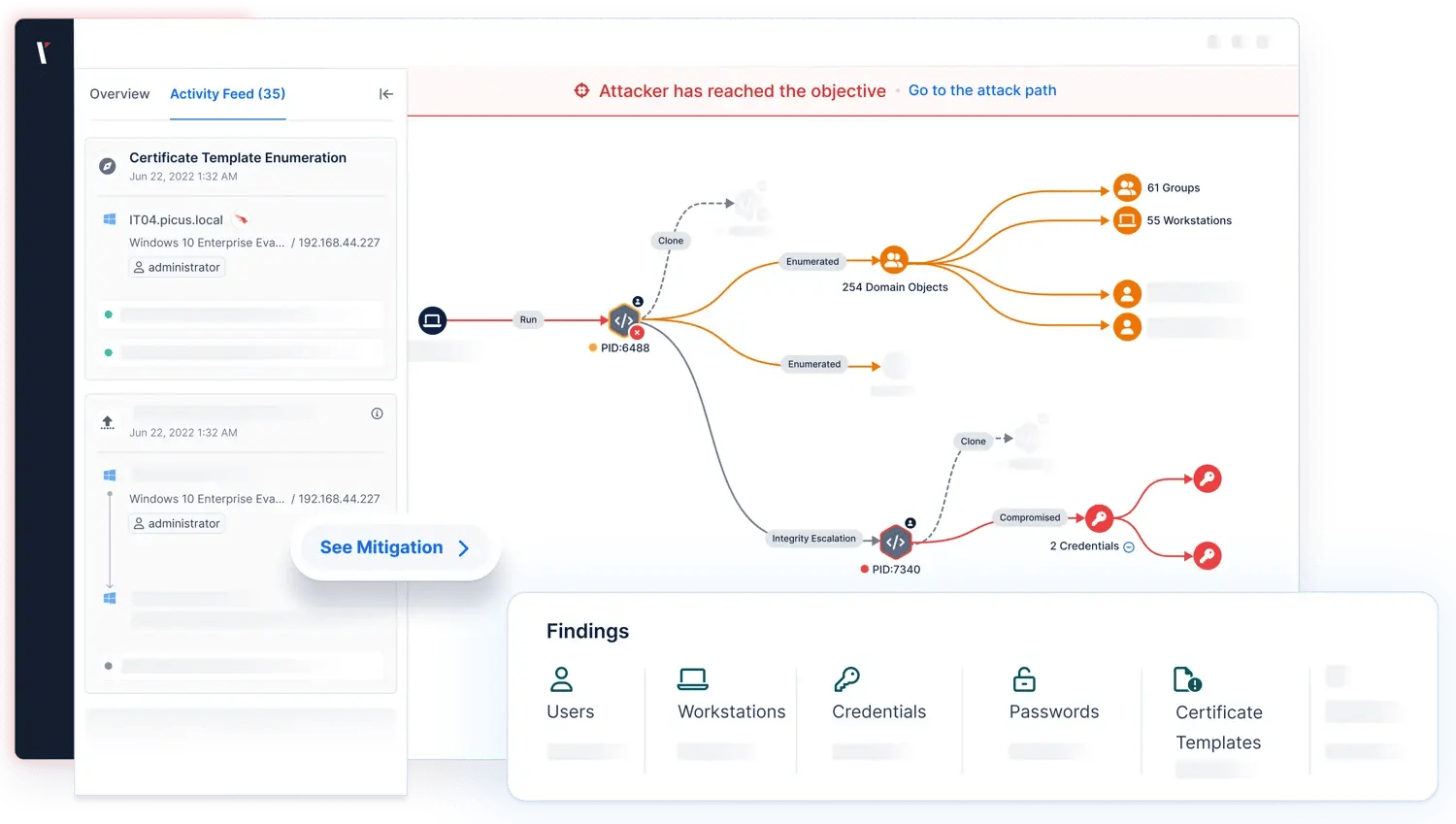
What Is Adversarial Exposure Validation?
Adversarial Exposure Validation (AEV) delivers consistent, continuous, and automated evidence of whether an attack is actually feasible in your environment. It confirms how attack techniques would exploit your exposures and circumvent your prevention and detection controls, by running attack scenarios and measuring the outcome.
Rather than assuming a scanner-flagged vulnerability is dangerous, AEV proves whether the exploit would succeed against your controls, then resolves each exposure into a clear, evidence-backed decision.
Why Validate Your Exposures
- Separate theoretical risks from the ones attackers can use
- Prioritize by validated exploitability, not severity scores
- Prove your controls hold against real-world attacks
- Make every patch, mitigate, monitor, or accept call defensible


AI Has Collapsed the Time Between Disclosure and Attack
Adversaries now weaponize new CVEs in hours, not weeks, and break out in under 30 minutes. Finding the exposure was never the hard part, proving the right call is.
-
Decision Without Proof
Patch, mitigate, monitor, or accept, every call rests on scores or assumptions. When attacks happen in minutes, teams cannot prove which is defensible.
-
Exposure Debt
Known exposure accumulates faster than any team can safely remediate. With ~132 new CVEs a day and fewer than 0.5% ever patched, the backlog grows and the risk window never closes.
-
Exploitability Blind Spot
Teams know which vulnerabilities exist, but not whether the exploit chain would actually succeed here, against their controls, in their environment.
Each gap has a matching validation, and a product that runs it.
The Picus Platform delivers Adversarial Exposure Validation by converging three validation disciplines, Breach and Attack Simulation, Autonomous Penetration Testing, and Exposure Validation into one continuous loop that proves which exposures are truly exploitable across every asset and resolves each into a decision.
Breach and Attack Simulation
Continuously test whether your stack detects, blocks, and responds to the techniques attackers use now, and keep every decision defensible as the environment changes.
Autonomous Penetration Testing
Which vulnerabilities are actually exploitable here? Live execution against reachable assets prioritizes remediation by real exploitation risk, not CVSS scores.
Exposure Validation
No published or safe exploit? Map the CVE to its TTP chain and validate those behaviors against your controls. Exploitability proven the day it lands, even on assets you cannot touch.
Picus runs the three together as one loop: ingest your scanner and asset data, validate exploitability live and by inference, converge the result into a single Exploitability Finding that re-ranks the backlog and opens a ticket, then re-validate continuously as controls and assets change. Validate, decide, fix, re-validate.
Prove your controls hold, and keep proving it.
Identifying an exposure is only half the answer. Picus tests whether your prevention and detection stack actually blocks and alerts on the techniques tied to each exposure, then re-validates automatically when an EDR policy, segmentation, or SIEM rule changes.
Cut a backlog of thousands down to what actually matters.
Stop triaging by severity. Picus proves which exposures an attacker could realistically reach and exploit, and how far each one spreads, so a backlog of undifferentiated findings becomes a short list ranked by validated impact and blast radius, plus a set of accept decisions backed by evidence.
Get proof on every CVEs and assets.
Live exploitation is a strong proof on the assets it can safely reach. Standalone pentest tools stop there and go dark on the rest. Picus also proves exploitability on restricted systems, and on CVEs with no working exploit yet, so no exposure is left unanswered.
Value for Every Team
- Cut the backlog to validated, exploitable risk
- Stop chasing theoretical high-CVSS findings
- Route real risk to remediation with evidence
- See which techniques slip past detection
- Prove controls block what attackers use now
- Re-validate the moment a policy changes
- Defend every accept decision with evidence
- Show board-ready proof of real exposure reduction
- Modernize spend toward what changes the outcome
Open by design. Bring your own data.
Picus does not reproduce your scanners, it consumes their output. Bring assets, vulnerabilities, and business context in, validate exploitability, then push evidence-ranked results out to the remediation and detection workflows you already run.
Trusted by Security Teams, Recognized by the Industry
.png?width=161&height=136&name=gartner-logo-2025%201%20(1).png)
Customer's Choice
2025 Gartner Peer Insights Voice of the Customer for Adversarial Exposure Validation

Built for proof across every exposure
Where standalone pentest tools go dark on restricted, regulated, and air-gapped assets and on CVEs with no working exploit, Picus proves exploitability there too, with no live exploit fired.
Attack-surface, exposure, and control data converge into one exploitability finding that shows how far an attack spreads, rather than three disconnected reports that only say a vulnerability exists.
Bring your own scanner and pentest data. Picus turns the full picture into a decision and keeps it defensible through continuous re-validation.
See the Picus Platform

.png?width=3200&height=323&name=Pattern(1).png)
See Picus run on your environment
In a live demo, watch Picus validate a real exposure end to end, from exploit to fix to re-test.
Discover the Platform
Simulate real-world cyber threats in minutes and see a holistic view of your security effectiveness.
Frequently Asked Questions about Exposure Validation
Adversarial Exposure Validation delivers consistent, continuous, and automated evidence of whether an attack is feasible, confirming how techniques would exploit an organization's exposures and circumvent its controls. As a market category it brings together breach and attack simulation, automated penetration testing, and red teaming. It filters out exposures with no real impact so teams focus on the issues that most reduce risk, and resolves each into an evidence-backed decision.ation testing identifies and exploits vulnerabilities across an environment, validating real attack paths without a manual engagement for every assessment. Modern platforms like Picus use autonomous AI agents that reason, adapt, and chain techniques like a real attacker, operating continuously rather than as a periodic test.
AI has collapsed the time between disclosure and attack from weeks to hours, while exposure backlogs keep growing. The traditional scan-and-score model cannot keep pace, and as of June 2026, CISA's Binding Operational Directive 26-04 has begun replacing CVSS-led patching with prioritization based on real exploitability. Validation is becoming the expected standard.
Vulnerability management and exposure assessment platforms discover, score, and prioritize exposures across the estate, but they cannot give direct evidence that a given exposure is actually exploitable against your controls, or show its blast radius. Adversarial Exposure Validation proves which of those exposures an attacker could truly exploit in your environment. It does not replace your scanners, it consumes their output and re-ranks the backlog by validated exploitability rather than abstract severity.
Live exploitation only covers assets it can safely reach. For business-critical, restricted, and air-gapped systems, and for CVEs with no working exploit, Picus Exposure Validation maps the CVE to its TTP chain and validates those behaviors against your controls by inference, so exploitability is proven without firing a live exploit, even on day one of disclosure.
Adversarial Exposure Validation is the validation engine inside a Continuous Threat Exposure Management program. Assessment tools discover, inventory, and prioritize exposures; validation is the stage unique to CTEM that filters those findings, ratifies whether they are genuinely accessible, reachable, and feasible for an attacker, and closes the mobilization loop by retesting after remediation. Picus proves which exposures are exploitable, ranks them by validated risk, and feeds that finding back to drive the decision.
Yes, when operated with proper guardrails. Picus supports tunable autonomy that defines scope, restricts techniques, and requires human approval where needed, with every action logged end to end for full chain of custody. Where live execution is not safe, control inference proves exploitability without touching the asset.
Continuously. Threats are weaponized in hours, and controls and assets change daily, so a point-in-time test ages quickly. Picus re-validates as your environment changes, reopening any finding that is no longer safe and keeping every accept decision defensible over time.
Picus is open by design. It ingests assets, vulnerabilities, and business context from scanners and assessment platforms such as Tenable, Wiz, and Snyk, then pushes evidence-ranked results out to EDR, SIEM, firewall, SOAR, and ticketing tools like Jira and ServiceNow, so validated risk lands in the workflows you already run.