
Know Which Attacks Would Actually Succeed in Your Environment
Run autonomous AI agents that chain real attacks across your full environment at machine speed, so you see exactly which exposures an attacker can reach, what your defenses stop, and how to close the gaps.
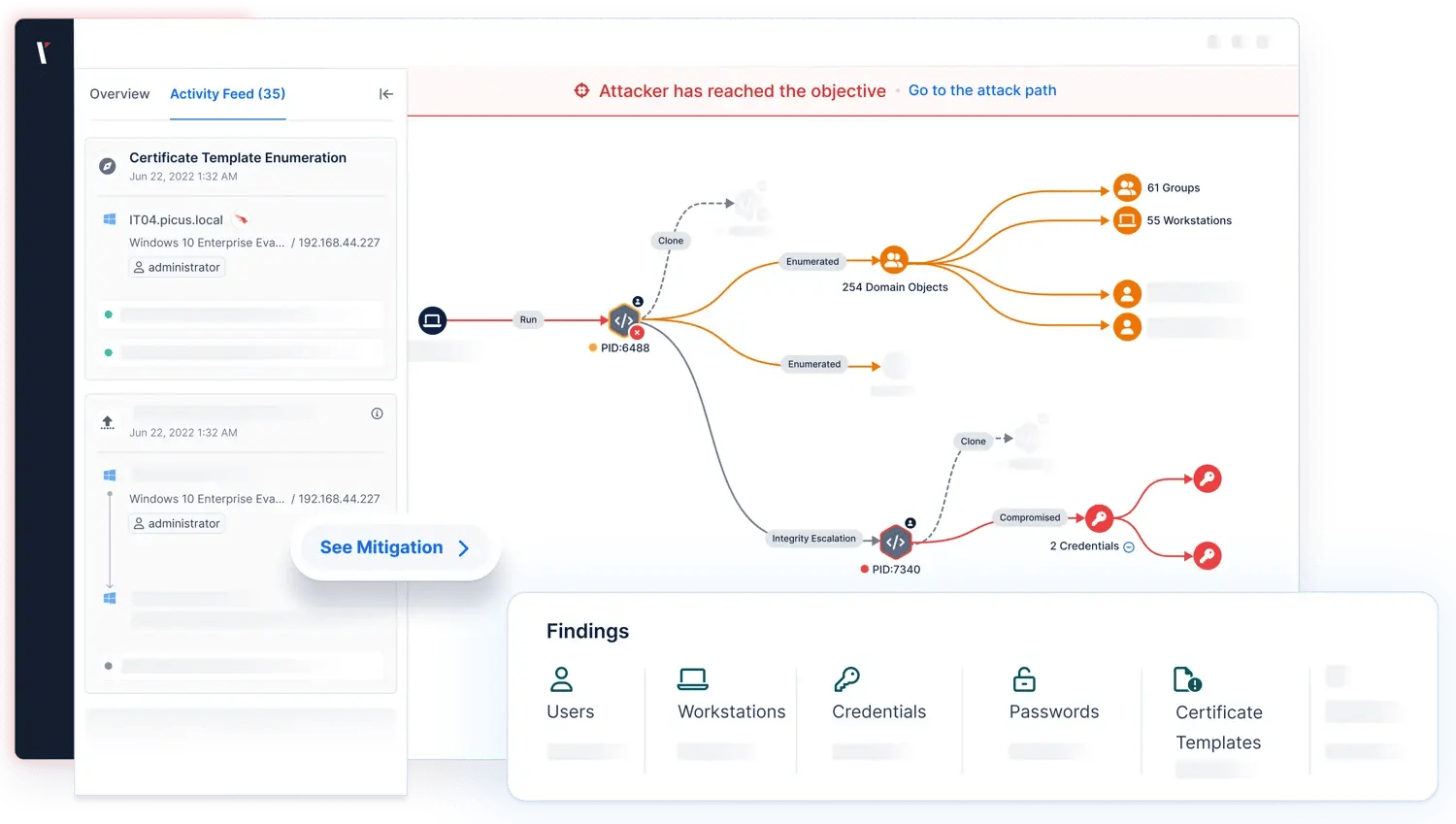
What Is Automated Penetration Testing?
Automated penetration testing identifies and exploits vulnerabilities across an environment, validating real attack paths without a manual engagement for every assessment. Modern platforms use autonomous AI agents that reason, adapt, and chain techniques like a real attacker.
Rather than assuming a vulnerability is risky because a scanner flagged it, automated pentesting proves whether the exploit would actually succeed against your live defenses, and it runs continuously instead of as a once-a-year test.
Why It Matters?
- Prove which exposures attackers can truly reach
- Keep pace with threats that move in hours, not quarters
- Focus remediation on real risk, not scanner noise
- Show evidence that controls hold, or where they fail
You can see your vulnerabilities. You still can't see which ones an attacker would actually use.
A manual engagement takes weeks to schedule and hands back a report that ages the moment testing stops. The gaps it missed stay open.
Scanners surface thousands of issues ranked by abstract severity, with no way to tell which are truly reachable in your environment.
Knowing a vulnerability exists is not knowing the exploit would succeed against your controls, or chain into a path to your crown jewels.
AI has collapsed the time between disclosure and attack from weeks to hours. Controls drift, infrastructure shifts, and new techniques appear daily, so what passed a test last quarter may quietly be failing now.
Put your environment under real attack, continuously.
Picus Autonomous Penetration Testing uses autonomous AI agents to discover vulnerabilities, develop and chain exploits, and execute real attack campaigns against your live defenses, then proves exactly which paths are exploitable and how to close them. It turns "we think we are covered" into "we have proven what an attacker can and cannot reach, with evidence."
See which exposures an attacker can actually reach.
Stop triaging another scanner list. Agents chain real exposures across hosts and identities to your crown-jewel assets, so you can tell a critical, reachable path from a theoretical one and fix the choke point that breaks the chain.
Prove what your defenses stop, and what they miss.
Every attack path is validated against your existing controls, so you get a per-step verdict instead of a hopeful assumption. You see which defenses held, which were bypassed, and exactly where the gap is.
Close gaps with fixes written for your exact stack.
Every finding comes with specific mitigation steps for the technologies you run, not generic advice. Apply the fix, then re-run the exact attack path with one click to confirm the gap is closed in minutes instead of days.
Stay current as new threats appear.
Testing never goes stale. The platform responds on its own to new CVEs, asset exposure, configuration drift, and emerging threats as they surface, so your validation keeps pace with an environment that changes daily.
One loop, each step driven by a specific part of the platform.
Audit, simulate, emulate, fix, then re-validate — continuously, so proof keeps pace with how fast the cloud actually moves.
-
1
Cloud Auditing
Audit
Inspects core cloud and Kubernetes resources against best practice with read-only permissions, surfacing misconfigurations.
-
2
Attack Simulation
Simulate
The Policy Decision Engine runs gathered identities through a local policy simulator to map possible escalation techniques.
-
3
Attack Emulation
Prove
Actively exploits the findings in your real environment like an adversary, returning the outcome and dropping false positives to zero.
-
4
Mitigation Insights
Fix
Returns severity, finding detail, and policy-level mitigation guidance, so you fix one policy and close many exposures at once.
-
5
Picus Swarm
Re-validate
Responds to new policies, permissions, and config changes as they happen, re-validating the affected surface on signal, not on a calendar.
↻ Then it repeats, continuously, as your cloud configurations and identities change.
Value for Every Team
- See which attacks slip past detection, and where
- Sharpen alerting against real, validated paths
- Stay ready as new techniques appear
- Automate exploit chaining and re-testing at scale
- Free up time for novel, human-driven research
- Validate fixes the moment they ship
- Prioritize spend by proven, real-world risk
- Show board-ready evidence that controls hold
- Reduce exposure windows continuously
Works With the Cloud Stack You Already Run.
Picus validates with read-only access and feeds validated exposures into your existing CSPM, CNAPP, and security data tooling, so you act on proof of exploitability instead of fragmenting into separate, inconsistently checked estates.
Trusted by Security Teams, Recognized by the Industry


.png?width=161&height=136&name=gartner-logo-2025%201%20(1).png)
Customer's Choice
2025 Gartner Peer Insights Voice of the Customer for Adversarial Exposure Validation

%20(1).png?width=136&height=176&name=frost-radar-leader-badge-2026%20(1)%20(1).png)
Automated pentesting is one pillar of the Picus Platform.
Picus converges breach and attack simulation, automated pentesting, and exposure validation into a single platform. Proving what is exploitable feeds a bigger loop: validate, find exploitable paths, prioritize real exposure, then mitigate and re-validate, all in one place.
Built for Proof, not just activity.
Agents reason, adapt, and chain techniques dynamically, rather than replaying predefined playbooks, so testing reflects how real adversaries operate.
Every validated gap ships with a vendor-specific mitigation and one-click re-validation, so you close the loop instead of inheriting another backlog.
Exploitability proof feeds exposure prioritization and control validation in one platform, so a single finding carries through to a fix and a re-test.
explore more
Validate Across Your Whole Program
Attack
Simulation
Continuously test what your EDR, SIEM, and firewall block and detect against the newest TTPs.
Chain real exposures to your crown jewels, safely and continuously, without the manual effort.
Validation
Confirm which exposures across your environment are genuinely exploitable, even the assets you can't touch.
See the Picus Platform
See Picus run on your environment
In a live demo, watch Picus validate a real exposure end to end, from exploit to fix to re-test.
Discover the Platform
Simulate real-world cyber threats in minutes and see a holistic view of your security effectiveness.
Frequently Asked Questions about Automated Penetration Testing
Automated penetration testing identifies and exploits vulnerabilities across an environment, validating real attack paths without a manual engagement for every assessment. Modern platforms like Picus use autonomous AI agents that reason, adapt, and chain techniques like a real attacker, operating continuously rather than as a periodic test.
AI has collapsed the time between disclosure and attack from weeks to hours, and environments change daily. A point-in-time engagement cannot keep pace, so teams need continuous proof of what is exploitable rather than a report that ages the moment testing stops.
Manual pentesting delivers human-led depth within a limited scope, typically once or twice a year. Automated pentesting continuously validates the broader attack surface as the environment changes. The strongest programs use both: automation for scale, frequency, and continuous re-validation, while human operators focus on bespoke adversary emulation and novel research.
They solve different problems. Automated pentesting identifies and validates real attack paths by exploiting actual vulnerabilities and misconfigurations. Breach and attack simulation validates whether controls prevent, detect, and alert on known adversary behaviors. One proves exploitability, the other proves defensive effectiveness. Picus delivers both through the same platform.
No. It automates the work that does not require continuous human involvement, including exploit chaining, attack-path validation, and post-remediation re-testing across the full surface. Red teams remain essential for bespoke adversary emulation, novel research, business-logic abuse, and complex human-driven operations.
Continuously. Modern attack windows move too fast for scheduled assessments. Picus operates in a signal-driven model, responding autonomously to new CVEs, infrastructure changes, configuration drift, and emerging threat intelligence as they appear.
Yes, when operated with proper guardrails. Picus supports tunable autonomy controls that define scope, restrict techniques, and require human approval where needed. Every action is logged end to end with complete operational traceability and chain of custody.
No. Picus is designed for operational security teams, not only dedicated red teams. Picus handles the offensive execution and reasoning, while your team receives validated findings, prioritized attack paths, and vendor-specific remediation guidance.
Picus integrates with vulnerability scanners, ASM tools, SIEMs, EDRs, and operational workflows to normalize findings, validate exploitability, prioritize real exposure, and push validated results into your existing remediation and detection pipelines.