
PROVE WHAT ATTACKERS CAN ACTUALLY EXPLOIT
Autonomous Penetration Testing
Picus runs autonomous agents that chain real attacks across your full environment to show which exposures are genuinely exploitable.
- Safely hack your environment. AI agents run real attacks against your production environment, with guardrails you control.
- Act on real risk. Prioritize exposures by validated risk and blast radius, remediate the ones that matter most, then verify the fix.
- Decide on evidence. Patch, Mitigate, Monitor, or Accept Risk, each call backed by a validated exploit chain, not a static score.
WHY NOW
Finding the exposure was never the hard part. Proving the right call is.
AI has collapsed the time between disclosure and attack. New vulnerabilities are weaponized in hours, and adversaries break out in minutes. Teams are not short on findings. They are short on defensible answers.
Known exposure accumulates faster than any team can safely remediate. With roughly 135 new CVEs a day and a 0.5% ever patched, the risk window stays open.
Teams can see which vulnerabilities exist, but not whether the exploit would actually succeed against your controls, in your environment.
Patch, mitigate, monitor, or accept. When attacks happen in minutes, teams cannot prove which decision is defensible to auditors or the board.
The answer is not another scanner list, more visibility, or more headcount. It is autonomous exposure validation that knows your environment and proves what an attacker could actually do in it.
AI agents find, exploit, and prove what matters.
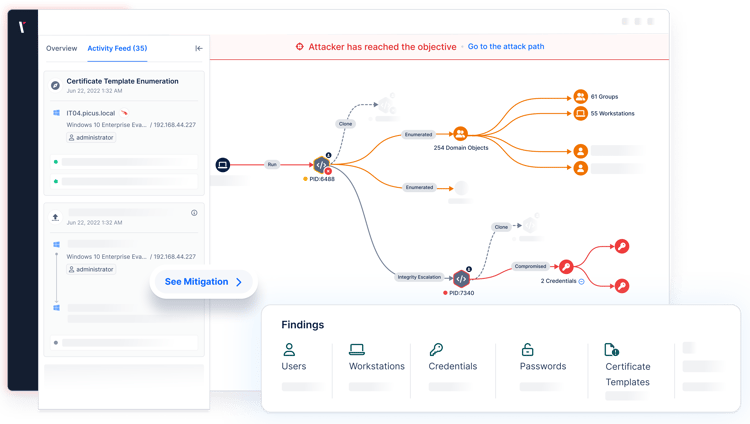
The answer is not another scanner list, it is Picus Autonomous Penetration Testing that knows your environment and proves what an attacker could actually do in it. Agents reason and chain techniques like a real attacker, continuously.
-
Recon
Map the attack
surfaceContinuously enumerate external assets, internal networks, identities, and misconfigurations across the environment.
-
Exploit
Chain real exposures, safely
Autonomously execute real-world exploitation techniques and chain exposures across hosts, within the guardrails you set.
-
Prove
Demonstrate true impact
Reach crown-jewel assets and capture concrete proof of compromise. This is proof, ordered by blast radius, not another ranked list.
-
Prioritize
Fix what actually breaks you
Rank remediations by real exploitability and blast radius, then re-validate the specific path you fixed. Loop until clean.
↻Then it loops, continuously, re-validating as your environment changes.
Outcomes You Can Act On
Focus on exploitable exposures
Prove which exposures attackers can actually reach and weaponize, so you can act on real risk.
Operate at machine speed
Weeks of manual pentesting compressed into minutes. Continuous and on demand, so the picture is always current, never a snapshot.
Reveal critical attack paths
Chained weaknesses cause breaches. Map the full chain from foothold to crown jewels and show exactly where to break it.
Get attacker-grade findings your team can act on
Agents handle the offensive execution and reasoning, so your team receives validated findings and prioritized paths.
Close the loop with one-click re-validation
Test fixes the moment they ship. Picus re-runs the exact path you remediated to confirm the gap is closed in minutes.
Autonomy without losing control
Run fully autonomous, fully supervised, or anywhere in between. Every action and decision is logged end to end.
A standalone pentest tool can only validate a fraction of your security program.
Across organizations, 95% rank pentesting a top priority, yet just 32% of the global attack surface gets tested on average. That leaves roughly two-thirds of the environment untested.
of the attack surface of an enterprise goes untested, beyond the reach of pentesting.
Synack & Omdia, 2026
known ransomware CVEs from 2025 still had no public or commercial exploit to fire as of January 2026.
VulnCheck Exploit Intelligence Report, 2026
of CVEs is weaponized, highlighting the limits of relying on exploitation alone to understand the exposure.
VulnCheck Exploit Intelligence Report, 2026
One platform validates your whole security program.
Autonomous Penetration Testing is one part of the Picus Platform. Together, these capabilities converge into one continuous validation loop, from attack surface to controls to exploitable exposures.
PROOF
Trusted by security teams, recognized by the industry.
It allows me to test current cyber attack scenarios within my own environment, which is extremely valuable for improving our security posture.
Manager, IT Security and Risk Management, IT Services
Clear metrics, great outputs for reporting C-Level; measurable risk drop. Optimization by focusing patching efforts on assets that truly present risk.
CISO, Banking
The vendor provides quick customer support and the technical sales team and support team has been fantastic.
Engineer, Consumer Goods
A very successful platform where we can test the accuracy of our security investments and see their scores.
Manager, IT Security and Risk Management
Picus is one of the best BAS solution on the market today. The threat database it is constantly updated.
ICT Security Engineer, Oil and Gas
Picus completes the task it is required to do near perfect as a BAS solution. Threat database is up to date & updated frequently after a new malware or campaign, also the database is large.
Consultant Security Engineer, Telecommunications
There is a very nice team from which I can get quick support. The application provides us with great convenience and confidence in our work.
Information Security Specialist, Healthcare
To test our systems with the real-time attack product is helping us to improve our security maturity. At the same time, the real time attacks are updating with the zero-day vulnerabilities.
Senior Vulnerability Management Engineer, IT Services
With the help of this product we can perform continuously endpoint attack via latest tactics and techniques which are used by threat actors.
Manager, IT Security and Risk Management, IT Services
It is possible to customize the campaign or schedule the assessment periodically, to test protection measure implemented on network, endpoint and email.
ICT Security Engineer, Manufacturing

Customer's Choice
2025 Gartner Peer Insights Voice of the Customer for Adversarial Exposure Validation
Andrea Licciardi
Senior Cyber Security Manager

Picus has been instrumental in elevating our proactive defense capabilities, particularly through its automated pentesting features.
Its capabilities allow us to identify gaps swiftly and enhance our cybersecurity posture in real time.
Latest Resources on
Automated Penetration Testing
See the Picus Platform
See Picus run on your environment
In a live demo, watch Picus validate a real exposure end to end, from exploit to fix to re-test.
Discover the Platform
Simulate real-world cyber threats in minutes and see a holistic view of your security effectiveness.
Frequently Asked Questions
It uses autonomous AI agents to discover vulnerabilities, develop and chain exploits, and execute real attack campaigns against your environment. Rather than running as a periodic test, it operates continuously, reasoning and adapting like a real attacker to prove which exposures are genuinely exploitable.
Manual pentesting delivers human-led depth within a limited scope, typically once or twice a year. This automates the work that does not need continuous human involvement, exploit chaining, attack-path validation, and post-remediation re-testing across the full surface, so it stays current as the environment changes. The strongest programs use both: automation for scale and frequency, humans for bespoke adversary emulation and novel research.
No. Red teams remain essential for bespoke adversary emulation, novel attack research, business-logic abuse, and complex human-driven operations. This handles the continuous, repeatable offensive work so your red team can focus where human creativity matters most.
Yes, when operated with proper guardrails. Tunable autonomy controls let you define scope, restrict techniques, and require human approval where needed. Every action is logged end to end with complete operational traceability and chain of custody.
Live exploitation can only validate the fraction of your environment it can safely reach and actively exploit. For business-critical, restricted, and air-gapped assets, CVEs with no working exploit, and the day-one window before an exploit exists, Picus Exposure Validation maps the CVE to its TTP chain and validates it against your controls without firing a live exploit. Together with Picus Breach and Attack Simulation, that is how the loop covers what live testing cannot.
Continuously. Modern attack windows move too fast for scheduled assessments. Picus operates in a signal-driven model, responding autonomously to new CVEs, infrastructure changes, configuration drift, and emerging threat intelligence as they appear.
It integrates with vulnerability scanners, ASM tools, SIEMs, EDRs, and operational workflows to normalize findings, validate exploitability, prioritize real exposure, and push validated results into your existing remediation and detection pipelines, with evidence attached.
Lorem ipsum dolor sit amet, consectetur adipiscing elit. Aenean auctor, velit id tincidunt interdum, felis lorem commodo ipsum, eget dapibus enim ligula at erat.
Nam sed est massa. Fusce volutpat iaculis maximus. Phasellus ultricies fringilla leo. Integer nec ipsum sed nibh vehicula pulvinar id ac mi. Quisque odio velit, fermentum non eleifend vel, hendrerit in diam. Morbi eu tellus vitae orci fringilla mattis sed non velit. Quisque odio velit, fermentum non eleifend vel, hendrerit in diam. Morbi eu tellus vitae orci fringilla mattis sed non velit.
.png?width=161&height=136&name=gartner-logo-2025%201%20(1).png)