
How Did BFSI Perform in Prevention and Detection in 2026?
BFSI prevention effectiveness stands at 67% in the Picus Blue Report 2026, down nine points from the 76% recorded in the previous edition. Financial institutions logged 65% of simulated attacks, meaning the attacker behavior was recorded somewhere in their telemetry, but alerted on only 16%, so fewer than one in six attacks reached a security team as an alert. This year's figures come from more than 338 million attack simulations that Picus customers ran against their own security controls in live production environments between January and June 2026, anonymized and aggregated by Picus Labs.
Last year, financial institutions ranked among the stronger performers. This year they sit in the group the report singles out: sectors that led in 2025 and gave ground in 2026. Healthcare fell nine points. Manufacturing fell nine. Retail fell ten. BFSI fell nine. The report puts the pattern in one sentence: strong performance is rented, not owned.
Why Did BFSI Prevention Effectiveness Drop in 2026?
Financial institutions did not stop investing in security. They stopped proving that the investment still worked. The Blue Report 2026 traces swings this large to how quickly an environment changes underneath a posture that was strong only months earlier: new adversary techniques, infrastructure shifts, tooling changes, and configuration drift erode controls that nobody re-tested.
The mechanism cuts both ways, and Transportation is the proof: last year's weakest sector at 50%, it rose 29 points to 79% by operationalizing validation findings and closing gaps systematically. What neglect lets slip, validation can restore, and the gaps BFSI opened this year are the same kind Transportation closed.
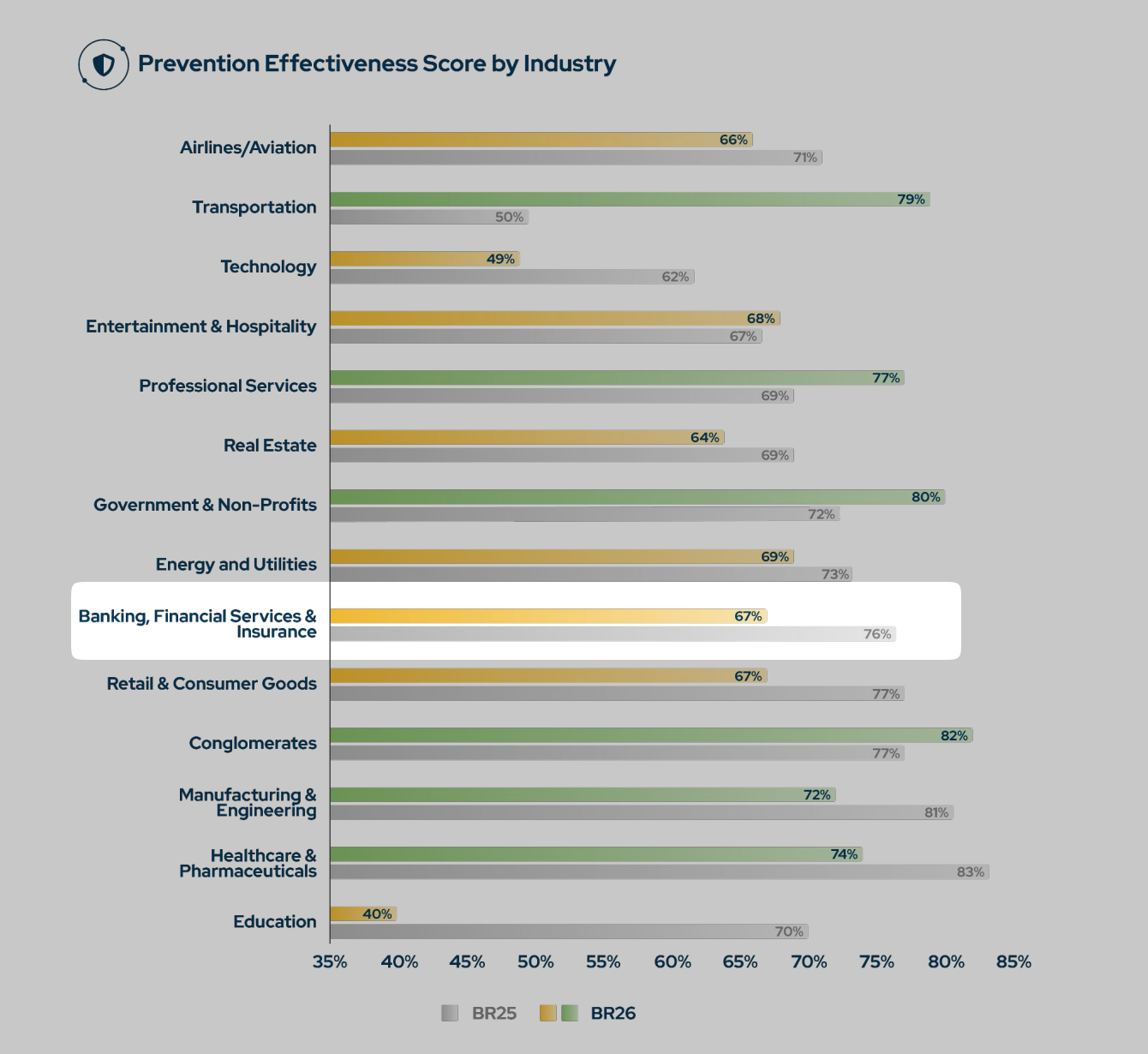
Two findings from the report show where that drift bites hardest, and both point the same way: defenses hold where the threat is recognizable and give way where it is not.
The interior is soft. Globally, prevention effectiveness recovered to 69%, back to its 2024 peak. But that score comes from Breach and Attack Simulation, which runs known threats against a customer's own controls, from firewalls, WAFs, and email and web gateways to EDR and XDR, and counts how many are blocked. Autonomous Penetration Testing asks a different question: what an attacker accomplishes once already inside, holding authenticated access. Under that test, only 37% of their actions get blocked, and quiet discovery and collection actions are stopped roughly one time in ten.
For financial institutions, that interior is where account data, payment systems, and trading infrastructure live. An attacker who gets past a bank's perimeter can map the domain and read credential material with little resistance, all before doing anything loud enough to trip an alert.
Malware defense keeps sliding. Malware download prevention fell to 50%, down 21 points in two years. That test delivers a known malware sample as a download or an email attachment, so the score reflects one thing only: whether a control recognizes the file. Recognition cannot keep pace with the roughly two million new files VirusTotal sees every day. Behavior-based prevention, which targets what a payload does rather than what it matches, is now the required baseline for a sector that ransomware operators target first.
The Detection Gap: 65% Logged, 16% Alerted
Financial institutions log 65% of simulated attacks but alert on only 16%. That is slightly ahead of the global 58% and 14%, but the extra visibility buys nothing: roughly three of every four attacks the sector records never become an alert, the same conversion rate as everyone else. More telemetry did not produce more detection.
A logged-but-unalerted attack is one nobody is working.
The attacker keeps enumerating accounts, reading credentials, and staging payment or customer data while the evidence sits unread in a SIEM. This is where the sector's two weakest numbers compound, since the interior actions blocked only 37% of the time are the same quiet actions least likely to raise an alert.
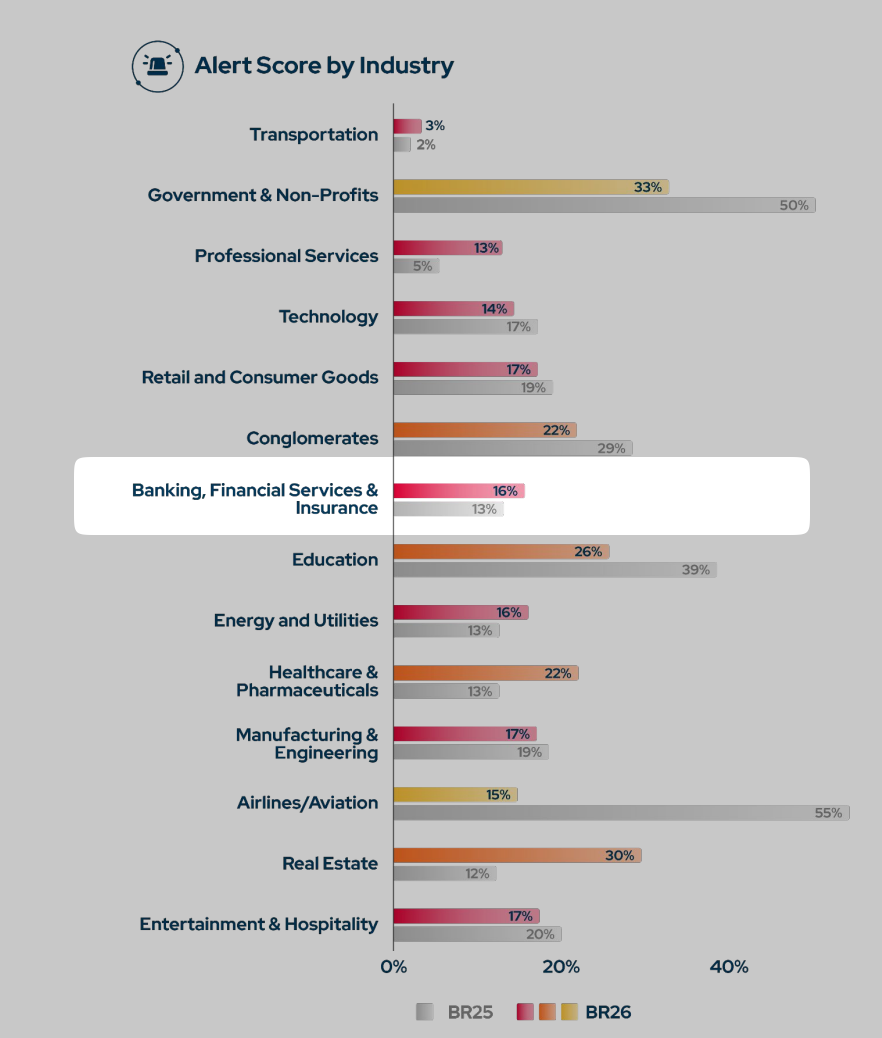
DORA sharpens the stakes, requiring initial notification of a major ICT-related incident within 4 hours of classification and no later than 24 hours from detection, deadlines that cannot begin to run until something in the pipeline actually fires.
The report locates the failure one layer down, in the detection rules themselves: the logic that decides whether a logged event becomes an alert. For the first time, performance issues lead all detection rule failures at 49% of the total, more than doubling from 24% a year ago. These are rules built too broadly, with wide time ranges and free-text matching, that cost too much to run and fire too imprecisely to trust. Log collection problems fell to 41%, but they remain the more dangerous half, because a behavior that is never captured can never raise an alert. The fix is detection rule validation: testing that rules fire, tuning them against noise, and re-validating as infrastructure changes.
Which Cyber Threats Should Financial Institutions Validate Against?
The Blue Report 2026 findings most relevant to BFSI defenders:
- Valid Accounts (T1078) was prevented in 15% of simulations. Controls still cannot reliably separate an attacker holding stolen credentials from a legitimate user, the exact failure mode behind account takeover.
- Data exfiltration was the least prevented attack vector for the fourth year running, blocked in just 7% of simulations. More than nine in ten data theft attempts succeed, and with double extortion, exfiltration is the step that sets the ransom.
- Play ransomware collapsed from 50% to 13% prevention, making it the hardest strain to stop. Play's intermittent encryption, abuse of legitimate tools, and exploitation of public-facing applications defeated controls that handled it a year ago.
- Venom Spider, a malware-as-a-service operation used in targeted financial and e-crime campaigns, fell from 62% to 47% prevention. It is not an outlier: prevention declined against nine of the ten least prevented threat groups, whose average dropped from roughly 48% to 40%.
The common thread is quiet tradecraft, and these findings line up in sequence: the attacker signs in with valid credentials, moves data out, and detonates ransomware only at the end, when the damage is already done and being loud no longer costs anything.
One finding exposes the mechanism. The same credential-theft tool was run against defenses in different ways: dumping credentials straight from LSASS memory, the loud and heavily signatured path, was blocked in the large majority of attempts, while reading the same credentials from the registry was blocked in well under 1%. Same tool, same goal, same environment. Only the recognizability of the method changed, the same line that separates a 69% score from a 37% one.
Recompile the binary, run it in memory, or reach the same credentials with a signed Windows tool already on the machine, and a signature-led control has nothing to match, even though the behavior is identical every time. So the answer to what financial institutions should validate against is not only a list of names. Validate the methods behind them, and confirm that controls trigger on what an action does rather than on what it matches.
Key Recommendations for BFSI Cybersecurity in 2026
The Blue Report 2026 shows that gaps close when they are tested and tuned, and reopen when that discipline lapses. Five priorities for financial institutions:
Validate Exposure, Not Just Inventory
Move from knowing where exposures exist to proving which ones an attacker can exploit. Exposure Validation confirms exploitability before prioritization, cutting the wasted effort that theoretical risk scores create in large financial estates.
Harden the Interior Against Quiet Actions
Validate defenses against domain enumeration, session and file share discovery, and credential reads from memory and the registry as rigorously as against lateral movement and privilege escalation. Autonomous Penetration Testing executes real attack paths inside production environments and shows what an authenticated attacker reaches before a real one does.
Move Defense Beyond Indicators to Behavior
Malware download prevention at 50% and a credential-theft tool that walks past controls by changing method point to the same weakness: controls tuned to recognize a file or a signature, not to evaluate an action. Shift weight toward behavior-based detection and sandboxing, and validate it against current delivery techniques rather than last quarter's samples.
Simulate Complete Ransomware and APT Kill Chains
With Play at 13%, every leading ransomware family at 38% or lower, and prevention declining against nearly every top threat group, coverage built on last year's playbook fails against this year's variants. Breach and Attack Simulation runs full, current kill chains for the families and actors targeting financial services, from initial access through exfiltration and encryption, and confirms controls interrupt them at multiple points.
Close the Log-to-Alert Gap Through Detection Engineering
A 65% log score against a 16% alert score means most BFSI telemetry never becomes action. Treat detection content as something built, measured, and maintained, and validate log source health alongside it, since collection failures fail silently and no rule can fire on a behavior that was never captured. The Picus Platform validates that rules fire against current adversary behavior and re-tests them as threats change, the same continuous discipline that restored prevention scores globally.
BFSI enters the second half of 2026 with a clear lesson from its own data. The sector held a strong position and lost nine points in a year, not because attackers found new magic, but because validated controls drifted out of tune. Transportation gained 29 points in the same year doing the opposite. The institutions that recover fastest will be the ones that prove their defenses work continuously, against the threats actually targeting them.
Download the Blue Report 2026 for the full industry analysis, or see how security validation works for financial institutions.