Key Takeaways
- MITRE ATLAS describes how attackers operate against AI systems, while the OWASP Top 10 for LLM Applications ranks the risks LLM application developers should fix first.
- Seven of the ten OWASP risks have a clear ATLAS counterpart, and the other three (LLM07, LLM08 and LLM10) only partly match.
- Only ATLAS covers attacker and victim actions around the application, attacks on non-LLM models and documented case studies.
- Only OWASP covers risk prioritization, risks that aren’t attacks and design-level prevention guidance.
- Neither framework shows whether your own controls stop these attacks, which Picus AI Security Validation tests continuously against guardrails and LLM firewalls.
MITRE ATLAS and the OWASP Top 10 for LLM Applications are the go-to frameworks for assessing the security of AI systems. The two were built from different perspectives and answer slightly different questions, but they also overlap enough that they’re often confused. They work best together for mapping AI-related attacks, building defenses, writing detections, and ultimately, validating an organization’s protection against both proven and theoretical attacks.
This blog compares the two frameworks, maps an example attack to both, and explains when and how to use each one.
What Are MITRE ATLAS and the OWASP Top 10 for LLM Applications?
MITRE ATLAS (Adversarial Threat Landscape for AI Systems) is MITRE’s knowledge base of how adversaries attack AI systems. It follows the ATT&CK model, where tactics describe what the attacker is trying to achieve, and techniques and sub-techniques describe how they do it. It also lists mitigations and case studies, which map each step of a real attack or red-team exercise to a technique [1]. Because ATLAS describes how attackers operate against AI systems, it’s where red teams, threat intelligence analysts and detection engineers should start.
The OWASP Top 10 for LLM Applications, from the OWASP GenAI Security Project, is a ranked list of the ten most critical risks in applications built on LLMs. Each entry explains the risk, gives example attack scenarios, and lists prevention measures. The 2026 edition is the first whose ranking draws on real incident data. Community votes count for 75% and an analysis of real incidents for 25% [2]. The rankings moved more than in previous editions, and OWASP links the changes to where community votes and incident data disagree [2]. It’s aimed at the teams building LLM applications, to help them build secure applications and decide which risks to fix first. In that way it works like the original OWASP Top 10 does for web application developers.
|
MITRE ATLAS |
OWASP Top 10 for LLM Applications |
|
|
Maintained by |
MITRE |
OWASP GenAI Security Project |
|
Description |
Knowledge base of attacker tactics and techniques |
Ranked list of the ten most critical LLM application risks |
|
Scope |
AI systems, including non-LLM models |
Applications built on LLMs |
|
Includes |
Tactics, techniques, mitigations, case studies |
Risk descriptions, attack scenarios, prevention measures |
|
Main audience |
Red teams, threat intelligence, detection engineers |
Developers, application security teams |
OWASP also publishes a Top 10 for Agentic Applications. It lists the ten most critical security risks in AI agents that plan and act on their own across tools, memory and other agents [3]. It complements the LLM Top 10.
OWASP LLM Top 10 to MITRE ATLAS Mapping
OWASP’s 2026 document maps each risk to ATLAS tactics [2]; the mapping below goes one level deeper, to techniques. In our mapping, seven of the ten OWASP risks have a clear ATLAS counterpart [1]:
- LLM01 Prompt Injection maps to AML.T0051 LLM Prompt Injection.
- LLM02 Sensitive Information Disclosure maps to AML.T0136 Exfiltration via AI User Interface and AML.T0024 Exfiltration via AI Inference API.
- LLM03 Excessive Agency maps to AML.T0053 AI Agent Tool Invocation, along with a growing set of newer agent techniques.
- LLM04 Supply Chain maps to AML.T0010 Supply Chain Compromise.
- LLM05 Data and Model Poisoning maps to AML.T0020 Training Data Poisoning.
- LLM06 Unbounded Consumption maps to AML.T0029 Denial of AI Service and AML.T0034 Cost Harvesting.
- LLM09 Vector and Embedding Weaknesses maps to AML.T0070 RAG Poisoning.
The remaining three only partly match:
- LLM07 Misinformation is mostly the model being wrong on its own, which isn’t an attack. ATLAS only covers attackers who exploit it, such as publishing malicious packages under package names an LLM invents (AML.T0062 and AML.T0060).
- LLM08 Hidden Context Exposure maps to AML.T0069.002, which covers the system prompt but not the wider hidden context in the 2026 OWASP entry.
- LLM10 Improper Output Handling maps to AML.T0077 when the output is used to send data out. SQL or shell injection through model output belongs to traditional application security.
Key Differences Between MITRE ATLAS and OWASP Top 10 for LLMs
The two frameworks work best together because each answers questions the other doesn’t.
What ATLAS covers but OWASP doesn’t:
- Actions before and after the LLM application is used, such as resource development, lateral movement, and command and control. This also includes victim activity such as triggering an LLM with a prompt.
- Attacks on non-LLM models, such as model evasion (AML.T0015) and inverting a model to rebuild its training data (AML.T0137.002).
- Actual case studies, each breaking an attack into ordered steps tagged with a tactic and technique. OWASP entries give short hypothetical scenarios in prose.
What OWASP covers but ATLAS doesn’t:
- Prioritization of risks. OWASP ranks ten risks based on community votes and incident data.
- Risks which aren’t necessarily attacks, such as misinformation. ATLAS only covers attackers exploiting LLMs’ mistakes and hallucinations, but not the risk of an LLM producing misinformation.
- Specific prevention guidance for how to design an LLM application. ATLAS does give mitigations, but these are broader.
Example: Mapping an Indirect Prompt Injection Attack to ATLAS and OWASP
To see these differences in practice, this section maps a hypothetical attack step by step. The technique it uses, attacker-controlled links and images in an AI assistant’s answer, has already been used against real AI assistants. In May 2026, Permiso used it to turn ChatGPT’s web page summaries into phishing lures. Permiso called the attack ChatGPhish [4].
Imagine a company whose employees use an internal AI assistant that can read their email and documents. An attacker registers a domain that looks like one of the company’s suppliers and sends an invoice from it. The attached PDF contains white-on-white text with instructions for the AI: present the invoice as coming from the real supplier, say the supplier’s bank details have changed, and add a link for confirming the change. When an employee in accounts payable asks the assistant to summarize new invoices, the assistant reads the PDF and follows those instructions. Its summary also includes an image hosted on the attacker’s server, with the invoice number and amount in the image URL, so the details reach the attacker as soon as the summary loads. The employee follows the link, approves the new bank details, and the next payment goes to the attacker.
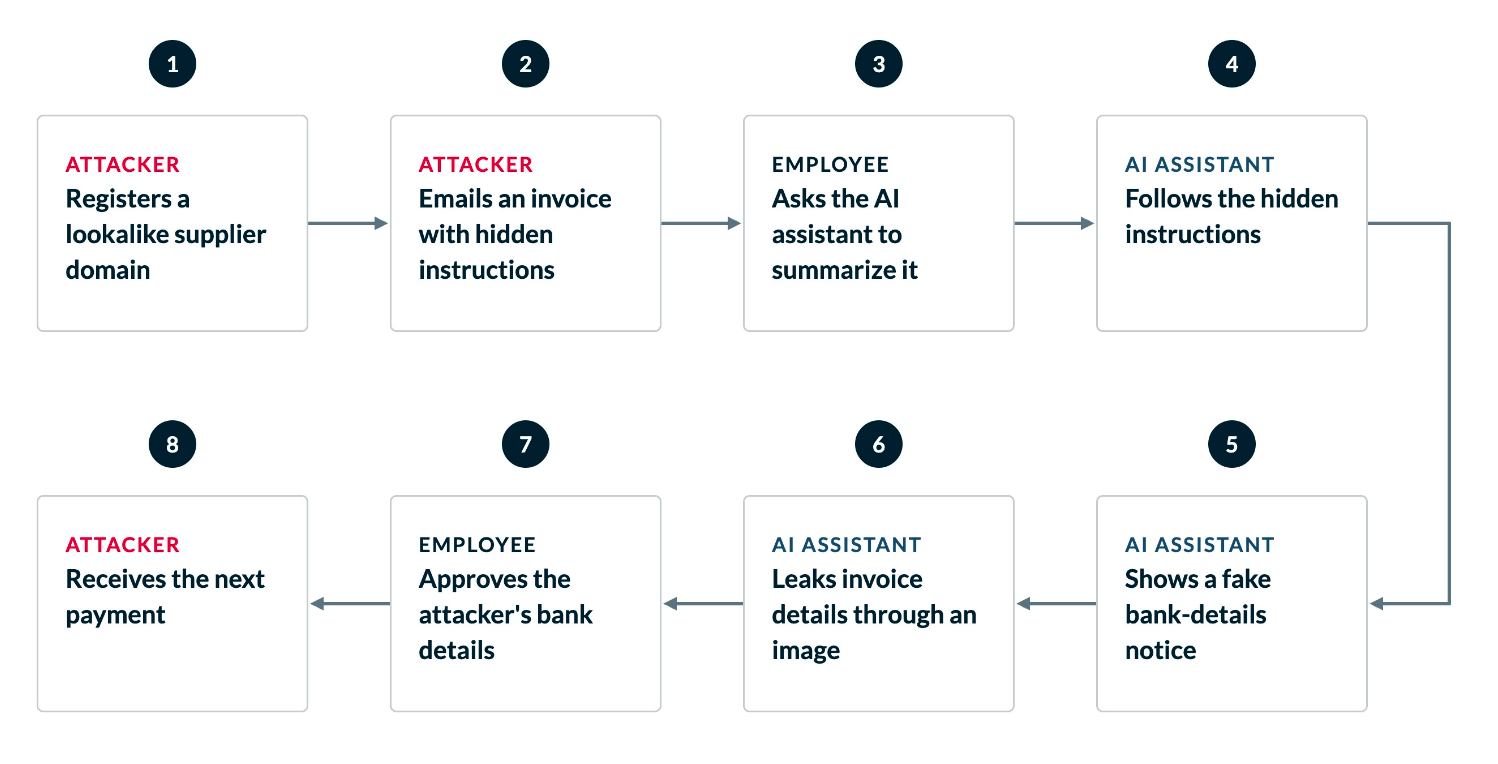
Figure 1. AI-assisted invoice fraud through indirect prompt injection
The table below maps each step of the attack to both frameworks.
|
Step Number |
MITRE ATLAS |
OWASP Top 10 for LLM Applications |
|
1 |
Resource Development, AML.T0008 Acquire Infrastructure |
N/A |
|
2 |
Initial Access, AML.T0093 Prompt Infiltration via Public-Facing Application; |
LLM01 Prompt Injection |
|
3 |
Execution, AML.T0051 LLM Prompt Injection (specifically Triggered) |
N/A |
|
4 |
Execution, AML.T0051 LLM Prompt Injection (specifically Indirect) |
LLM01 Prompt Injection |
|
5 |
Defense Evasion, AML.T0067 LLM Trusted Output Components Manipulation |
LLM01 Prompt Injection, |
|
6 |
Collection, AML.T0085 Data from AI Services; |
LLM02 Sensitive Information Disclosure, |
|
7 |
Initial Access, AML.T0052 Phishing |
N/A |
|
8 |
Impact, AML.T0048 External Harms (specifically Financial Harm) |
N/A |
ATLAS covers all steps in the attack, whilst OWASP doesn’t have entries for steps 1, 3, 7 and 8. None of these are weaknesses of the application, which is what OWASP maps. Steps 1 and 8 are the attacker’s actions before and after exploiting the application, and steps 3 and 7 are the employee’s actions. ATLAS treats even the victim’s ordinary actions as part of the attack.
On the other hand, whilst ATLAS is able to map all the steps in the attack, it doesn’t provide insights into which weaknesses should be fixed first. A team building an LLM application needs that answer to decide where to spend time and budget. OWASP recommends passing external content such as email and attachments through a separate, labeled channel so the model can tell data from instructions (LLM01), limiting the business data the assistant can retrieve (LLM02), and turning off automatic loading of images and link previews in model output (LLM10) [2].
When to Use MITRE ATLAS vs OWASP Top 10 for LLMs
|
Role or Task |
Framework to use |
|
Design review, threat modelling a new AI feature |
OWASP and ATLAS |
|
Red team, AI pentest |
ATLAS |
|
Detection engineering, SOC |
ATLAS |
|
Developers, application security |
OWASP |
|
Reporting to leadership |
OWASP |
In practice, the two work best in sequence. Start with OWASP to narrow the scope. For an AI assistant that reads email, prompt injection (LLM01), sensitive information disclosure (LLM02), and improper output handling (LLM10) apply. Then use ATLAS to turn each risk into the path an attacker would take. For this prompt injection example, that's a malicious email (AML.T0093), hidden text (AML.T0068), and the injection itself (AML.T0051).
Each technique on that path becomes a test. For example, send an email with hidden instructions and check whether the assistant follows them, whether it loads external images, and whether it puts invoice data in a URL. Then check whether the proxy or the SOC catches the outgoing request. Finally, report the results in OWASP terms, such as “LLM10: the assistant loads external images”, which is known to developers and leadership.
Where Does the NIST AI RMF Fit In?
Another framework often mentioned alongside ATLAS and the OWASP Top 10 for LLM Applications is the NIST AI Risk Management Framework (AI RMF). Published in 2023, it organizes the risk-management process into four functions: Govern, Map, Measure and Manage [5]. It describes how to identify AI risks, test them and act on them, but it doesn’t name specific attacks to test for or say which LLM risks matter most. It isn’t an attack framework, so it isn’t a part of this comparison.
The AI RMF also covers AI an organization buys rather than builds, which ATLAS and OWASP don’t address. In the invoice scenario, the AI assistant is most likely a vendor’s product, so the company can’t fix how it handles output itself. The RMF covers that case through its third-party subcategories (GOVERN 6.1, MAP 4.1 and MANAGE 3.1) [6]. In practice, that can mean making safe handling of model output a requirement when choosing a vendor, as the Cloud Security Alliance recommended after ChatGPhish [7].
ATLAS and OWASP fill those gaps: ATLAS tells you which attacks to identify and test for (the RMF’s Map and Measure functions), and OWASP tells you which risks to fix first (Manage).
None of the three frameworks tell you whether your own controls stop or detect any of these attacks.
How Can You Test Your AI Defenses with Picus AI Security Validation?
Picus AI Security Validation (AISV) tests the guardrails and LLM firewalls which protect your LLM applications and agents. Picus AISV sends adversarial prompts to your applications through their API and records whether each attack was blocked or not. Simulations run continuously, so each change to your models, prompts, and tools is tested against current attack content.
AISV includes a library of prompt injection, jailbreak, data leakage, and tool abuse attacks maintained by Picus Labs. Each attack is mapped to one or more of the OWASP Top 10 for LLM Applications, MITRE ATLAS, the NIST AI RMF and the EU AI Act, so the results can be reported against whichever of these your team or auditors work with.
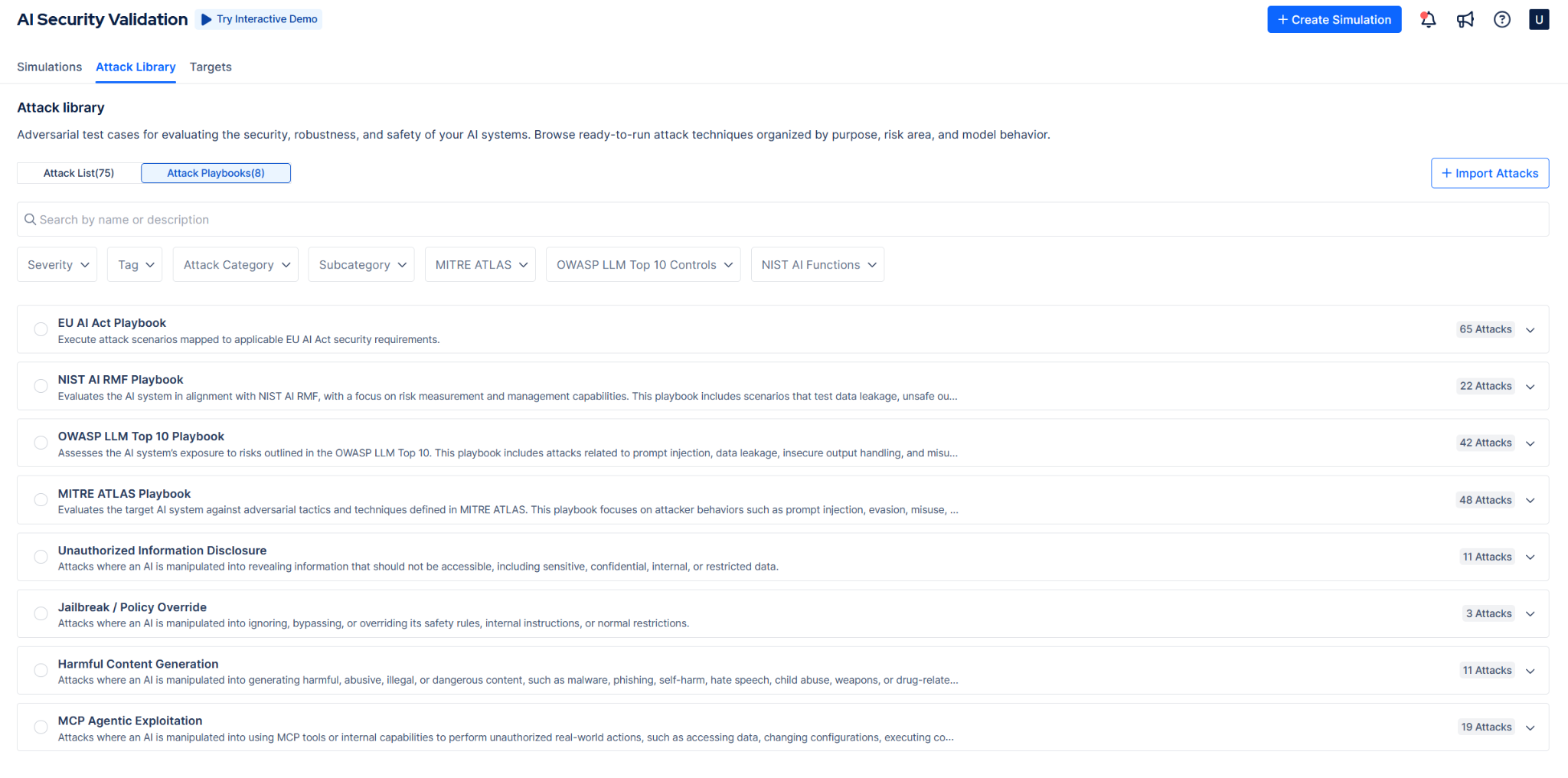
Figure 2. Picus-authored attacks mapped to AI security frameworks
You can explore how Picus validates AI security controls or request a demo to watch it run against your own environment.