
Mythos readiness is a security program's proven ability to withstand attacks weaponized at the speed of frontier AI models such as Anthropic's Claude Mythos, where disclosure-to-exploit is measured in hours rather than weeks. A Mythos-ready organization can show which controls hold, which do not, and what evidence backs each decision to patch, mitigate, monitor, or accept.
Something changed in 2026 that most vulnerability management programs were not built for. It was not that attackers got smarter. Finding a vulnerability got orders of magnitude cheaper, while fixing one stayed as expensive as it was in 2019.
This guide covers what Mythos-ready means, where the claims are weaker than the headlines suggest, and how to build the layer that closes the gap.
What is Mythos-ready? definition & examples
An organization is Mythos-ready when it can prove which attacks its controls stop, which they only detect, and which get through. The shift is from patching at human speed to proving defenses at machine speed. Proof means current test results against what frontier AI models generate today, not installed products, written policies, or a test from last quarter.
A Mythos-ready team can defend three claims at any moment:
- You measure control effectiveness rather than assume it. EDR policies degrade. Detection rules go stale. Firewall configs drift. Nobody tests the AI guardrails. Owning a control and knowing it works are two different things.
- You prove exploitability rather than score it. You know which vulnerabilities an attacker could actually exploit in your environment. CVSS tells you severity in the abstract, not risk in your estate.
- You back every risk decision with evidence. Patch, mitigate, monitor or accept with evidence: dated test results support each call, and an auditor or a board member can read them.
What that looks like in practice:
|
Situation |
Not Mythos-ready |
Mythos-ready |
|
A CVSS 9.8 lands in your scanner |
Escalate as critical, page the owner |
Test it against that asset's controls first. A 9.8 your stack already contains is not a 9.8 for you |
|
The same CVE turns up on 480 hosts |
Open 480 tickets |
Prove which instances are reachable and exploitable, remediate those, accept the rest with evidence |
|
A new APT campaign hits the news |
Ask your EDR vendor if they cover it |
Run its behaviors against your live stack and know within the hour |
|
A production system can't take a live exploit |
Mark it untestable and assume the worst |
Establish exploitability from control evidence, executing nothing |
|
Segmentation changed after you accepted a risk |
The acceptance stands until the next review |
Revalidation fires on the change and re-opens the finding if it no longer holds |
|
An auditor asks why a risk was accepted |
Show a CVSS score and a register entry |
Show dated test results from the day the call was made |
If your answer to "are we secure right now?" is a severity score, a patch percentage, or a vendor datasheet, you are not Mythos-ready.
Why Mythos readiness is urgent: discovery outpaces patching
Mythos-class models now find vulnerabilities far faster than anyone can verify and fix them, and most exploitation happens before a patch exists to apply.
Anthropic launched Project Glasswing in April 2026, giving around 50 organizations access to Claude Mythos Preview to audit their own code. In the first month it surfaced more than 10,000 high- and critical-severity vulnerabilities. [1] Open source is the one place the whole pipeline is visible, because Anthropic publishes it as a live dashboard:
|
Stage |
Count |
|
Candidate findings |
23,019 |
|
Reviewed by external security firms |
1,900 |
|
Confirmed valid |
1,726 |
|
Committed to the public ledger |
1,611 |
|
Disclosed to maintainers, across 281 projects |
1,596 |
|
Acknowledged by maintainers |
1,451 |
|
Patched upstream, by Anthropic's count |
97 |
|
Carrying a verified fixed status in the ledger |
27 |
|
Given a CVE or GHSA advisory |
88 |
Source: Anthropic's disclosure dashboard and ledger, snapshot of 22 May 2026. [5]
Look at the two patch figures. The summary reports 97 patched. The ledger shows 27 carrying a verified fixed status, the rest still inside their disclosure windows. Even the patch count separates into what Anthropic gets told and what Anthropic can show, which is the distinction this article turns on.
Anthropic is direct about why the pipeline jams. Fixes averaged about two weeks each, and some maintainers asked it to slow disclosures down because they could not absorb the volume. The bottleneck sits with human capacity, not with finding bugs. [1] One detail says it plainly: the dashboard has not moved since 22 May.
The rest of the ecosystem reacted the same way. In March 2026 a coalition including Anthropic, AWS, GitHub, Google, Microsoft and OpenAI put $12.5M through OpenSSF and Alpha-Omega to help maintainers triage AI-generated security reports. [6] curl closed its bug bounty outright in January, after its confirmed-vulnerability rate fell below five percent. [7]
How fast do attackers exploit a new vulnerability?
Among vulnerabilities confirmed to have been exploited, the share exploited on or before the day of disclosure rose from 19% in the 2018 cohort to 54% in 2025, while the median gap fell from 771 days to zero. [3]
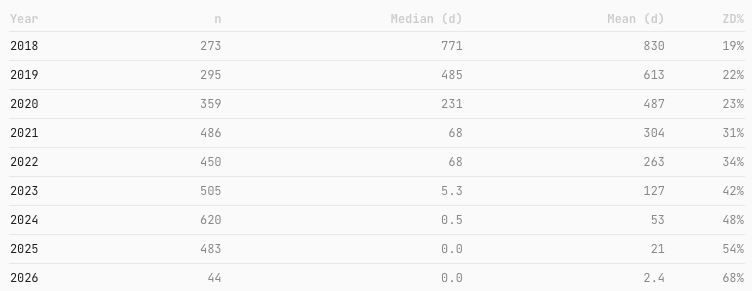
Figure. Zero Day Collapse/Audit
TTE is the gap in days between NVD publication and the first confirmed exploitation signal. Zero Day Clock computes it only across the roughly 3,500 CVEs with confirmed in-the-wild exploitation, about 1.5% of the 235,000 published since 2018, using CISA KEV and VulnCheck KEV timestamps with VulnCheck XDB filling the thinner pre-2022 coverage. [3]
Google's Threat Intelligence Group documented the first AI-generated zero-day exploit seen in the wild in May 2026. [2]
When most of what gets exploited is exploited by the day it is disclosed, remediation coverage stops being a measure of safety. What matters is whether the controls you already run stop the technique, and whether you can show it.
What Mythos readiness is not
The honest version of this argument is weaker than the headline version.
Not every finding is a real critical. Six independent firms assessed 1,752 of Mythos's high/critical open-source findings. 90.6% were valid, but only 62.4% held up as genuinely high or critical. [1] Reviewers and the model agreed on exact severity in 58.7% of a 463-case sample. [5] Roughly a third of the criticals were over-rated. Volume is not signal.
Not every vulnerability is exploitable where you run it. Segmentation, EDR visibility, allow-listing and attack economics still decide outcomes. That is not a reason to relax. It is the reason validation beats assumption: the only way to know which part of your backlog matters is to test it against your own controls.
The capability is emergent and cuts both ways. Anthropic did not train for it, and states that the improvements making Mythos better at patching also make it better at exploiting. [4] Glasswing itself is a defensive program.
These numbers are self-reported, but auditable. Anthropic published them and Anthropic sells the model. It also publishes a SHA-3-512 hash of each sealed report the moment an external firm validates it, archives every dashboard snapshot at a dated URL, and has withdrawn no entry. [5] Treat the trend as established and any single figure as provisional.
Mythos readiness is not a purchase. No tool makes an organization Mythos-ready. Evidence does, and you have to generate it continuously in the environment you actually operate.
Mythos readiness vs. AI readiness: what's the difference?
|
AI-ready |
Mythos-ready |
|
|
Core question |
"Is the AI we adopt safe and governed?" |
"Are we secure against AI-speed offense, and can we prove it?" |
|
Scope |
AI inventory, model governance, shadow AI |
Control effectiveness, exploitability, residual risk |
|
Evidence type |
Policy, attestation, model cards |
Adversarially tested proof |
|
Cadence |
Quarterly or annual review |
Continuous validation |
|
Primary failure mode |
Ungoverned AI adoption |
Unvalidated exposure |
You can be fully AI-ready and still not Mythos-ready. AI readiness governs the technology you bring in. Mythos readiness proves your defenses survive what attackers bring at you.
How to become Mythos-ready: a 90-day plan
Start with the validation motion that matches your worst problem, then widen the loop. Picus customers report control effectiveness roughly doubling within three months of deployment, which is where the horizons below come from. Treat them as a sequence, not a commitment calendar.
Days 1 to 30: prove one thing
Manually triggered, on-demand validation. Pick the entry point that matches your situation:
- Backlog is thousands of criticals with no clear priority. Chain real exposures by execution and prove which findings an attacker can actually reach and weaponize, ranked by blast radius.
- Critical assets cannot be actively tested. Establish exploitability from control evidence instead, without executing anything against production.
- Controls are deployed but unproven. Validate the controls themselves against your live EDR, SIEM, NGFW and WAF stack.
Whichever you pick, it measures what you already own. Most teams surface a control gap within days, not after a procurement cycle.
Days 31 to 60: schedule it and widen coverage
Scheduled runs and AI-assisted scenarios. Extend into the assets a live exploit can never touch: derive the attacker behaviors exploitation depends on from the vulnerability class rather than from published exploit code, then test each against the controls deployed on that asset.
Take CVE-2025-29824, the Windows CLFS use-after-free that Storm-2460 chained into RansomEXX. Exploitation needs a sequence: file transfer and execution, system reconnaissance, kernel privilege escalation, token manipulation, then credential dumping. Test each against your EDR policy, hardening and allow-listing. Exploitability established on day one, nothing detonated in production.
Start attaching dated test results to every decision. Close tickets only on a proven broken chain.
Days 61 to 90: make it continuous
End-to-end validation, with humans reviewing exceptions rather than running tests. Revalidation fires automatically when EDR policy, segmentation or SIEM rules change, because a Mythos-ready decision has a shelf life and expires silently otherwise.
By day 90, "are we secure right now?" has a dated answer instead of an estimate.
Mythos-ready checklist
A lightweight Mythos readiness assessment:
- [ ] We measure EDR, SIEM, WAF, and NGFW effectiveness continuously.
- [ ] We can validate a brand-new, high-impact TTP the day it appears in the news.
- [ ] When a control fails, we get deployable mitigation content, not just a finding.
- [ ] Every accepted risk has attached, dated evidence.
- [ ] We re-validate automatically after control or infrastructure changes.
Fewer than four boxes ticked means unvalidated exposure is sitting in your environment.
How Picus SCV delivers Mythos readiness
Picus Security Control Validation is the Mythos-readiness layer. Built on Picus BAS technology, it turns "are we secure?" from an assumption into evidence: it makes the controls you already own measurably effective, proves continuously what holds and what doesn't, and when a control can't block an attack, supplies the signatures and detection rules to fix it, then re-validates.
Provenance doesn't matter, impact does. Human-found or agentic-AI-found, if a technique hits critical software it enters the Picus Threat Library. Picus Labs triages disclosures and intel feeds daily, and an agentic pipeline turns them into runnable simulations mapped to MITRE ATT&CK. New threat to validated defense: 10 minutes.
SCV is one component of the Picus Autonomous Exposure Validation Platform. Picus Autonomous Penetration Testing proves exploitability by execution, and Picus Exposure Validation establishes it for the assets execution cannot reach. The three run as one loop rather than three purchases: controls get re-tested after every decision, and findings get re-scored when the environment moves. That is why evidence compounds instead of expiring.
Picus Swarm is the autonomy layer above it. Automation runs tasks; autonomy runs workflows. Swarm combines the platform's execution tools, your own operational logic about which assets matter and who approves what, and AI agents that apply that logic and carry a workflow to its outcome. A new CVE arrives and the chain runs itself: enrich it, map the affected asset groups and the controls deployed on them, scope and run the validation, auto-deploy the low-risk mitigations, ticket the rest, and issue the decision report.
Customer-reported outcomes:
- 2x control effectiveness within three months
- 89% lower MTTR
- 92% fewer SLA violations on high and critical vulnerabilities.
These are customer results, not benchmarks, and your own baseline will differ.
Ready to be Mythos-ready?
You do not need a program overhaul to start. Pick one control you believe is working, one technique you have never tested against it, and run it. Whatever comes back is the first piece of evidence a Mythos-ready program is built from.
Start your Mythos readiness assessment.
Request a Picus demo → and see your first validated control gap in 10 minutes.
References
[1] Anthropic, Project Glasswing: An initial update, 22 May 2026. https://www.anthropic.com/research/glasswing-initial-update
[2] Google Threat Intelligence Group, Adversaries Leverage AI for Vulnerability Exploitation, Augmented Operations, and Initial Access, 11 May 2026
[3] Zero Day Clock, yearly cohort audit. https://zerodayclock.com/audit
[4] Anthropic Frontier Red Team, Assessing Claude Mythos Preview's cybersecurity capabilities, 7 Apr 2026. https://red.anthropic.com/2026/mythos-preview/
[5] Anthropic, Coordinated vulnerability disclosure dashboard and Disclosure ledger, snapshot 22 May 2026. https://red.anthropic.com/2026/cvd/ and https://red.anthropic.com/2026/cvd/ledger/
[6] OpenSSF and Linux Foundation, Leading tech coalition invests $12.5 million through OpenSSF and Alpha-Omega, 17 Mar 2026. https://openssf.org/blog/2026/03/17/leading-tech-coalition-invests-12-5-million-through-openssf-and-alpha-omega-to-strengthen-open-source-security/
[7] The Register, on curl ending its HackerOne bug bounty, Jan 2026.
[8] Zero Day Clock, The Collapse. https://zerodayclock.com/collapse