

Why Security Teams Switch to


The differences are concentrated in two areas:
Coverage. Picus provides all three validation methods: Breach and Attack Simulation (BAS), Autonomous Penetration Testing, and Exposure Validation. AttackIQ relies only on BAS, with no autonomous pentesting and no way to validate a CVE's real exploitability.
Mobilization. Picus supplies detection rules built natively for your SIEM and EDR, and vendor-specific prevention signatures for your NGFW, IPS, and WAF. AttackIQ converts Sigma rules into vendor formats. It doesn't provide vendor-specific prevention signatures.


This comparison chart outlines the key differences between Picus and AttackIQ across validation coverage, AI and autonomy, threat readiness and speed, mobilization, and support and trust. It provides a clear view of how each platform approaches security validation and highlights which capabilities support broader coverage and more actionable results for strengthening security controls.
| Category | Comparison Criteria |
Picus
|
AttackIQ
|
|---|---|---|---|
| Validation Coverage | Security Control Validation (BAS) |
Continuous, production-safe testing of prevention and detection controls against roughly 30,000 techniques and 6,000 threat scenarios, with full attack payload transparency for every customer. |
Adversary emulation against security controls. Full threat library access is tied to the Enterprise edition. |
| Autonomous Penetration Testing |
Picus Autonomous Penetration Testing executes real exploit chains across hosts and identities, reaches crown-jewel assets, captures proof of compromise ordered by blast radius, and reruns the exact path after a fix. |
No autonomous penetration testing product in public materials. |
|
| Exploitability Validation for All CVEs |
Picus Exposure Validation maps a CVE to the technique chain its exploitation requires and validates that chain against deployed controls, returning a per-asset verdict on day one of disclosure, including for CVEs with no working exploit and assets off-limits to live testing. |
No equivalent method. It does not produce an exploitability verdict for a specific CVE on a specific asset. |
|
| Attack Surface Context |
Attack Surface Validation is embedded at platform level; the platform ingests scanner, penetration test, and bug bounty findings to validate them. |
EMM contributes asset, identity, and configuration context connected to modeled attack paths. |
|
| Cloud Security Validation |
Supports AWS, Azure, and Google Cloud Platform with one library and one reporting model. |
Cloud modules support AWS, Azure, and GCP. |
|
| Cloud Audit |
Audits cloud configurations and permissions alongside attack simulation, so misconfigurations and exploitable paths are validated together. |
Cloud audit capabilities are not documented. |
|
| Operating System Coverage |
Validates Windows, Linux, and macOS endpoints, containers and cloud, with the same library and reporting. |
Windows focused validation. Public reviews cite limited attack coverage for Linux, macOS, containers, and cloud. |
|
| AI and LLM Security Validation |
Picus AI Security Validation tests generative AI applications, including guardrail testing through agentless API connections. |
AI security testing missions announced with AVA in July 2026; depth not documented. |
|
| Custom Threats Without Code |
Drag-and-drop, code-free custom threat builder. |
Custom threats require Python development. |
|
| Custom URL Filtering Threats |
Creates custom URL filtering threats from a submitted URL to validate web security controls against the destinations that matter to you. |
Providing an initial assessment within 24 hours and complete MITRE ATT&CK-aligned attack graph emulation packages within 72 hours. |
|
| Threat Readiness and Speed | 24-Hour Emerging Threat SLA |
Contractual 24-hour SLA for critical emerging threats, including CISA alerts, delivered by a 20-plus-person Picus Red Team. |
Providing an initial assessment within 24 hours and complete MITRE ATT&CK-aligned attack graph emulation packages within 72 hours. |
| Threat Intelligence to Simulation Under 10 Minutes |
AI Threat Builder turns a URL, PDF, CVE ID, or actor name into a runnable, ATT&CK-mapped simulation in about 9 minutes, in-product or through the Picus MCP API. |
Watchtower automates CTI-driven emulation creation. No documented threat generation time. |
|
| Threat Library Transparency |
Transparent, continuously updated library with full MITRE ATT&CK sub-technique mapping and payload visibility for every customer. |
Full threat library access is limited to the Enterprise edition; partial on Ready!; not included with Flex. |
|
| Mobilization: Fix What Fails | Vendor-Specific Prevention Signatures (NGFW, IPS, WAF) |
Mitigation Library of natively built, validated prevention signatures for Check Point, Cisco, Citrix, F5, Forcepoint, Fortinet, Imperva, ModSecurity, Palo Alto Networks, Snort, Trend Micro, and Trellix. |
No vendor-specific prevention-signature library for NGFW, IPS, or WAF devices is documented. |
| Detection Rules Natively Authored and Validated per SIEM and EDR Product |
Picus Labs authors and validates detection rules for each SIEM and EDR vendor in a lab running those actual products. |
Natively authored rules are not documented. Detection content is translation-based: Sigma rules are converted into SIEM formats. |
|
| Detection Rule Health and Hygiene |
Detection Rule Validation performs static rule analysis, rule performance checks, and hygiene diagnostics for broken log sources, wildcard-heavy queries, and overly broad time ranges. |
Static rule analysis, rule-performance, and hygiene diagnostics are not documented. |
|
| Tool-Agnostic Simulation (Detects the TTP, Not File Path) |
Detection rules are built to detect attacker behavior rather than the file paths of testing binaries, so detection scores reflect real readiness. |
Obfuscation options are not documented. Public reviews report that SOC teams identify simulations by binary paths. |
|
| Validated Prioritization and Decision |
Picus Exposure Score ranks by validated exploitability, control performance, asset criticality, and exploit signals. Every exposure ends in a decision: Patch, Mitigate, Monitor, or Accept with Evidence. |
EMM ranks by modeled reachability, business impact, and control results rather than validated proof. |
|
| Easy Remediation and Re-Validation |
Deploys the vendor-specific fix, then reruns the test or the exploit path to prove the gap is closed. |
Public reviews report remediation guidance requires additional implementation work. |
|
| AI and Autonomy | Signal Driven Agentic Validation Architecture |
Picus Swarm: five specialist agents (Discovery, Exploitation, Validation, Mobilization, Reporting) conducted by Numi, running the validation loop on signal rather than schedule. |
AVA Agentic OS, announced July 2026, orchestrates agent missions, but not signal driven. |
| Autonomy Governance |
Tunable autonomy per workflow (Manual, Supervised, Fully Autonomous), full audit trail, and named-human approval for every risk-acceptance decision. No machine ever accepts risk. |
Governance and approval model for agent actions is not documented. |
|
| AI Grounded in Your Environment Data |
Numi is grounded in the customer's environment through the Picus data fabric across 75+ integrations, 13 years of validation engineering, and 300 million+ attack simulations of telemetry in the last year. |
Environment-data grounding for agent decisions is not documented. AVA connects to external AI tools such as ChatGPT and Copilot. |
|
| Deployment and Operations | Agentless Validation |
Browser-as-agent validation: nothing to deploy and no manual work for simulation or reporting. |
Flex packages tests as downloadable executables that the user runs manually and uploads results from. |
| Agent Operations at Scale |
Agent health visible in-product with one lightweight agent architecture across the platform. |
Public reviews report difficulty tracking agent health and that all agents must egress directly without an on-premises proxy host. |
|
| Executive and Compliance Reporting |
Framework-aligned reporting, benchmark scoring, and audit-ready evidence with a full chain of custody from finding to fix. |
Customizable dashboards and PDF or CSV reports. Public reviews report gaps for executive audiences. |
|
| Integration and Ecosystem | Security Stack Integration and Normalization |
Integrations across SIEM, EDR, NGFW, scanners, and ticketing (Jira, ServiceNow), designed as one system of record for exploitability. |
Public reviews report integration depth varies and field mapping for correlation requires effort. |
| Support and Trust | Regional Support Coverage |
Follow-the-sun support with presence across regions, including the US, Europe, UK, India, APAC, LATAM, Middle East and Africa. |
Corporate presence in the US, UK, and Spain; regional coverage elsewhere is delivered through partners. |
| Customer Ratings - Gartner Peer Insights Customer' Choice 2026 |
Customers' Choice in the 2026 Gartner® Peer Insights™ Voice of the Customer for Adversarial Exposure Validation (AEV) with 98% willingness to recommend. Gartner Peer Insights 4.8 with 337 ratings. |
No Gartner Customers' Choice. Gartner Peer Insights 4.6 with 138 ratings. |
|
| Customer Ratings - G2 Leader in Best BAS Software |
Picus Named #1 Breach and Attack Simulation (BAS) solution by G2 for the fifth consecutive time, 4.8 G2 Score with 229 reviews. |
1 G2 review with 4.5 score. |
|
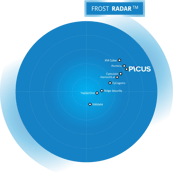
| Frost Radar™: Automated Security Validation, 2026 |
Picus Named Innovation Leader for Automated Security Validation in Frost Radar™ 2026 |
No presence in the Frost Radar. |

Picus executes real exploit chains across hosts and identities, captures proof of compromise, and reruns the same path after the fix. AttackIQ doesn't have an autonomous penetration testing product; its emulation graphs execute scenario steps.

Picus supplies prevention signatures built and validated for NGFW, IPS, and WAF products including Palo Alto, Fortinet, Check Point, Cisco, F5, and Imperva. AttackIQ's public materials document no vendor-specific prevention-signature library.

Picus Exposure Validation returns an exploitable-or-not verdict for each CVE on each asset, on the day of disclosure. AttackIQ documents no equivalent; its EMM ranks exposures by modeled likelihood rather than validating them.

Picus provides natively authored and validated detection rules for SIEM and EDRs. AttackIQ converts Sigma rules into vendor formats. Picus DRV performs static rule analysis, rule performance checks, and hygiene diagnostics. AttackIQ's DRM doesn't provide rule hygiene diagnostics.


"What I like best about Picus Security is how it combines comprehensive threat simulations with actionable insights. The platform makes it possible to continuously validate whether our defenses—from endpoint solutions to firewalls and SIEM—are actually effective against the latest threats. The frequent updates and breadth of the threat library keep everything relevant, and the integrations with existing tools make adoption seamless. Whether in a large enterprise environment or a smaller team setup, Picus helps transform cybersecurity from reactive to proactive, saving time and strengthening overall resilience."
— User in Banking, Enterprise (>1000 employees)

Gartner Peer Insights Voice of the Customer Adversarial Exposure Validation
AttackIQ shows how your controls respond to simulated attacks. Picus tests those controls too. However, AttackIQ emulates attack steps rather than executing real exploit chains to prove compromise. Picus does both, combining autonomous pentesting, BAS, and exposure validation in one platform. It also provides detection rules built for your security products and vendor-specific prevention signatures helping your team close gaps and check that the fixes work.
.png?width=353&height=200&name=picus-blog-Pentera-preview-april29%20(1).png)

Picus combines BAS, autonomous penetration testing, and exposure validation on one platform. It executes real exploit chains, captures proof of compromise, validates exploitability without a live exploit, and supplies vendor-specific detection rules and prevention signatures. AttackIQ combines adversary emulation, modeled exposure analysis through EMM, and agent missions through AVA. It has no dedicated autonomous penetration testing product or equivalent to exploitability validation without a live exploit.
AttackIQ has no dedicated autonomous penetration testing product. Its EMM models attack paths from environment data, and its emulation graphs execute scenario steps rather than real exploit chains. Picus Autonomous Penetration Testing executes real exploit chains within an authorized scope, including privilege escalation and lateral movement, and returns proof of compromise. Teams can rerun the exact path after a fix.
Both platforms support AWS, Azure, and GCP, as well as Windows, Linux, macOS, and containers. Picus combines that coverage with real exploit-chain execution, exposure validation without a live exploit, and AI guardrail testing through agentless API connections. AttackIQ AVA also includes AI security testing missions, though their depth is not yet documented. User feedback highlights limited attack coverage within AttackIQ's cloud, Linux, container, and macOS support.
Picus Exposure Validation helps teams prioritize vulnerabilities by validating whether they can be exploited in their environment and whether existing controls would stop the attack. Picus uses real exploits when available. When no exploit is available, Exposure Validation assesses exploitability without live exploitation, including for critical systems. Picus Exposure Score combines these findings with asset criticality and business context to help teams decide what to fix first. AttackIQ EMM also considers business impact and control results, but relies on modeled attack paths and has no equivalent to exploitability validation without a live exploit.
Picus Labs authors and validates detection rules natively for each SIEM and EDR vendor. Its Mitigation Library also provides vendor-specific prevention signatures for NGFW, IPS, and WAF products. AttackIQ SigmAIQ translates Sigma rules into SIEM formats, supported by AI-assisted generation and tuning in DRM, but this translation-based approach can miss vendor-specific detection nuances. Vendor-specific prevention signatures are not documented for AttackIQ, and users report that its remediation guidance requires additional implementation work.
Picus Swarm uses five specialist agents coordinated by Numi: Discovery, Exploitation, Validation, Mobilization, and Reporting. Workflows run on signals rather than schedules, with configurable autonomy and a requirement for named human approval of risk acceptance. AttackIQ AVA Agentic OS, announced in July 2026, orchestrates agent missions across CTEM workflows, with missions launched from ChatGPT, Claude, Cursor, and Copilot. Its governance and approval model is not detailed in public materials.
Picus Detection Analytics shows whether each simulated attack was blocked, alerted on, logged, or missed. Detection Rule Validation adds static analysis, rule-performance analysis, and hygiene diagnostics. AttackIQ DRM includes rule health and execution-to-detection timing, but does not provide equivalent static analysis, rule-performance, and hygiene diagnostics. User feedback also highlights limitations in AttackIQ's SIEM and EDR event correlation.
Picus BAS provides continuous, production-safe control testing, with agent health visible in-product and one lightweight agent architecture across the platform. Its browser-as-agent option requires no deployment or manual simulation and reporting steps. AttackIQ Enterprise supports agent-based testing at up to 500 test points, with Mission Control available as an orchestration add-on. AttackIQ Flex supports agentless endpoint testing through a workflow that requires manual execution and result uploads. Both vendors offer SaaS, on-premises, and air-gapped deployment options.
Picus AI Threat Builder converts a URL, PDF, CVE ID, or actor name into a runnable, ATT&CK-mapped simulation in about nine minutes. Picus Labs also provides a contractual 24-hour SLA for critical emerging threats. AttackIQ Watchtower automates CTI-driven emulation creation, while AttackIQ states a 48-hour delivery target for attack graphs following CISA alerts.