Key Takeaways
- KryBit is a Ransomware-as-a-Service operation launched in late March 2026, leasing encryption builders to affiliates.
- Builders cover Windows, Linux, VMware ESXi, and NAS devices, extending encryption across endpoints, servers, virtualization, and network storage.
- Double extortion stages 10 GB to 250 GB per victim before encryption, with ransoms of $40,000 to $100,000.
- Rival group 0APT breached the administrator panel on 13 April 2026, exposing two administrators, five affiliates, and twenty negotiations.
- Operations continued after the leak, surpassing 50 claimed victims by the close of the first full quarter.
- The Picus Platform simulates KryBit ransomware attacks so teams can validate security controls against this threat.
KryBit is a Ransomware-as-a-Service operation that launched in late March 2026 with builders for Windows, Linux, VMware ESXi, and NAS devices, staging 10 GB to 250 GB of victim data before encrypting files with a fixed .KRYBIT extension and dropping a RECOVER-README.txt ransom note [1].
Weeks after launch, it was breached by a rival group, which published its administrator panel and exposed two operators, five affiliates, twenty live negotiations, and five reused Bitcoin wallets [2].
This blog analyzes the KryBit ransomware and explains how to test your security controls against this threat.
KryBit Ransomware at a Glance
|
Field |
Detail |
|
Category |
Ransomware-as-a-Service, double extortion |
|
Emergence date |
Late March 2026, first victims posted within two weeks |
|
Affiliate model |
80/20 split, affiliate keeps 80 percent, operator keeps 20 percent |
|
Target platforms |
Windows, Linux, VMware ESXi, NAS devices |
|
Encrypted file extension |
.KRYBIT, fixed |
|
Exfiltration volume |
10 GB to 250 GB staged per victim before encryption |
|
Ransom demands |
$40,000 to $100,000 per victim |
|
Payment infrastructure |
Five Bitcoin wallets reused across affiliates and victims |
What Is KryBit Ransomware?
KryBit is a Ransomware-as-a-Service (RaaS) operation that launched in late March 2026 and leases encryption builders for Windows, Linux, VMware ESXi, and NAS environments to its affiliates.
It runs a double-extortion model, stealing data before encrypting it, appending a fixed .KRYBIT extension to affected files, and dropping a ransom note named RECOVER-README.txt that threatens publication of the stolen data if payment is not made. Affiliate recruitment is built around an 80/20 revenue split in which the affiliate keeps 80 percent of any ransom and the operator retains the remainder.
The operation is unusual because it became a breach victim within weeks of launching. On 13 April 2026, the rival RaaS group 0APT published KryBit's administrator panel, exposing operator accounts, affiliate accounts, and live victim negotiation data. The exposed panel showed two administrators, five affiliates, and 20 potential victims under negotiation, with per-victim exfiltration volumes between 10 GB and 250 GB and ransom demands between $40,000 and $100,000.
KryBit retaliated the next day. On 14 April 2026, it gained access to 0APT's infrastructure, exfiltrated it, listed 0APT as a victim on its own leak site, and defaced the 0APT leak site with a custom message.
Despite the exposure, the operation kept running. KryBit posted 10 legitimate victims in its first two weeks, had 20 active negotiations at the time of the panel leak, reached roughly three dozen claimed victims by late May 2026, and logged just over 50 claims by the close of its first full quarter. Claimed victims concentrate in business services, consumer services, manufacturing, education, and technology, and cluster geographically in Germany, Mexico, Thailand, Spain, and Austria.
How Does KryBit Ransomware Work?
Initial Access and Delivery
Initial access varies from one affiliate to the next, with no single entry signature tied to the group, and no CVE exploitation has been attributed to the operation as of May 2026. The operator supplies the builders and the panel, while affiliates supply their own access.
Execution and Cross-Platform Payload Deployment
Affiliates receive builders that produce encryptors for Windows endpoints, Linux servers, VMware ESXi hypervisors, and NAS appliances, so one builder family covers workstations, servers, the virtualization layer, and network storage.
Its antivirus detection names place the code in the Babuk family.
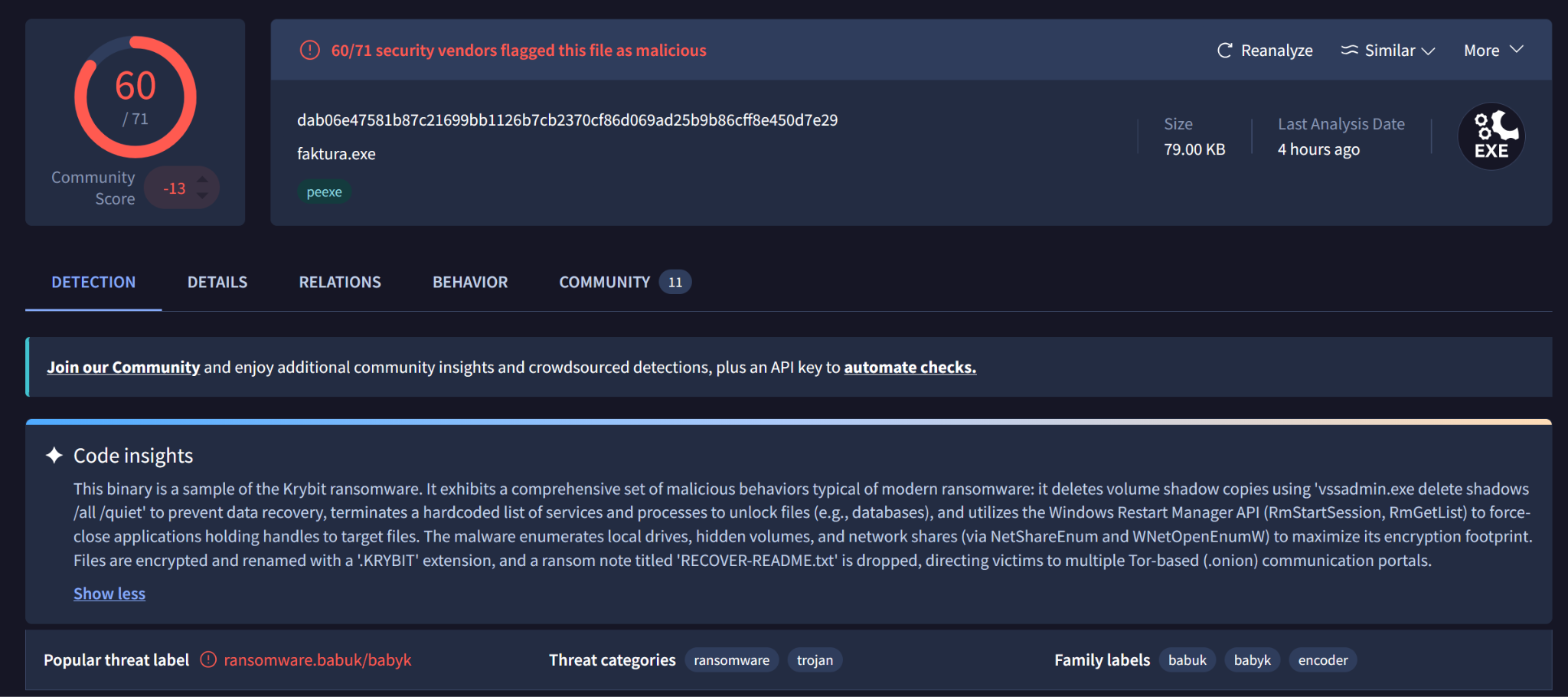
Figure 1. VirusTotal results of the sample
Command and Control, Negotiation, and Extortion Infrastructure
Victim communication and leak site hosting run over Tor. The data leak site is krybitxdpxohsmjooeb3gbgpmdddreh6mnflzac6bnezz74b7yje67yd[.]onion, and operator and affiliate contact runs over Tox.
The administrator identities are KRYBIT and GREP, and some of the affiliate identities are fsociety, M*A*R*S, D9D938D9AC9, 464D03CA2AF05, and 753766EFA0462B [1].
Five Bitcoin wallets were reused across all affiliates and victims instead of one address per negotiation. None showed transactions sent or received.
How Picus Simulates KryBit Ransomware Attacks
We strongly suggest simulating KryBit Ransomware Attacks to test the effectiveness of your security controls against real-life cyber attacks using the Picus Platform. You can also test your defenses against hundreds of other ransomware variants, such as Warlock, BlackCat, Black Basta, and Akira, within minutes with a 14-day free trial of the Picus Platform.
Picus Threat Library includes the following threats for the KryBit Ransomware Attacks:
|
Threat ID |
Threat Name |
Attack Module |
|
87154 |
KryBit Ransomware Download Threat |
Network Infiltration |
|
50836 |
KryBit Ransomware Email Threat |
E-mail Infiltration |
Start simulating emerging threats today and get actionable mitigation insights with a 14-day free trial of the Picus Platform.
References
[1] “KryBit.” Accessed: Aug. 31, 2026. [Online]. Available: https://www.halcyon.ai/threat-group/krybit
[2] “0APT vs. KryBit Ransomware Actors List Opposing Operators as Victims.” Accessed: Aug. 31, 2026. [Online]. Available: https://www.halcyon.ai/ransomware-research-reports/0apt-vs-krybit-ransomware-actors-list-opposing-operators-as-victims





.png?width=353&height=200&name=picus-threat-research-preview-Dragon%20Breath-august-11%20(1).png)