What Are the Best Alternatives to Cymulate?
In 2026, security teams evaluating or already using Cymulate are increasingly looking for platforms that deliver more accurate simulations, faster emerging-threat updates, stronger detection engineering, and broader validation across the entire kill chain within a unified platform.
Based on publicly available customer feedback from peer review and ratings platforms and competitive analysis, the six strongest alternatives to Cymulate today are:
- Picus Security
- AttackIQ
- SafeBreach
- Pentera
- XM Cyber
- Horizon3
This blog provides a concise breakdown of each option and why modern teams are choosing them over Cymulate in 2026.
The Top 6 Best Alternatives to Cymulate in 2026
1. Picus Security
Picus Security stands out as the leading alternative to Cymulate for Breach and Attack Simulation (BAS), Adversarial Exposure Validation (AEV), Automated Penetration Testing, and Continuous Threat Exposure Management (CTEM).
Picus offers a unified security validation platform that simulates real-world attacks to prove how well defenses actually detect and block threats, prioritize only truly exploitable business-critical risk, and deliver precise, actionable remediation, driving deeper control validation and clearer operational outcomes than competitors.
Picus Platform stands out for:
-
Comprehensive BAS + Exposure Validation across email, web, endpoint, network, data, and cloud, ensuring full attack coverage.
-
Ready-to-implement vendor-based prevention signatures for security controls such as NGFW, IPS, and WAF, along with generic security best practices and mitigation recommendations. For detection, Picus delivers vendor-specific detection rules as well as vendor-neutral formats such as SIGMA for major SIEM and EDR platforms, enabling effective detection of endpoint attacks. In addition, it offers log source recommendations to enhance log visibility and improve SIEM efficiency.
-
Quick time-to-value and intuitive UX, enabling rapid deployment with minimal setup.
-
Fastest emerging threat updates, with 24-hour SLA for new TTPs and vulnerabilities with publicly known Proof of Concepts (PoC).
-
Ideal for mid-sized and enterprise teams seeking continuous, automated security validation across the full adversary attack chain, delivering consistent and accurate results through seamless integration and actionable remediation guidance that drive measurable ROI.
Picus Security vs Cymulate: Key Differences
|
Category |
Picus Security |
Cymulate |
|
Primary Use Case |
Best-in-class BAS + Attack Path Validation (& Automated Penetration Testing) + ASM + Exposure Validation + Automated Mitigation + Detection Analytics & Engineering |
BAS + Attack Path Discovery + ASM + Exposure Validation + Automated Mitigation |
|
Simulation Accuracy |
High-fidelity TTP-level adversary simulation and emulation |
Multiple customer reviews indicate false positives. E.g., "...some modules produce time-consuming false positives." |
|
MITRE ATT&CK Mapping |
Precise, behavior-based TTP-to-technique mapping. |
Heatmap includes deprecated techniques & flawed “malware download blocked = all ATT&CK techniques used by the malware blocked” logic |
|
Detection Engineering |
Automated and granular log & alert level validation, automated detection rule hygiene and performance analysis. Deep validation of SIEM rules; Log source health checks; AI-mapped MITRE coverage |
Keyword-based, no detection rule hygiene check. AI-driven (unvalidated) detection rule generation and mapping. |
|
Emerging Threat Updates |
Updated within 24 hours under SLA |
Often delayed; no SLA for emerging threats |
|
Remediation Guidance |
Vendor-specific mitigation content for prevention + detection, as well as generic guidance. Direct IoA injection is available, which is a proactive and behavioral indicator. |
Generic guidance, limited depth and coverage in vendor-specific mitigation signatures. Direct IoC injection is available, which is a reactive indicator. |
|
WAF Testing |
Provides both agent-based and agentless testing, avoiding production impact |
Provides only agentless testing, sends malicious payloads directly to customer web apps, risk of DoS/performance issues or accuracy issues because of rate-limits for controlled payload delivery. |
|
CVE Testing |
True exploit-based simulations |
Flawed “malware download blocked = all CVEs used by the malware blocked” logic |
|
Stability & UX |
Clean, reliable, intuitive platform |
Customer complaints: platform lag, crashes, long assessments |
|
ASM Capabilities |
Picus Attack Surface Validation integrates with data sources like Microsoft Active Directory (AD), Endpoint Protection Platforms (EPP), Vulnerability Management Solutions (VM), Endpoint & Config Management Systems, and External Attack Surface Management Tools. |
Includes ASM modules; External (EASM) + Internal (CAASM) |
|
Licensing |
Modular, tier-based licensing model with pricing based on the number of assets and modules (e.g., SCV, APV, CSV) selected. |
Modular, tier-based pricing with separate product pillars (BAS, ASM, CART, Exposure Analytics) |
|
Deployment & Data Residency |
In addition to cloud, full on-premise and air-gapped deployment & data residency offered. |
Cloud deployment |
|
Investment in Open Cybercommunity |
Offers online, completely free Purple Academy with verifiable certification. |
Not Available |
What Real Users Think About Picus
Picus consistently outperforms Cymulate and other security validation vendors on independent review platforms.
On Gartner Peer Insights, Picus is a Customers’ Choice, with a 4.8/5 overall rating and an industry-leading 98% willingness to recommend, compared to Cymulate's 94% willingness to recommend.
On G2, Picus earns an exceptional 4.9/5, reflecting its strong user satisfaction and product experience.
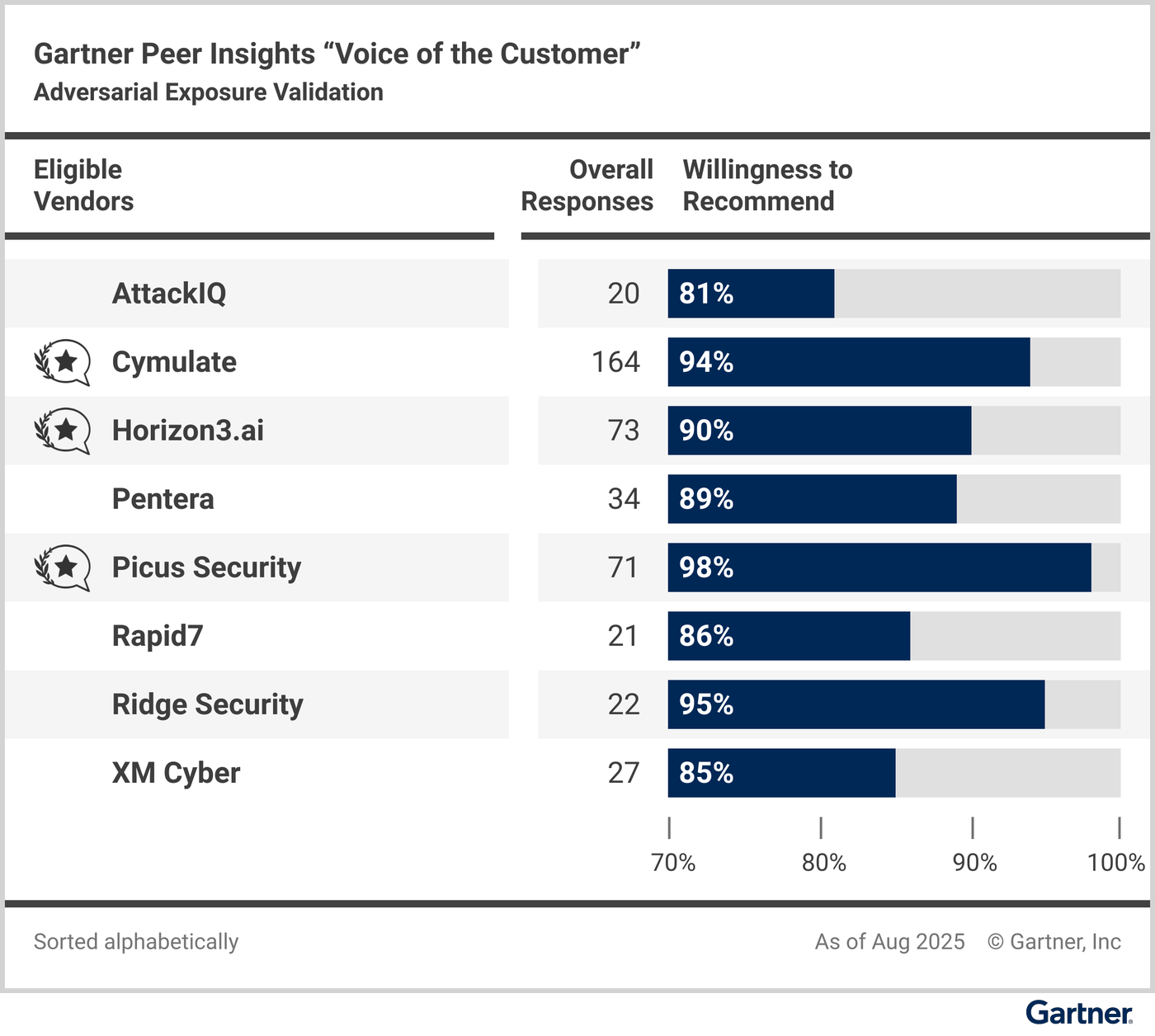
Figure. Gartner Peer Insights “Voice of the Customer, As of August 2025
Users praise Picus for its ease of use, powerful detection engineering capabilities, continuous validation, and clear, actionable remediation guidance. Security teams highlight how quickly the platform delivers value and how it transforms their ability to monitor and improve defenses in real time.
- “Proactive, insight-driven and reliable security validation.” – IT Security & Risk Management (Energy & Utilities)
- “Continuous validation and automation enhance defense capabilities and efficiency.” – Network Security Engineer (IT Services)
- “The tool has proven to be an invaluable asset… intuitive, automated, and effective at identifying weaknesses before attackers do.” – IT Security & Risk Management (IT Services)
- “Stronger detections with Picus. They significantly improved our correlation and detection capabilities.” – Engineer (Banking)
Together, this feedback makes one thing clear:
Real users see Picus as the most reliable, highest-rated, and fastest-to-value security validation platform available today.
Cymulate’s False Claims Against Picus: The Truth Uncovered
Healthy competition is always beneficial for growth, but unfortunately, Cymulate has chosen to spread false and misleading claims about Picus. These attempts to undermine the credibility of the Picus platform are not just misguided, they’re deliberate.
While we prefer to let our technology speak for itself, we cannot allow misinformation to cloud your decision-making. Below, we correct the record with verifiable facts.
|
False Claims of Cymulate |
The Truth |
|
Offers many control integrations, but the technical requirements are cumbersome with a dedicated agent and manual query creation for every scenario that requires detection validation. |
False. This claim is completely false, it's hard to believe such a misleading statement was made. Picus is specifically designed to eliminate manual effort in detection validation, which is one of the key differentiators that sets us apart from our competitors. We were the first in our field to introduce Detection Analytics and are the only vendor offering Detection Rule Validation (DRV) as a product. In reality, Picus does not require manual agent setup or custom-crafted queries for each validation scenario. Instead, Picus automatically discovers the relevant log sources, maps them to attack simulations, and generates detection queries as part of the validation process, eliminating the need for manual query creation or constant maintenance. |
|
Automated control updates are limited to Crowdstrike. Manually download and apply rules to each control. |
False. Picus offers automated control updates for multiple vendors, including Microsoft Sentinel, SentinelOne, Microsoft Defender, Splunk, and IBM QRadar, not just CrowdStrike. With a single click, rules created in Picus are deployed directly into the target platform, removing the need for manual exports or downloads. These rules are deployed in a disabled state for user review, enabling final activation. Advanced Query Mapping for Splunk and QRadar ensures precise field mappings and smooth integration. Unlike Cymulate’s focus on IoC updates, Picus rules include IoA, detection rules, and more. It’s important to note that IoCs are vulnerable to change by attackers, which is why Picus’ broader approach is critical for maintaining detection accuracy. |
|
Chained assessments are not realistic because there is no delay between actions. |
False. While Picus allows configurable delays between actions, we fail to understand why Cymulate places such importance on this delay factor. They present it as if delay is the key element for simulation realism, but there are many other crucial factors that should be considered. In reality, attackers may or may not introduce delays during an attack, but no attacker pauses and thinks, "I need to wait before continuing, or my attack won’t succeed." The focus should be on the accuracy of attack actions, real-world TTPs, and security control validation, not on introducing artificial delays. |
|
Attack paths are limited to basic lateral movement with user-defined scope. |
False. It's hard to overlook the clear technical details published on the Picus website, yet they’ve chosen to fabricate such a misleading statement. Picus Attack Path Validation (APV) is not limited to lateral movement. APV simulates a full range of adversary actions, including asset and service discovery, vulnerability assessment, credential harvesting and offline brute forcing, Kerberoasting, password cracking, privilege escalation, data exfiltration, and lateral movement. It enables teams to discover and mitigate exploitable vulnerabilities, privilege escalation paths, data exfiltration risks, and ransomware threats, with lateral movement representing only one stage within a complete attack path. |
|
Only offers basic Breach and Attack Simulation (BAS) for repeatable testing. |
False. This claim lacks clarity and seems to be more of an attempt to undermine than to provide an accurate assessment. Picus offers a comprehensive BAS solution that targets every layer of your infrastructure, whether it’s endpoint, network, cloud, or Kubernetes. We test all types of security controls, including prevention, detection, and response mechanisms, across on-prem, cloud, hybrid, and endpoint environments. This comprehensive approach makes us stand out as a leader in the BAS space. If you'd prefer to hear about our BAS capabilities from our users rather than us, you can check out our G2 and Gartner reviews. Picus is recognized as the #1 Leader in G2’s Fall 2025 and Winter 2026 Breach and Attack Simulation grids, reflecting strong customer satisfaction and platform depth. Picus continuously and automatically simulates real-world attacks across on-prem, cloud, and endpoint environments to validate control effectiveness and deliver prescriptive remediation. |
|
Provides only basic threat updates. |
False. It’s hard to take such a misrepresentation seriously. Anyone who takes a look at both Picus Security and Cymulate blogs will quickly notice the difference in attack quality. Picus doesn't focus on adding thousands of attacks just for the sake of quantity. Instead, we prioritize the inclusion of attacks that are relevant and impactful for our users, those they need to test and defend against. It’s easy to add hundreds of malware download attack simulations daily, but they don’t provide real value. In addition, Picus operates under a guaranteed 24-hour SLA to incorporate critical threats identified by CISA and US-CERT, including zero-day CVE exploitation techniques, as soon as public proof-of-concept code is available. |
|
Does not provide vendor-specific mitigation and only supplies IOC feeds. |
Picus offers over 80,000 vendor-specific mitigations tailored for a wide range of vendors. This includes validated rules and signatures that ensure precise, actionable mitigations. Unlike Cymulate, which relies on IOC-based blacklisting, a method that can be easily bypassed, Picus provides more secure, effective mitigation solutions. |
|
Cymulate’s agentless WAF simulation approach is better than Picus’s agent-based approach. |
Picus offers both agent-based and agentless WAF attack simulation, while Cymulate only provides an agentless method. Moreover, Picus' agent-based WAF simulation is far superior. Cymulate’s agentless method has potential performance issues and fails to provide a complete evaluation due to external influences, such as web server and application responses. In contrast, Picus sends attacks to its dedicated agent, ensuring accurate, reliable results, as validated by leading WAF vendors. |
|
Not led by offensive security research |
False. Picus is supported by more than 50 security researchers who conduct advanced offensive security research and regularly contribute to the global security community. Our research has been featured at leading forums such as Black Hat and published in well-respected outlets including Forbes, Dark Reading, CSO Online, BleepingComputer, and Hacker News, as well as cited in peer-reviewed academic journals. |
2. AttackIQ
AttackIQ and Cymulate are both BAS vendors, but they differ in execution philosophy. AttackIQ emphasizes open frameworks and customizable emulation, while Cymulate focuses on guided, packaged scenarios. Both validate security controls, but neither provides full automated penetration testing or deep attack path validation.
AttackIQ positions itself as the premier "threat-informed defense" platform, deeply aligned with the MITRE ATT&CK framework and targeting mature organizations that require rigorous, customizable adversarial emulation. As a founding research partner of the Center for Threat-Informed Defense, AttackIQ’s identity is inextricably linked to the academic and operational rigor of MITRE.
AttackIQ vs Cymulate: Key Differences
|
Category |
AttackIQ |
Cymulate |
|
Primary Use Case |
Security Control Validation (SCV); BAS-focused |
BAS + Attack Path Discovery + ASM + Exposure Validation + Automated Mitigation |
|
Customization |
Code-level customization (Python); Deep scenario editing |
Wizard-based; AI-driven scenario creation |
|
Detection Analytics |
Technique-level detection validation mapped to MITRE ATT&CK; limited native alert, log, and timing analytics |
Detection analytics available but cumbersome; rule mapping is AI-driven, not validated. API-driven integrations with major SIEMs (Splunk, QRadar, Azure Sentinel) |
|
MITRE ATT&CK Mapping |
Strong partnership with MITRE ATT&CK and MITRE Engenuity. |
Present but less granular |
|
Emerging Threat Updates |
Often delayed; no SLA for emerging threats |
Often delayed; no SLA for emerging threats |
|
WAF Testing |
Runs atomic HTTP/HTTPS attack tests (e.g., OWASP Top 10) tailored for WAFs |
Provides only agentless testing, sends malicious payloads directly to customer web apps, risk of DoS/performance issues |
|
ASM Capabilities |
Integrates with AWS, Azure, GCP, and on-prem systems to discover and validate attack surface; correlates asset ownership, criticality, and context using data from AD, CMDBs, and CAASM platforms |
Includes ASM modules; External (EASM) + Internal (CAASM) |
|
Deployment & Data Residency |
Hybrid (SaaS/On-prem). Uses agents for continuous testing; "Flex" module allows agentless testing. |
SaaS-first, no on-prem. |
|
Licensing |
Flex: credit-based pay-as-you-test; Ready!: subscription with regular automated validation; Enterprise: subscription with full platform access & customization; MSSP: partner-specific licensing available |
Modular, tier-based pricing with separate product pillars (BAS, ASM, CART, Exposure Analytics) |
|
Investment in Open Cybercommunity |
Offers online public AttackIQ Academy with free verifiable certification |
Not Available |
3. SafeBreach
SafeBreach is a powerful alternative to Cymulate, offering continuous security validation through its BAS platform. It provides customizable attack simulations across multiple vectors, delivering detailed insights into security posture via an intuitive interface.
As one of the earliest BAS vendors, SafeBreach is renowned for its extensive attack playbook and ability to execute high-volume, continuous simulations across large enterprise environments. The platform focuses on scalability, comprehensive attack coverage, and operationalized BAS, making it an excellent choice for organizations seeking broad testing coverage and automated purple teaming workflows.
SafeBreach excels especially in:
-
Massive attack library (one of the largest in the BAS market)
-
Highly scalable simulation engine capable of running thousands of tests at once
-
Continuous validation programs suited for enterprises with mature security teams
-
Flexible attack orchestration and replaying attacker behaviors at scale
SafeBreach is powerful but has historically been viewed as complex to deploy and manage at scale. Users have reported "cumbersome navigation" and high overhead in managing the agents and simulators. It is often a tool that requires a dedicated BAS engineer to manage effectively. The platform is designed for the power user who wants to tweak every parameter of a simulation.
SafeBreach vs Cymulate: Key Differences
|
Category |
SafeBreach |
Cymulate |
|
Primary Use Case |
BAS + Attack Path Validation |
BAS + Attack Path Discovery + ASM + Exposure Validation + Automated Mitigation |
|
Simulation Strengths & Accuracy |
Strong at consistent, repeatable control testing using predefined adversary simulations, but its accuracy is limited when it comes to validating real detection outcomes, environment-specific exploitability, and complex multi-stage attack behavior |
Multiple customer reviews indicate false positives. E.g., "...some modules produce time-consuming false positives." |
|
Detection Engineering |
Deep integrations with EDR/SIEM vendors to verify if alerts were actually triggered |
Keyword-based, no detection rule hygiene check |
|
MITRE ATT&CK Mapping |
Well-aligned BAS-focused TTP mapping |
Heatmap includes deprecated techniques & flawed “malware download blocked = all ATT&CK techniques used by the malware blocked” logic |
|
Emerging Threat Updates |
Continuously updated threat library; ~24-hour SLA for CISA and emerging threats |
Often delayed; no SLA for emerging threats |
|
WAF / Web Testing |
Provides agentless testing |
Provides only agentless testing, sends malicious payloads directly to customer web apps, risk of DoS/performance issues |
|
ASM Capabilities |
Includes an “ASM dashboard” that maps data across multiple attack surfaces |
Includes ASM modules; External (EASM) + Internal (CAASM) |
|
Deployment Model |
Hybrid/SaaS. Often requires more infrastructure prep for complex lateral movement sims. |
SaaS-first. |
|
Licensing |
A custom, annual enterprise subscription, typically priced based on deployment scope, number of simulators, environments covered, and licensed modules |
Modular, tier-based pricing with separate product pillars (BAS, ASM, CART, Exposure Analytics) |
4. Pentera
Pentera offers a powerful security validation alternative to Cymulate with its automated pentesting capabilities, continuous security validation, and real-world attack simulation across on-premises and cloud environments.
However, Pentera and Cymulate address different layers of validation. Pentera focuses on automated internal penetration testing using an assumed-breach mindset, while Cymulate concentrates on control-level BAS scenarios. The key distinction is depth of post-compromise realism versus breadth of security control testing.
Pentera focuses heavily on Internal Network Penetration: lateral movement, privilege escalation, and password cracking (e.g., SMB relay, Kerberoasting). While Pentera has expanded into "Surface" (External Attack Surface Management) and Cloud, its core strength remains proving how an attacker moves between machines inside the network. It answers the question, "If an attacker gets on the network, how far can they go?" Cymulate answers, "Are my individual security controls (Email, Web, Endpoint) functioning correctly?"
Customers value Pentera for its:
-
Clear remediation wiki
-
Exploit-based testing
-
Strong lateral movement and credential abuse simulations
However, Pentera does not provide capabilities beyond automated pentesting (e.g., no detection engineering, no SIEM/EDR validation, no ASM suite).
Pentera vs Cymulate: Key Differences
|
Category |
Pentera |
Cymulate |
|
Primary Use Case |
Automated internal penetration testing |
Breach and Attack Simulation |
|
Threat Library Transparency |
Built for easy point and test, but library operates as a “black box” |
Visible threat library |
|
Detection Engineering |
No detection analytics; users manually sift logs to analyze their detection capabilities |
Detection analytics available but cumbersome; rule mapping is AI-driven, not validated. API-driven integrations with major SIEMs (Splunk, QRadar, Azure Sentinel) |
|
ASM Capabilities |
Pentera Surface - EASM module |
External (EASM) + Internal (CAASM) |
|
Control Validation |
Indirect, via exploitation success |
Direct per control scenario |
|
Attack Path Mapping |
Native and outcome-driven |
Limited |
|
MITRE ATT&CK |
Mapped to the framework, but focuses on the "success" of a chain rather than just atomic tests. |
Mapped to the framework |
|
Testing Frequency |
Periodic / Scheduled (Higher operational sensitivity) |
Continuous / On-demand (Low risk) |
|
Cloud & SaaS Coverage |
Strong focus on "Cloud-to-On-Prem" lateral movement and IAM misconfigurations. |
SSPM (SaaS Posture) and Kubernetes testing |
|
Licensing |
Uses an IP-based licensing model, where customers pay based on the number of IPs scanned |
Modular, tier-based pricing with separate product pillars (BAS, ASM, CART, Exposure Analytics) |
5. XM Cyber
XM Cyber is one of the leading alternatives to Cymulate, specializing in proactive continuous exposure management. The platform maps attack paths and prioritizes remediation from an attacker's perspective, helping organizations identify and manage security vulnerabilities.
Known for its focus on attack path simulations, XM Cyber excels at uncovering critical exposures in hybrid and cloud environments. It offers detailed insights into potential attack paths and provides actionable remediation guidance.
XM Cyber excels especially in:
- Attack path management that simulates potential attacker movements across networks
- Continuous exposure management with a strong focus on hybrid and cloud environments
- Prioritization of vulnerabilities based on exploitability and criticality
- Context-aware remediation guidance to address security gaps efficiently
However, XM Cyber is focused on exposure management and lacks broader BAS capabilities, such as automated penetration testing or full-featured attack simulations across multiple vectors. It also does not support detection rule validation or extensive attack surface management (ASM).
XM Cyber and Cymulate approach the problem of exposure management from opposite ends of the spectrum. Cymulate is dynamic and active; it sends traffic, drops files, and executes commands to empirically test controls. XM Cyber is static and logical; it analyzes configurations, permissions, and vulnerabilities to mathematically model "Attack Paths". XM Cyber’s "Attack Path Management" (APM) focuses on identifying "choke points", critical junctions where multiple attack paths converge, allowing teams to sever widespread risks with minimal effort.
XM Cyber vs Cymulate: Key Differences
|
Category |
XM Cyber |
Cymulate |
|
Core Technology |
Attack Path Management (APM) & Attack Graph Analysis |
Breach and Attack Simulation (BAS) |
|
Methodology |
Passive/Logical: Analyzes configs & logs to model paths |
Active: Sends test traffic/files to validate controls |
|
Visibility |
Structural Weakness (Is it possible?) |
Control Effectiveness (Did it block?) |
|
Cloud Capabilities |
Deep Identity & Permission Analysis (Static configuration) |
Validates Cloud Security Posture (Runtime detection) |
|
Key Advantage |
Choke Point Identification. Shows the single fix that breaks the most attack paths. |
Breadth of Vectors. Testing for Email, Phishing, WAF, Web, and Endpoint. |
|
Control Effectiveness Proof |
Indirect |
Direct but scenario-scoped |
|
WAF |
Does not perform active WAF payload testing (like SQLi or XSS); it focuses on pathway validation, identifying if an attacker can reach your critical assets even if your WAF is functioning perfectly |
Provides only agentless testing, sends malicious payloads directly to customer web apps, risk of DoS/performance issues |
|
ASM Capabilities |
Provides an EASM module |
External (EASM) + Internal (CAASM) |
|
Licensing |
Licensed via a per-asset annual subscription (Servers/Workloads/K8s nodes), tiered by the level of support (Standard to Elite), with multi-year discounts typical for enterprise agreements. |
Modular, tier-based pricing |
6. Horizon3
Horizon3 is a strong alternative to Cymulate for automated penetration testing. Its NodeZero platform behaves as an active adversary, proving reachability to critical assets by chaining misconfigurations, unpatched vulnerabilities, and harvested credentials to reveal the real attack paths an adversary would use. This approach is particularly effective in hybrid environments, where it exposes the identity and IAM seams attackers exploit to pivot between on-prem environments and cloud services such as AWS, Azure, and GCP.
Horizon3.ai and Cymulate serve different validation needs. Horizon3.ai focuses on autonomous exploitation and internal pentesting, while Cymulate focuses on security control testing through BAS.
|
Category |
Horizon3 NodeZero |
Cymulate |
|
Core Technology |
Automated Penetration Testing |
Breach and Attack Simulation |
|
Simulation Accuracy |
High practical accuracy driven by real exploit execution and attack-path chaining |
Multiple customer reviews indicate false positives. E.g., "... some modules produce time-consuming false positives." |
|
MITRE ATT&CK Mapping |
Automatically maps real exploit actions to MITRE ATT&CK TTPs |
Heatmap includes deprecated techniques & flawed “malware download blocked = all ATT&CK techniques used by the malware blocked” logic |
|
Emerging Threat Updates |
No SLA |
Often delayed; no SLA for emerging threats |
|
Remediation Guidance |
Offers 1-click verification to instantly confirm if your fixes actually worked; generic remediation guidance |
Generic guidance, limited depth and coverage in vendor-specific mitigation signatures. Direct IoC injection is available. |
|
WAF Testing |
Does not offer comprehensive WAF testing, it focuses on autonomous attack-path validation across networks, identities, and infrastructure, and any interaction with WAF protections is indirect through its broader external penetration tests |
Provides only agentless testing, sends malicious payloads directly to customer web apps, risk of DoS/performance issues. |
|
Stability & UX |
Intuitive UI and clear exploit-proof reporting |
Customer complaints: platform lag, crashes, long assessments |
|
Licensing |
Tiered packages based on asset counts and feature sets |
Modular, tier-based pricing |
What Is Better than Cymulate?
Picus stands out as the superior solution compared to Cymulate in several important areas.
-
Picus provides vendor-specific mitigation rules and detailed signatures, which makes its threat mitigation far more actionable and relevant to organizations. In contrast, Cymulate relies on generic detection content like Sigma rules and limited Sigma-converted vendor rules that don't offer the same level of precision or value for SOC teams.
-
While Cymulate has complex usability and a steep learning curve, Picus offers a user-friendly interface and streamlined processes that reduce the learning curve, allowing teams to quickly deploy and manage simulations. Picus also offers automatic detection rule validation, while Cymulate requires significant manual intervention, placing a higher burden on security teams.
-
When it comes to simulation accuracy, Picus leads with real exploit payloads and behavior-based testing for CVEs and MITRE ATT&CK techniques, providing much more reliable and realistic threat simulations. Cymulate, on the other hand, uses IOC-based methods, which oversimplify simulations and fail to capture the full scope of threats.
-
Picus integrates seamlessly with existing security tools, including SIEM and EDR systems, and provides detection mitigation recommendations for comprehensive security assessments. In contrast, Cymulate struggles with detection analysis, requiring complex configurations and offering inconsistent results.
-
Moreover, Picus supports both cloud, on-premises, air-gapped, and hybrid deployments, offering more flexibility compared to Cymulate’s only cloud/SaaS deployment. Picus also incorporates emerging threats much faster, with a guaranteed SLA of 24 hours, whereas Cymulate lags behind in quickly incorporating new threats.
-
Overall, Picus offers faster time to value, more precise and comprehensive simulations, and a more intuitive and efficient platform, making it the better choice for organizations looking to proactively assess and validate their cybersecurity posture.
Book a demo to find out what separates Picus from Cymulate, and other Cymulate competitors.