Capitalize on Mythos Hype to Fix Your Exposure and Vulnerability Management
Every few years, something shifts the executive conversation about cybersecurity.
The rise of AI-driven exploitation is one of those moments.
Gartner's advice: use the momentum to fix the structural problem that has always been there.
The Structural Problem the Hype Exposes
Traditional vulnerability management programs were built around assessment: find vulnerabilities, score them, prioritize by severity, remediate in order. Three things break that model.
Discovery and threat activity now operate at machine speed. Remediation decisions remain constrained by static scoring models, manual approvals, and fragmented ownership across multiple teams. The result is a remediation gap where exposure persists long enough for attackers to act, even when the vulnerability is well understood.
AI lowers the effort required to exploit existing weaknesses. It does not introduce fundamentally new threats. The problem was always the gap. Mythos readiness starts with closing it.
What Gartner Recommends Security Leaders Now
Gartner frames this as a rare opportunity. Board attention on AI-driven risk creates a window to push for structural changes that would have been harder to fund before. The report outlines four concrete shifts.
Transition to time-based metrics. The question to answer changes from "which vulnerabilities are most severe?" to "where does exploitable exposure persist long enough for attackers to act?" Success is measured by how quickly exposures are identified and fixed relative to how fast attackers can move, not by how many CVEs were closed in a quarter.
Prioritize validated attack paths. Focus on exposures that intersect to form viable attack routes within your infrastructure. Severity scores alone cannot tell you which vulnerabilities are actually reachable, chainable, and exploitable in your environment. Adversarial testing and continuous validation can.
Drive decision-driven response. Replace generic scoring with clear, actionable guidance. Each exposure should resolve into a specific call: remediate immediately, validate further, or defer with documented justification. Ambiguous findings sit in queues. Explicit decisions move.
Operationalize and automate exposure reduction. Embed response actions directly into engineering, DevOps, and IT workflows. Automate wherever possible. Close the feedback loop by verifying that response actions are complete and validated, not just logged.
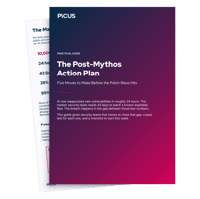 The Post-Mythos Action Plan
Five concrete moves to close the gap between attacker speed and remediation speed, with a pass/fail test for each one.
How Picus Helps
The Picus Platform is built around the same logic Gartner describes: exposure management as an operational discipline measured by time, not volume. It is how security teams turn Mythos readiness from a board talking point into a measurable program.
Breach and Attack Simulation
Continuously test what EDR, SIEM, firewall, and WAF tools actually block and detect against attacker techniques. Validate whether your controls catch it and get vendor-specific fixes when they do not. This is what time-based metrics require: a continuously updated picture of control performance.
Autonomous Penetration Testing
Chain real attacks across your environment to prove which exposures are genuinely exploitable. After remediation, re-run the exact path to confirm the gap is closed.
Exposure Validation
Prove exploitability without firing an exploit, covering restricted assets and CVEs with no public or safe exploit. Get a defensible verdict on day one of disclosure. The Picus Exposure Score factors in control effectiveness, asset criticality, and exploit signals to resolve each exposure into a clear decision: Patch, Mitigate, Monitor, or Accept with Evidence.
Why Security Teams Choose Picus
Validate exploitability across attack surfaces, exposures, and security controls together.
Prove exploitability on restricted assets and CVEs with no safe exploit, from day one of disclosure.
Resolve every exposure into a clear decision: patch, mitigate, monitor, or accept with evidence.
Close gaps with ready-to-deploy, vendor-specific fixes.
Re-run the exact path you remediated to confirm the gap is closed.
Run fully supervised or fully autonomous, with complete audit trails throughout.
See Picus In Your Environment
Exposure persists until it is validated and closed. See how Picus compresses that window from days to minutes.
Gartner, Pivotal Moment: Capitalize on Mythos Hype to Fix Your Exposure and Vulnerability Management, Dhivya Poole, Jonathan Nunez, et al., 13 May 2026.
GARTNER is a registered trademark and service mark of Gartner, Inc. and/or its affiliates in the U.S. and internationally and is used herein with permission. All rights reserved.
Gartner does not endorse any vendor, product or service depicted in its research publications, and does not advise technology users to select only those vendors with the highest ratings or other designation. Gartner research publications consist of the opinions of Gartner's research organization and should not be construed as statements of fact. Gartner disclaims all warranties, expressed or implied, with respect to this research, including any warranties of merchantability or fitness for a particular purpose.
Share this: