How to Implement a Continuous Offensive Security Testing Program: Key Insights from Gartner®
Annual penetration tests made sense when environments changed slowly. Most organizations now push code daily, deploy infrastructure on demand, and onboard new SaaS tools every quarter. The test that ran last quarter reflects an environment that no longer exists.
Gartner's report makes the case that this model can no longer keep pace. Modern environments change too fast, and the window between a meaningful change and a validated response needs to close from weeks to hours.
The Four-Step Journey Gartner Recommends
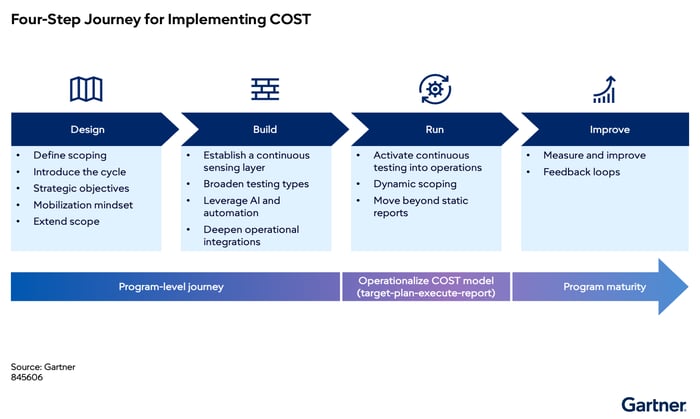
Design: Replace calendar-based scoping with risk-tiered triggers. Define what constitutes a high, medium, or low-risk event and what testing response each one requires. Set the SLAs: high-risk triggers should complete validation within 72 hours. Medium-risk within seven days.
Build: Establish the sensing layer that feeds the program. This means integrating exposure signals, threat intelligence, asset data, and control posture into a unified view so that triggers fire based on real signals, not noise. Connect testing into CI/CD, ITSM, and SecOps workflows.
Run: Execute COST cycles adaptively. Scope shifts in real time as findings emerge. An unexpected attack path discovered mid-cycle redirects the test. A newly reachable asset gets added. Findings flow directly into treatment workflows rather than sitting in a PDF queue.
Improve: Track metrics that reflect actual program performance: trigger-to-execution time, percentage of high-risk triggers validated within SLA, exposure window reduction, and detection coverage lift. Use these to refine triggers, improve automation, and close gaps.
The Technology Landscape for Continuous Offensive Security Testing
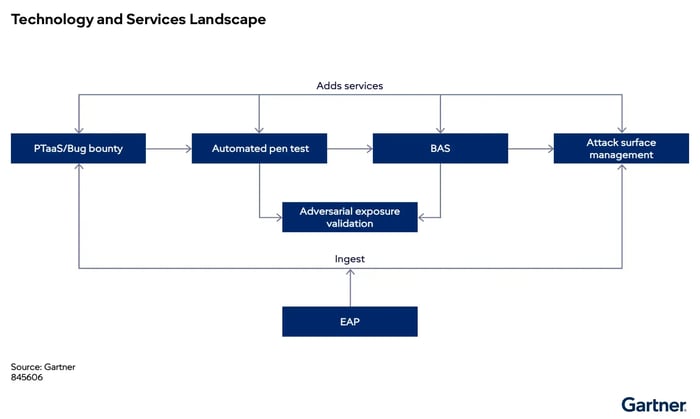
Gartner maps how the different offensive testing modalities fit together. AEV sits at the center, ingesting from exposure assessment platforms and connecting to pen testing, BAS, and attack surface management. The diagram shows AEV as the connective layer, not just another point tool.
Each testing method has its trigger type. Penetration testing fires on new feature branches, zero-day alerts, and internet-exposed assets. Control validation fires when SIEM or EDR rules change. Red teaming fires on major architecture shifts or spikes in specific attack vectors. AEV supports all of these in a coordinated way, with automation handling the repeatable work and humans reserved for complex exploit chains and creative adversarial thinking.
How Picus Enables Continuous Offensive Security Testing
Picus Security is recognized as a sample vendor for AEV (BAS+PT) in the report.
Picus Autonomous Exposure Validation Platform is built to turn exposure awareness into defensible action. Assessment finds the exposure. Picus proves what is actually exploitable, prioritizes based on real evidence, and keeps the picture current as the environment changes.
Breach and Attack Simulation
Continuously tests what EDR, SIEM, firewall, and WAF tools actually block and detect against the newest attacker techniques. Ships vendor-specific fixes and re-validates that the gap has closed. This is the control validation trigger the COST model calls for whenever a SIEM rule changes, a new control is introduced, or a critical configuration update ships.
Autonomous Penetration Testing
Executes real exploit chains against reachable assets to show what an attacker can actually reach and do, run safely in production. Fires on the triggers COST identifies as high-risk: new publicly exploitable exposures, zero-day alerts, and new internet-exposed assets.
Exposure Validation
Proves exploitability without firing an exploit, covering the restricted assets no live test can touch and the CVEs with no public or safe exploit. Delivers a defensible verdict on day one of disclosure. The Picus Exposure Score factors in control effectiveness, asset criticality, and exploit signals to answer what CVSS cannot: is this actually exploitable here, right now?
Picus Swarm
The agentic layer that makes the program run autonomously. Numi AI, the orchestrator, senses what changes across feeds and infrastructure, decides which workflow it matters for, and runs the right validation without waiting for a human to schedule it. Discovery, exploitation, validation, mobilization, and reporting each run as a specialist agent with a defined role and a clear handoff. Teams choose the autonomy level per workflow, from supervised to fully autonomous, with full audit trails throughout.
The result is a COST cycle that can be completed in a matter of hours. Findings flow directly into ticketing and control APIs. Re-validation confirms the exposure is resolved before the cycle closes.
See It In Your Environment
Your last pentest reflects how your environment looked on that one day. See how Picus runs continuous offensive security testing triggered by the changes that actually matter.
What Gartner Recommends for Security Leaders
A few points from the report worth keeping front of mind during program planning:
Automation and AI are necessary but not sufficient. Tools miss nuance, context, and creativity. Human involvement remains essential for realistic adversarial depth.
Avoid trigger noise. Too many low-value triggers overwhelm teams and dilute focus. Triggers should be tiered and tuned against business impact, not just technical signals.
Move beyond static reports. Hundred-page PDFs stall remediation. Findings need to feed directly into treatment workflows with clear ownership and SLAs attached.
Prevent tool sprawl. Uncoordinated tooling creates noise and slows execution. Testing methods need to be orchestrated into a coherent ecosystem, not accumulated independently.
Gartner, How to Implement a Continuous Offensive Security Testing Program, Dhivya Poole, 6 March 2026.
Gartner® does not endorse any vendor, product or service depicted in its research publications, and does not advise technology users to select only those vendors with the highest ratings or other designation. Gartner research publications consist of the opinions of Gartner’s Business & Technology Insights research organization and should not be construed as statements of fact. Gartner disclaims all warranties, expressed or implied, with respect to this research, including any warranties of merchantability or fitness for a particular purpose.
Share this: