How Did Healthcare Perform in Cybersecurity in 2026?
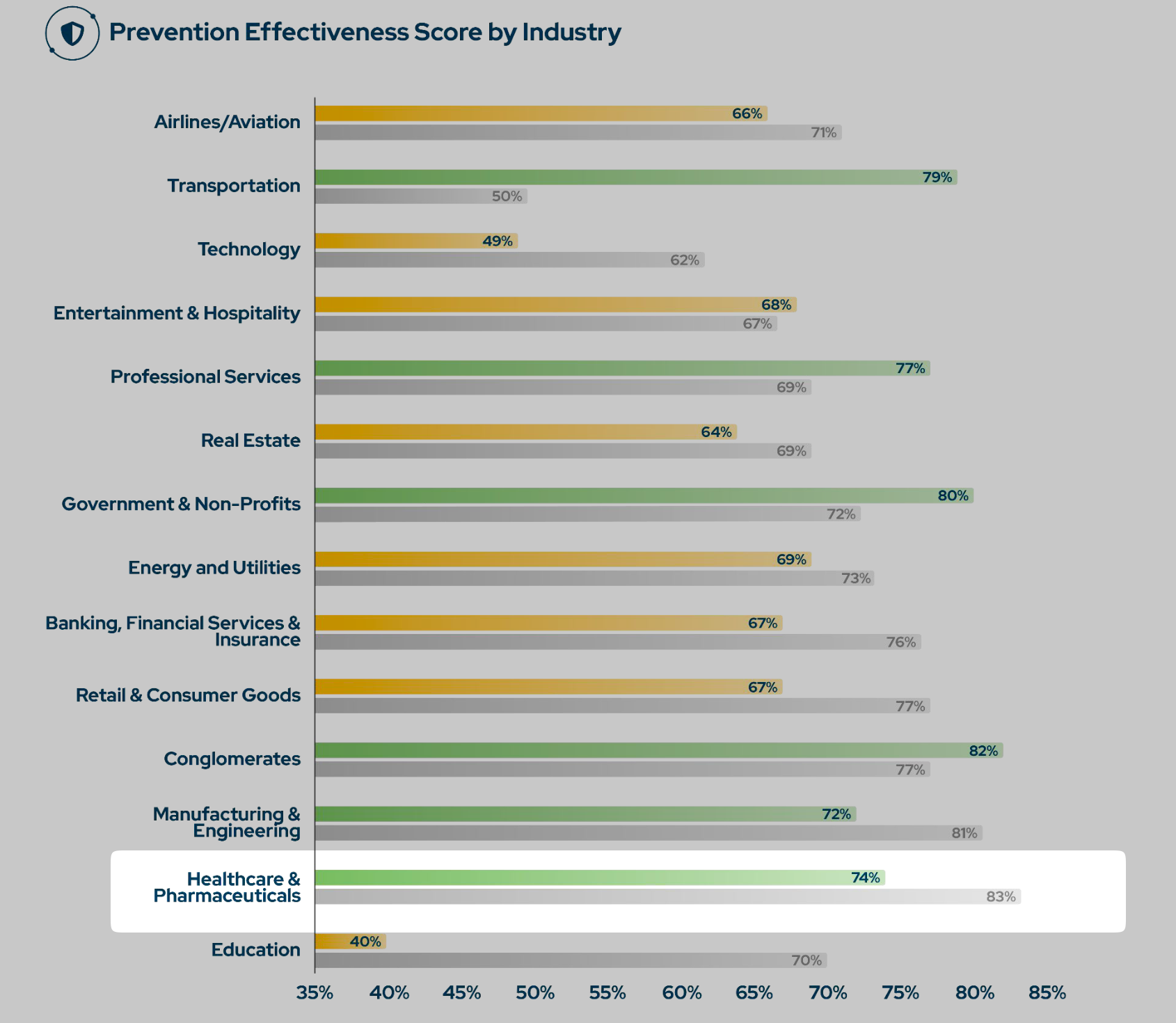
Healthcare and Pharmaceuticals scored 74% for prevention effectiveness in the Picus Blue Report 2026, nine points below the 83% that made it the top-performing industry a year ago. Prevention effectiveness measures the percentage of simulated attack actions that security controls block, counted across the individual actions that make up each simulated threat. The figures come from more than 338 million attack simulations that Picus customers ran against their own controls in live production environments between January and June 2026, anonymized and aggregated by Picus Labs.
The fall reads worse than it is. At 74%, healthcare still blocks more than the 69% all-industry average, and it lost those nine points the same way it earned them: controls are not set-and-forget. They drift as policies change, integrations break and configurations age. Last year's 83% was never a structural property of the sector. It was the result of validation and tuning, and it lasted exactly as long as that work did.
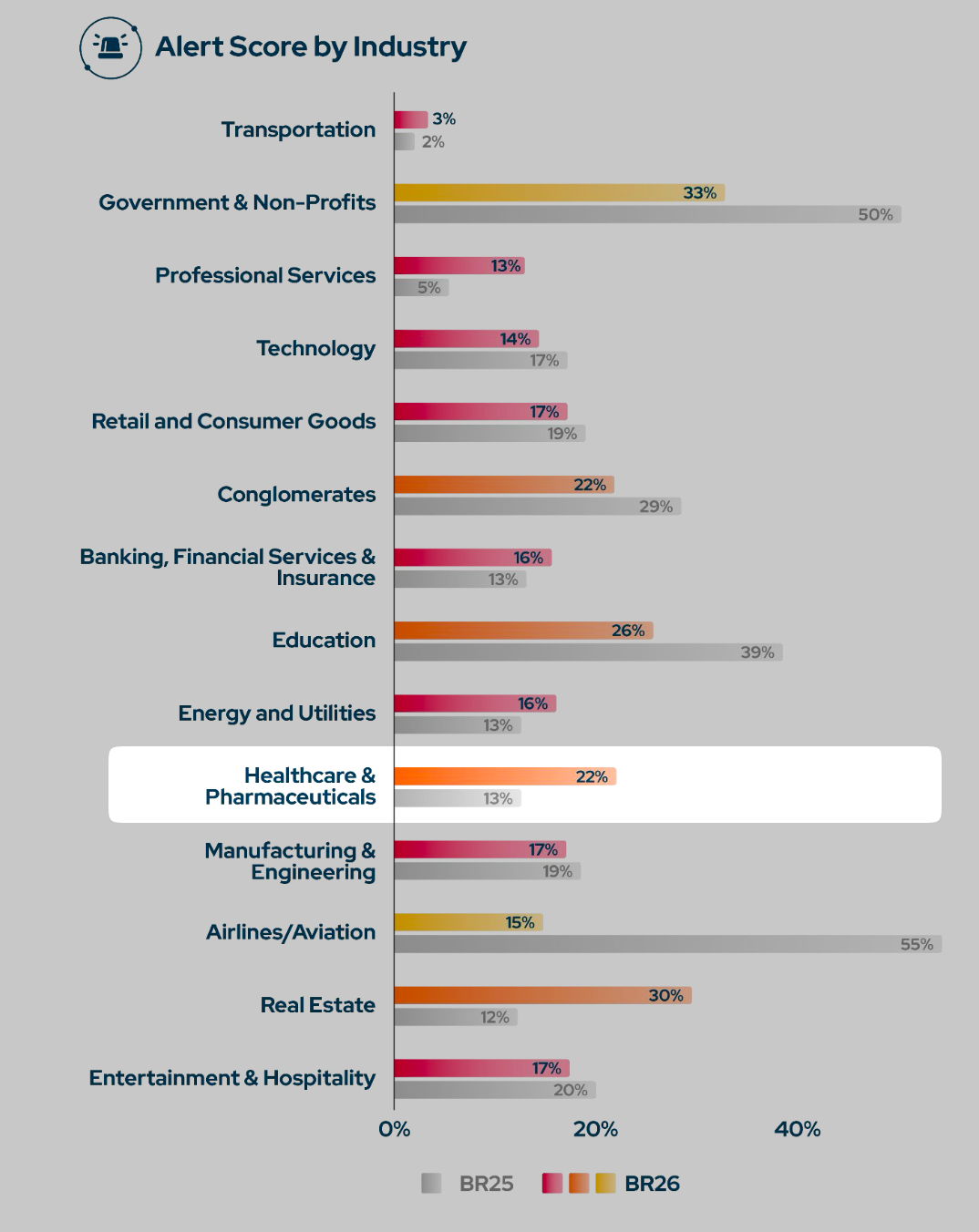
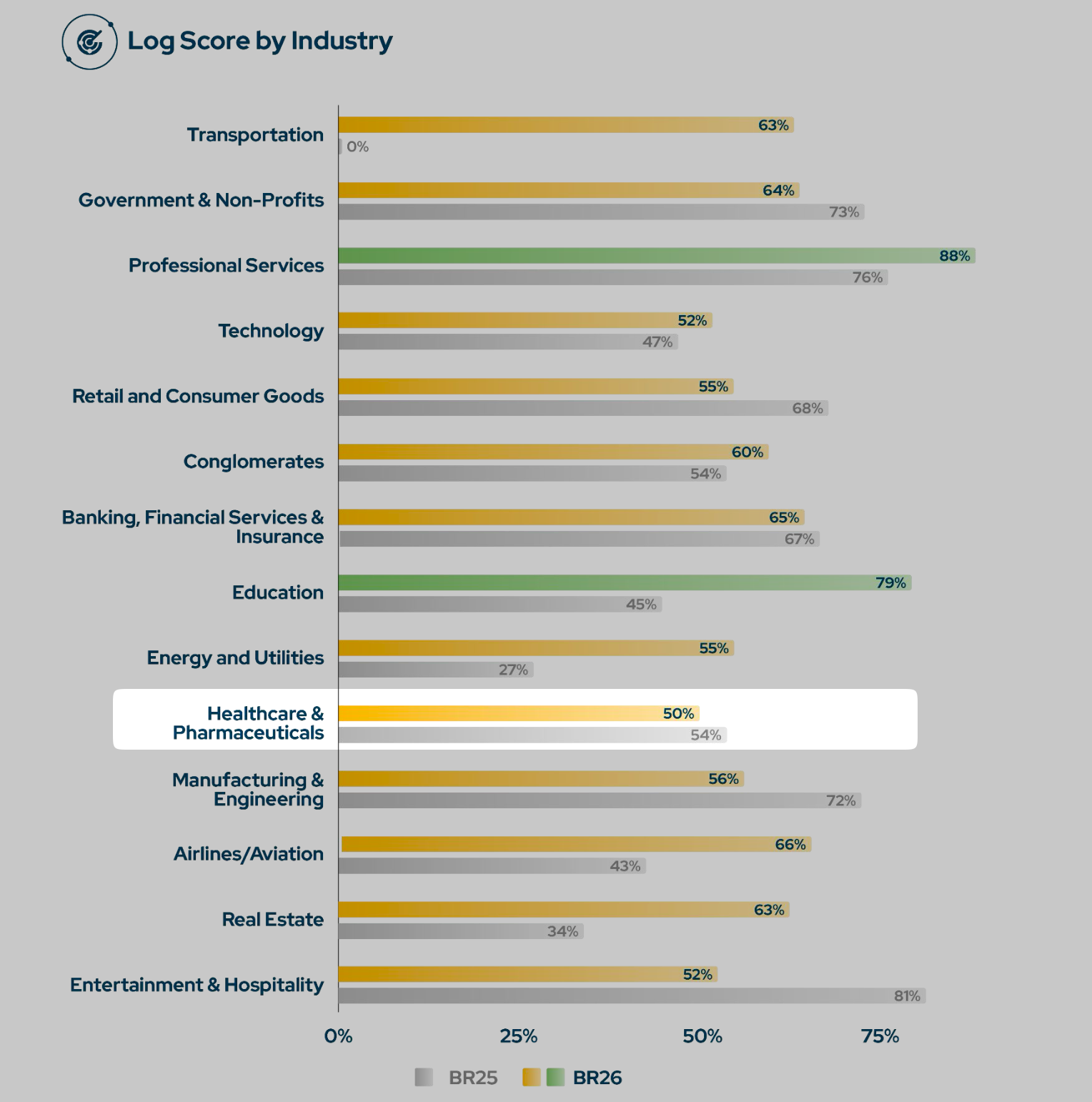
Detection is the harder story. Healthcare's log score fell from 54% to 50%, the lowest of any industry, and the direction matters more than the level, because logging was the one thing that improved almost everywhere this year. Healthcare went backwards while the field went forward. Its alert score, meanwhile, rose from 13% to 22%. The log score counts attacks recorded anywhere in telemetry; the alert score counts attacks that reached a security team as an alert.
So healthcare is seeing less and escalating more of what it still sees. That combination, not the nine-point prevention fall, defines the sector's year. And the alert gain is smaller than it sounds: at 22%, roughly four in five simulated attacks against healthcare environments still never surface as an alert. Better triage on a shrinking pool of telemetry is not the same as better detection.
Why Did Healthcare Prevention Effectiveness Drop?
Healthcare's controls were not re-tested at the pace its environment changed. The report traces swings of this size to drift: new adversary techniques, infrastructure changes, and configuration decay eroding controls that were strong only months earlier, with nothing in place to catch the erosion. The proof that the mechanism is controllable runs in the other direction. Transportation, last year's weakest sector at 50%, rose 29 points to 79%, the largest gain in the dataset, by operationalizing validation findings and systematically closing the gaps they exposed. What neglect lets slip, validation restores. Healthcare sat on the other side of that trade this year.
Two global findings show where the slippage exposes healthcare most. Both are global figures, and each lands differently in a hospital than in the average enterprise.
The interior is soft
Global prevention effectiveness recovered to 69%. That score comes from Breach and Attack Simulation, which runs known threats against an organization's controls and counts the blocks. Autonomous Penetration Testing asks a different question: what an attacker accomplishes while already inside, holding authenticated access. Under that test, only 37% of attacker actions were blocked. Reconnaissance was the weakest category of all, stopped roughly one time in ten, while credential reads from memory fared better at around 22%.
In a health system, the interior is where the electronic health record platform, the imaging archive, and the shared clinical workstations live. An attacker holding one set of stolen clinician credentials can enumerate the domain, locate the patient database, and harvest active sessions from shared workstations, all without tripping the controls that earned the 74%.
Recognition-based defense keeps sliding.
Malware download prevention now stands at 50%, down from 71% two years ago. The test delivers a known sample as a download or attachment, so the score isolates one question: does the control recognize the file? Payloads rebuilt or delivered through legitimate-looking infrastructure defeat recognition. A control that matches files instead of evaluating behavior loses ground every year this trend continues, and this year it lost 21 points of it.
Why Is Healthcare's Detection Gap Different?
Healthcare's detection problem sits in a different layer than everyone else's. Globally, organizations log 58% of attacks and alert on 14%, converting roughly one recorded attack in four into an alert. Healthcare converts more than two in five, the stronger ratio by a wide margin. Its rules work. What healthcare lacks is the raw material: with the lowest log score in the dataset, half of everything attackers do in a healthcare environment never reaches telemetry at all.
The report's failure data explains why that distinction matters. Detection rule failures now split into performance issues at 49% of the total, log collection issues at 41.5%, and configuration issues at 9.5%. Performance problems are visible: a slow or noisy rule announces itself. Log collection fails silently, and no rule, however well tuned, fires on a behavior that was never captured. Healthcare's improving alert score shows a sector doing detection engineering on the half of the picture it can see. The other half is not merely undetected; it is unrecorded, invisible to the SIEM, to the retrospective hunt, and to the incident responder reconstructing what happened.
The regulatory clock makes the blind spot concrete.
The HIPAA Breach Notification Rule requires covered entities to notify affected individuals within 60 days of discovering a breach, and breaches affecting 500 or more people trigger notification to HHS and the media on the same clock. Discovery starts the clock, and discovery depends on detection. An intrusion that never generates a log entry does not pause the obligation; it postpones the discovery date while the exposure compounds. For a sector holding the least telemetry in the dataset, the gap between when an attack happens and when its 60 days begin is structurally the widest.
The fix starts a layer below detection rules. Detection rule validation tests whether rules fire against real attacker behavior, and validating log source health alongside them confirms the telemetry those rules depend on actually arrives.
Which Cyber Threats Should Healthcare Validate Against?
The findings most relevant to healthcare defenders are global figures from the report's technique, vector, and post-compromise analysis. Translated into a healthcare environment, they line up into a single attack sequence, and the loud step comes last.
- Valid Accounts (T1078) was prevented in 15% of simulations. Controls still struggle to separate an attacker using stolen credentials from a legitimate user, and shared clinical workstations with persistent sessions widen exactly that seam.
- Discovery actions such as domain mapping and share and session enumeration were blocked roughly one time in ten in post-compromise testing. In a hospital network, that map is the reconnaissance an attacker needs before touching anything of value, and it comes essentially free.
- Credential reads from memory did better at around 22%, though four in five still went through. Set that against healthcare's 50% log score and the shape of the problem is clear. The actions least likely to be blocked are also the ones least likely to leave a trace, and healthcare has less telemetry than any other industry to catch them with.
- Data exfiltration was the least prevented attack vector for the fourth consecutive year, blocked in 7% of simulations. More than nine in ten simulated data theft attempts succeed. Patient records leave the network before anything fires, and with double extortion, the stolen data sets the ransom.
- The disruption comes last, when being loud costs nothing. Service Stop (T1489) was prevented in 19% of simulations and Account Access Removal (T1531) in 2%. In a hospital, those two techniques translate to halted clinical services and staff locked out of the systems that run them.
Ransomware sits on top of that sequence, and it is regressing. Every one of the ten least prevented ransomware families scored 38% or lower, and the average across the bottom ten fell from roughly 44% to 32%, with not a single family improving. Play collapsed from 50% to 13% prevention, the least prevented variant by a wide margin. Hive was prevented in 38% of simulations, down from 53%, despite the public takedown of its original operation and years of published intelligence on its tradecraft. The report's verdict applies to the whole list: documentation is not defense.
One controlled comparison exposes the mechanism behind all of it. The same credential-theft tool was run three ways against the same defenses, with the same objective each time. Dumping credentials from LSASS memory, the loud and heavily signatured path, was blocked in the large majority of attempts. Reading the same credentials straight from the registry was blocked in under 1% of them. Same tool, same goal, same environment; only the recognizability of the method changed. Controls tuned to the famous indicator miss the quiet variant, and the quiet variant is also the one least likely to be recorded. That is where healthcare's 50% log score turns a prevention gap into an invisible one: a sector cannot defend what it cannot see.
How Can Healthcare Improve Cybersecurity in 2026?
Each recommendation answers a gap the data above establishes, in the same order.
Re-Validate the Controls That Earned Last Year's Score
A nine-point fall from first place is drift, not disinvestment. Exposure Validation proves which exposures an attacker can actually exploit today, and continuous validation with Breach and Attack Simulation catches control decay before it accumulates into a headline number.
Fix Visibility Before Tuning Rules
Healthcare's alert conversion already beats the global rate; its telemetry capture is last. Validate log source health across clinical and IT environments, confirm attacker behaviors actually land in the SIEM, and only then invest in new detection content. A rule written for a log that never arrives is engineering spent on the wrong layer.
Test the Interior, Not Just the Perimeter
With 37% post-compromise prevention globally and discovery blocked one time in ten, assume-breach testing is where healthcare's real exposure surfaces. Autonomous Penetration Testing executes live attack paths inside production environments and shows what an attacker reaches from one compromised clinician account, before a real one demonstrates it.
Simulate Current Ransomware Kill Chains End to End
With the bottom-ten average at 32% and Play at 13%, coverage validated against last year's variants is demonstrably failing. Breach and Attack Simulation runs complete, current kill chains, from credential-based access through exfiltration, encryption, and service disruption, and confirms controls interrupt them at more than one point.
Healthcare ends the first half of 2026 with the report's clearest warning written in its own numbers. The sector held the top prevention score in the dataset and gave back nine points in a year, while recording less of what attackers do than any other industry. Transportation gained 29 points in the same twelve months by putting its controls under continuous test. The health systems that recover fastest will be the ones that make their defenses prove themselves, against the threats actually targeting them, on telemetry that actually exists.
Download the Blue Report 2026 for the full industry analysis, or see how security validation works for healthcare.