Key Insights from Gartner® Market Guide for Adversarial Exposure Validation 2026
Navigating the modern threat landscape and volume of data can feel like an uphill battle.
Security teams need to know whether an attacker can turn an exposure into impact, whether existing controls change the outcome, and what should be fixed first.
The 2026 Gartner® Market Guide for Adversarial Exposure Validation reflects this shift. Picus Security is named among the sample vendors exemplifying this trend.
What is Adversarial Exposure Validation?
Gartner defines Adversarial Exposure Validation (AEV) as technologies that deliver consistent, continuous, and automated evidence of the feasibility of an attack. Rather than predicting what might happen, AEV tools execute safe attack scenarios to prove whether a threat actor can successfully circumvent your existing preventive and detective security controls.
AEV officially consolidates and replaces previous segments from the 2023 Gartner Hype Cycle, specifically Breach and Attack Simulation (BAS) and automated penetration testing and red teaming technology.
The consolidation highlights a fundamental transition in the market.
Organizations no longer just want to simulate individual techniques or find a list of unpatched software. They need unified platforms that deliver clear evidence of operational risk.
A mature AEV platform helps teams:
Execute controlled attack scenarios against your environment
Validate whether exposures are exploitable in the context of existing controls
Measure whether security tools prevent, detect, log, or miss the behavior
Show which attack paths can lead to high-value assets
Prioritize findings based on validated impact
Recommend remediation, mitigation, or control tuning
Retest after action to confirm that the exposure is resolved
What Changed in the 2026 Gartner Market Guide
The 2026 Market Guide shows that AEV is becoming more central to how organizations manage exposure and readiness.
Several points stand out.
→ Gartner predicts that by 2029, 60% of organizations will have adopted a structured exposure validation practice as part of Continuous Threat Exposure Management.
→ Gartner also predicts that by 2029, 30% of organizations will link AEV results to automated remediation or orchestration workflows.
→ The market is moving from periodic validation toward frequent, automated, and measurable testing.
→ AI is becoming part of the AEV control plane, especially for scenario selection, prioritization, and interpretation of results.
→ Integrations with ticketing, workflow, EASM, vulnerability management, SIEM, EDR, XDR, and security controls are becoming more important.
Three Core Use Cases Driving Security Value
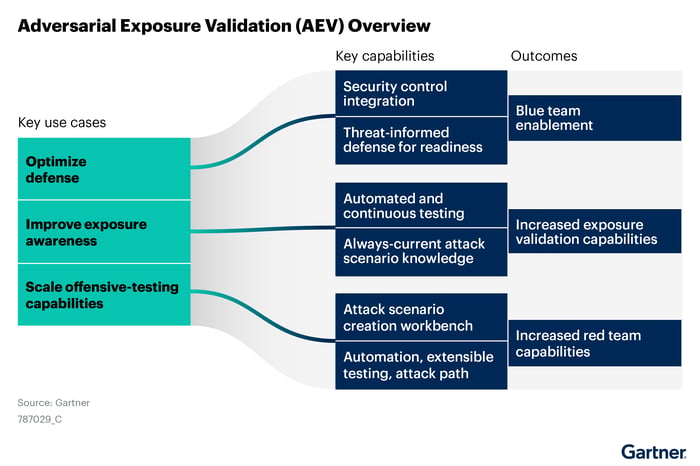
AEV technologies support three primary use cases, each delivering unique security outcomes:
1. Optimize Defense
This use case focuses heavily on empowering the blue team. By integrating directly with security controls, AEV tools provide continuous feedback on the performance of your defensive infrastructure. Teams use empirical results to manage detection stack tuning and establish vendor performance scorecards.
Starting with defense optimization is an excellent strategy if you are unsure where to begin, as it helps maximize the ROI of your current security investments without requiring complex offensive skill sets to run.
2. Improve Exposure Awareness
Traditional vulnerability management often leaves security operations teams overwhelmed by data. AEV plays a critical role by serving as a real-world filtering component. By testing actual attack paths against vulnerable assets, the platform filters out theoretical noise and elevates high-priority issues that represent actual impact.
3. Scale Offensive-Testing Capabilities
Building and maintaining a dedicated, highly skilled in-house red team is complex and expensive. AEV technologies bridge this gap by offering advanced workbenches that codify and automate manual testing tasks. This allows organizations to build custom, multi-staged attack chains, amplifying the scale and reach of their existing testing teams.
See How Leading Teams Operationalize AEV

This guide breaks down the exact steps to move from broad exposure assessment to validated prioritization. Learn why AEV is mission-critical, how it integrates into the CTEM cycle, and how leading organizations shrink massive vulnerability lists into a high-impact set of validated risks.
How Picus Platform Addresses AEV
Picus Security is proud to be recognized as a Representative Vendor in the 2026 Gartner Market Guide for Adversarial Exposure Validation.
Picus Platform brings core AEV capabilities together across exposure validation, security control validation, attack path validation, and detection rule validation.
Security Control Validation
Continuous simulation of adversarial techniques across network, endpoint, email, web application, and identity layers, mapped to MITRE ATT&CK.
Exposure Validation
Vulnerability data is correlated with control effectiveness and asset context to surface what is genuinely exploitable in your environment, narrowing large backlogs into a validated, prioritized set.
Attack Path Validation
Shows how isolated weaknesses chain together toward high-value assets, giving security leaders a full-compromise view rather than disconnected findings.
Detection Rule Validation
Tests SIEM detection rule performance and hygiene, identifying coverage gaps before an actual incident reveals them.
Vendor-Specific Mitigation Guidance
Remediation recommendations are tailored to the security stack already in place, shortening the path from finding to fix.
Agentic Workflow
Picus Swarm turns new CVEs, threat intelligence and infrastructure changes into agent-led validation activity. Picus AI agents help choose the next step, adapt when conditions change and document the path. Teams can ask posture questions, generate attack simulations and move from result to fix faster.
See It in Your Environment
Move beyond theoretical risks and start driving your security strategy with empirical, nonrefutable data.
See what adversarial exposure validation looks like when it runs in your actual environment.
Gartner®, Market Guide for Adversarial Exposure Validation, Dhivya Poole, Mitchell Schneider, 24 March 2026.
GARTNER® is a trademark of Gartner, Inc. and/or its affiliates in the U.S. and internationally and is used herein with permission. All rights reserved.
Gartner® does not endorse any vendor, product or service depicted in its research publications, and does not advise technology users to select only those vendors with the highest ratings or other designation. Gartner research publications consist of the opinions of Gartner’s Business & Technology Insights research organization and should not be construed as statements of fact. Gartner disclaims all warranties, expressed or implied, with respect to this research, including any warranties of merchantability or fitness for a particular purpose.
Share this:



.png?width=353&height=200&name=Picus-gartner-july22-post1%20(3).png)