Key Insights from Gartner® Emerging Tech: Unified Exposure Management Will Drive Displacement of Fragmented Point Solutions
Most organizations aren't running a unified security program. They're running five or six disconnected ones, each with its own data, its own queue, and no shared context.
Gartner report calls this out directly: fragmented point solutions can no longer keep pace with modern attack surfaces. The fix is Unified Exposure Management (UEM), a single, integrated approach that connects discovery, prioritization, validation, and remediation into one continuous workflow.
Picus Security is named among the sample vendors exemplifying this trend.
Why Point Solutions Are Failing
Most security teams suffer from too much data, scattered across tools that don't talk to each other.
Vulnerability scanners flag thousands of findings. External attack surface tools produce their own list. Identity, cloud, and endpoint data each live in separate systems.
The consequences are predictable:
Blind spots across the attack surface — only 17% of organizations can identify and inventory most of their assets, according to Gartner.
Missed exposure types — traditional Vulnerability Assessment focuses on technical vulnerabilities and routinely misses misconfigurations, weak access controls, and business process flaws.
Reports that don't drive action — lengthy outputs with generic recommendations leave teams overwhelmed.
Delayed response — manual handoffs between siloed tools slow down the time between discovery and remediation.
Security teams are overwhelmed with data but starved of the context needed to prioritize and act.
What Unified Exposure Management Changes
UEM isn't a new tool category; it's how the CTEM framework actually gets operationalized. Running CTEM across siloed tools breaks continuity between phases and creates gaps that attackers exploit.
Unified Exposure Management resolves this by integrating data and workflows across the entire life cycle. It requires four things working together:
Unified data — asset inventory, vulnerability data, threat intelligence, and control telemetry in one normalized context model.
Connected workflows — discovery feeding assessment, assessment feeding validation, validation driving mobilization.
Exploitability validation — confirming what's actually exploitable in your environment, not just what scores high on CVSS.
Prescriptive mobilization — vendor-specific guidance that tells teams exactly what to fix and how.
Where AI changes the equation: Adversaries already use AI to identify and exploit exposures faster than security teams can respond manually. UEM platforms that embed AI can identify, assess, prioritize, and validate exposures at machine speed, turning a process that used to take weeks into one that runs continuously.
Gartner's strategic planning assumption: by 2028, UEM platforms will capture 60% of the exposure management market, up from less than 5% today.
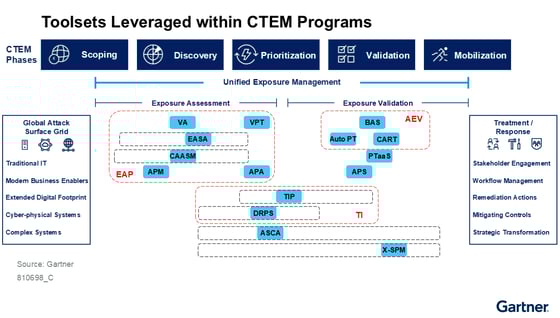
This graphic was published by Gartner® , Inc. as part of a larger research document and should be evaluated in the context of the entire document. The Gartner document is available upon request from Picus Security.
How Picus Delivers on Unified Exposure Management
Picus Platform combines breach and attack simulation, automated penetration testing, and exposure validation together so every phase of CTEM connects and every remediation decision is backed by evidence.
Exposure Validation: correlate vulnerability data, asset context, and control effectiveness to surface what's genuinely exploitable
Security Control Validation: simulate real adversarial techniques mapped to MITRE ATT&CK to confirm whether defenses block or detect what matters
Attack Path Validation: see exactly how attackers would chain vulnerabilities to reach your most critical assets
Vendor-Specific Remediation: get actionable, technology-specific guidance so your team knows exactly how to close each gap
Re-validation: know fixes actually worked, closing the loop between remediation and evidence
And as adversaries move faster, so does Picus. Picus Swarm AI agents work autonomously across your environment, finding, validating, and acting on exposures at machine speed, within guardrails your team defines. The workload shrinks. The coverage doesn't.
See It in Your Environment
If your tools don't connect, your exposures don't get managed. See what unified exposure management looks like when it runs in your actual environment.
Gartner, Emerging Tech: AI Vendor Race: Unified Exposure Management Will Drive Displacement of Fragmented Point Solutions, Luis Castillo, David Senf, 29 September 2025.
GARTNER is a registered trademark and service mark of Gartner, Inc. and/or its affiliates in the U.S. and internationally and is used herein with permission. All rights reserved.
Gartner does not endorse any vendor, product or service depicted in its research publications, and does not advise technology users to select only those vendors with the highest ratings or other designation. Gartner research publications consist of the opinions of Gartner's research organization and should not be construed as statements of fact. Gartner disclaims all warranties, expressed or implied, with respect to this research, including any warranties of merchantability or fitness for a particular purpose.
Share this:




.png?width=353&height=200&name=Picus-gartner-july22-post1%20(3).png)