Security teams evaluating or already using Horizon3 are increasingly looking for platforms that deliver broader security control validation, dedicated detection engineering, faster emerging threat updates, vendor-specific remediation content, and unified coverage across the entire attack kill chain, rather than automated pentesting alone.
Based on publicly available customer feedback from peer review and ratings platforms and competitive analysis, the two strongest alternatives to Horizon3 today are:
- Picus Security, the pioneer of Breach and Attack Simulation and a leader in Adversarial Exposure Validation
- Pentera, automated pentesting platform centered on internal pentesting and external attack surface management.
This blog provides a concise breakdown of each option and why modern teams are choosing them over Horizon3 in 2026.
The Top Alternatives to Horizon3 in 2026
1. Picus Security
Picus Security stands out as the leading alternative to Horizon3 for Breach and Attack Simulation (BAS), Adversarial Exposure Validation (AEV), Automated Penetration Testing, and Continuous Threat Exposure Management (CTEM).
Picus offers a unified security validation platform that simulates real-world attacks to prove how well defenses actually detect and block threats, prioritizes only truly exploitable business-critical risk, and delivers precise, actionable remediation. The platform answers a question Horizon3 leaves partially open. Not just where an attacker can go, but an organization's security controls are actually capable of stopping a real breach.
Picus Platform stands out in these ways.
- Comprehensive BAS plus Exposure Validation across email, web, endpoint, network, data, and cloud, ensuring full attack coverage with 30,000+ adversary actions fully mapped to MITRE ATT&CK.
- Vendor-specific prevention and detection content with 80,000+ ready-to-implement signatures for security controls such as NGFW, IPS, and WAF, and 4,400+ validated detection rules for major SIEM and EDR platforms. Picus also provides log source recommendations to enhance visibility and improve SIEM efficiency.
- Picus Labs threat research division delivers a guaranteed 24-hour SLA for emerging threats, with a measured mean time to release of 5.3 hours, the fastest in the market.
- Attack Path Validation (APV), Picus' automated pentesting solution, identifies and prioritizes the shortest, most exploitable attack paths using techniques such as credential harvesting, Kerberoasting, lateral movement, privilege escalation, and data exfiltration, executed in an evasive manner designed to avoid premature detection.
- Numi AI, an AI-powered virtual security analyst that translates complex findings into natural language recommendations, prioritized actions, automated playbooks, and tickets that teams can execute immediately.
- Flexible deployment, including on-premises, cloud, hybrid, and air-gapped environments managed from a single centralized console, an option that pure SaaS platforms like NodeZero cannot offer.
Picus Security vs Horizon3, Key Differences
|
Category |
Picus Security |
Horizon3 (NodeZero) |
|
Primary Use Case |
Best in class BAS + Attack Path Validation (Automated Penetration Testing) + ASM + Exposure Validation + Automated Mitigation + Detection Analytics & Engineering |
Automated penetration testing with attack chaining |
|
Threat Library Transparency |
Transparent, continuously updated library with full MITRE ATT&CK mapping |
Limited transparency into atomic actions |
|
Detection Engineering |
Automated SIEM rule validation, log source health checks, vendor-specific detection content, and detection rule hygiene analysis |
Limited to EDR effectiveness module. No native SIEM detection rule validation. Teams correlate telemetry manually by matching timestamps and commands to logs |
|
Emerging Threat SLA |
24-hour SLA with a measured 5.3 hour mean time to release |
Rapid Response alerting for critical CVEs. No publicly defined SLA for new threat content releases |
|
Remediation Guidance |
80,000+ vendor-specific prevention signatures and 4,400+ validated detection rules ready for immediate deployment |
Generic remediation guidance, but no vendor-specific prevention or detection signatures |
|
Email and Email Gateway Validation |
Full simulation of email infiltration, phishing payload delivery, and gateway bypass |
Phishing impact testing, but no native simulation of email infiltration to validate firewalls and email gateways |
|
Integration Breadth |
50+ native integrations across IPS, NGFW, WAF, EDR, EPP, XDR, SIEM, SOAR, email and web gateways, and ticketing tools |
Primarily ticketing platform APIs, webhooks, and a Splunk app |
|
Deployment and Data Residency |
Cloud, on premises, hybrid, and air gapped from a single console |
SaaS first. Air gapped or fully isolated network deployment is not documented |
|
Web Application Coverage |
General availability across web, network, endpoint, and cloud |
Web application pentesting remains in Early Access rather than general availability |
|
Best For |
Full spectrum CTEM, continuous security control validation, automated pentesting, lateral movement validation, and detection engineering |
Self-service automated pentesting |
What Real Users Think About Picus
Picus consistently outperforms Horizon3 and other security validation vendors on independent review platforms.
On Gartner Peer Insights, Picus is a Customers' Choice, with the highest 98% willingness to recommend score among all vendors in the 2025 Voice of the Customer for Adversarial Exposure Validation report, compared to Horizon3's 90%. Picus also earned a 95% willingness to recommend in the equivalent 2024 BAS Tools report, the highest score of any vendor in that report as well.
On G2, Picus earns an exceptional 4.9 out of 5, reflecting its strong user satisfaction and product experience.
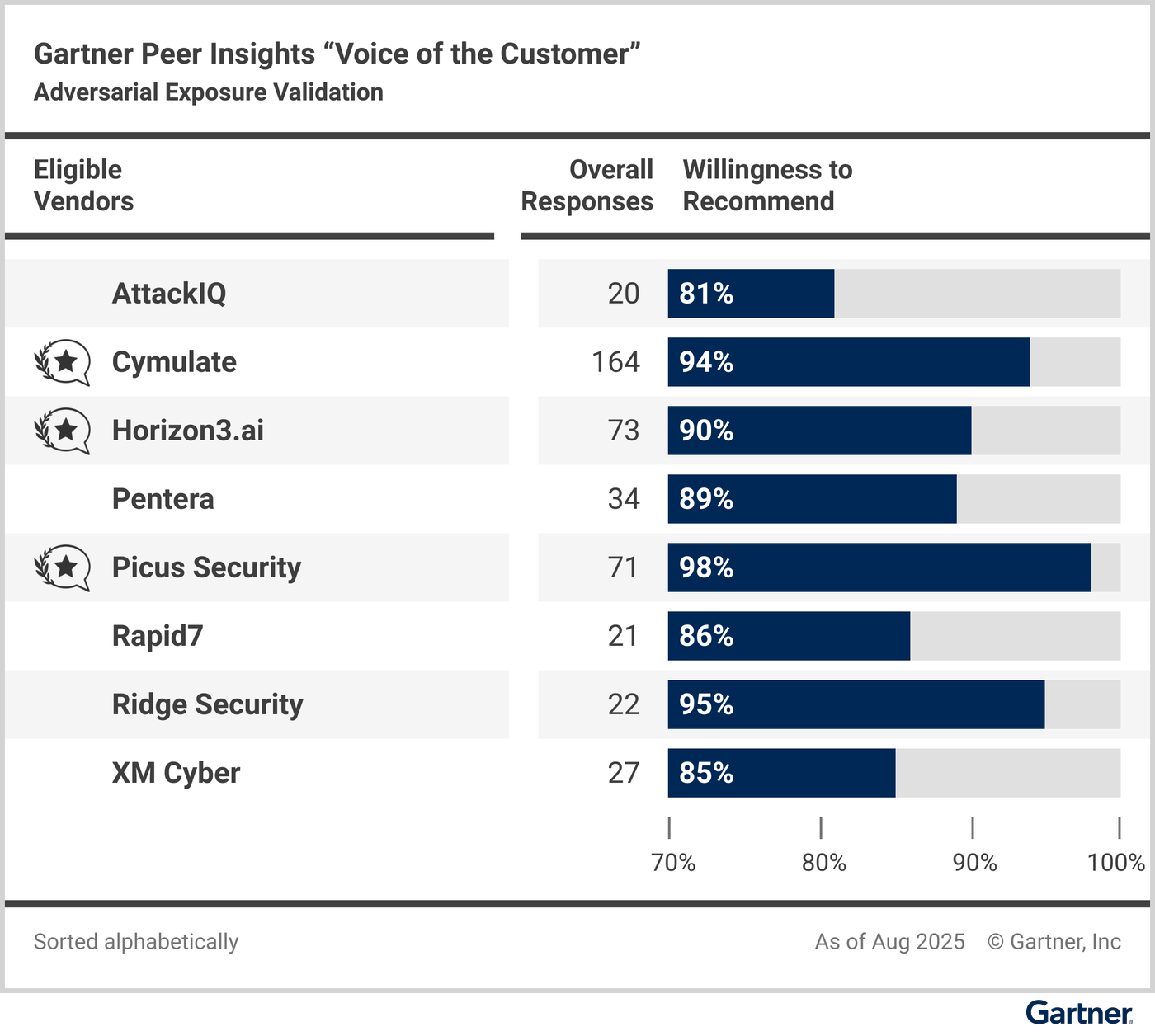
Figure: Gartner Peer Insights Voice of the Customer, As of August 2025
Users praise Picus for its ease of use, powerful detection engineering capabilities, continuous validation, and clear, actionable remediation guidance. Security teams highlight how quickly the platform delivers value and how it transforms their ability to monitor and improve defenses in real time.
- "Proactive, insight driven and reliable security validation." (IT Security and Risk Management reviewer, Energy and Utilities)
- "Continuous validation and automation enhance defense capabilities and efficiency." (Network Security Engineer, IT Services)
- "The tool has proven to be an invaluable asset, intuitive, automated, and effective at identifying weaknesses before attackers do." (IT Security and Risk Management reviewer, IT Services)
- "Stronger detections with Picus. They significantly improved our correlation and detection capabilities." (Engineer, Banking)
Together, this feedback makes one thing clear. Real users see Picus as the most reliable, highest rated, and fastest to value security validation platform available today.
2. Pentera
Pentera delivers an automated penetration testing platform built around internal network penetration testing combined with external attack surface management. Pentera targets organizations seeking automated lateral movement testing, credential abuse validation, and external exposure discovery.
Pentera and Horizon3 serve overlapping needs but with different philosophies. Horizon3 positions NodeZero as an active automated adversary built around cloud and hybrid attack chaining, while Pentera focuses on automated internal pentesting with coverage of credential abuse, lateral movement, and Windows endpoint exploitation, paired with EASM for outside-in visibility.
Pentera stands out in these ways.
- Automated internal pentesting that emulates attacker techniques such as password cracking, credential reuse abuse, Kerberoasting, and lateral movement across the internal network.
- External Attack Surface Management capabilities that complement internal testing with external asset discovery and exposure analysis.
- Realistic exploit testing with coverage of lateral movement and credential abuse across Windows environments.
- Remediation Wiki that provides directional remediation guidance for identified findings.
Pentera also has known limitations.
- No native BAS or security control validation. Pentera does not simulate email infiltration, phishing payload delivery, or gateway bypass, which limits its ability to validate firewalls, email gateways, and other prevention controls.
- No detection engineering. Pentera has no SIEM rule validation, no log source health checks, and no vendor-specific detection content. Users must manually export action logs and cross-reference against SIEM logs to understand detection posture.
- No vendor-specific signatures. The Remediation Wiki provides directional guidance only, with no ready-to-deploy prevention signatures or detection rules.
- Slower threat content cadence. Updates are deployed every 4 to 6 weeks, with no publicly defined SLA, in contrast to dedicated BAS platforms with rapid emerging threat coverage.
- Black box threat library. The library operates with limited visibility into what is being tested and why, making it harder for security teams to align tests with their threat models.
- Limited integrations. Connectors are positioned for workflow handoff rather than security control validation, which restricts closed-loop remediation workflows.
- Constrained air gapped support. Pentera is primarily delivered as cloud SaaS or on premises, with limited support for fully isolated environments.
Pentera vs Horizon3, Key Differences
|
Category |
Pentera |
Horizon3 (NodeZero) |
|
Core Technology |
Automated internal penetration testing with EASM |
Automated penetration testing with attack chaining |
|
Cloud Coverage |
Internal focus, lighter cloud and hybrid identity coverage |
Cloud and hybrid coverage across AWS, Azure, and GCP, including identity and IAM seam exploitation |
|
Production Safety |
Requires user approval for specific actions, which can slow large scale runs |
Production safe operation, but some actions can leave artifacts requiring manual cleanup |
|
Detection Engineering |
No detection analytics. Users manually sift logs to analyze detection capability |
EDR effectiveness module. No native SIEM detection rule validation |
|
Remediation Guidance |
Remediation Wiki, but no vendor-specific signatures |
Generic remediation guidance, but no vendor-specific signatures |
|
Threat Content Cadence |
Updates deployed every 4 to 6 weeks. No publicly defined SLA |
Rapid Response alerting. No publicly defined SLA |
|
Email Gateway Validation |
Does not simulate email infiltration attacks |
Phishing impact testing only, no email gateway control validation |
|
Air Gapped Support |
Limited |
Not documented |
|
Licensing |
Subscription-based, tied to endpoints and domains, with additional modules at extra cost |
Tiered packages based on asset counts and feature sets |
|
Best For |
Internal network pentesting and lateral movement validation |
Self-service automated pentesting |
What Is Better than Horizon3?
Both Picus Security and Pentera represent strong alternatives to Horizon3, each with a distinct approach to the security validation problem. Pentera offers automated internal pentesting and EASM in a single product, making it a familiar option for organizations focused primarily on internal lateral movement and credential abuse validation.
Picus Security takes a broader view of the problem, combining BAS, automated pentesting, attack path validation, detection rule validation, and exposure management into a single unified platform with the industry's fastest threat content SLA and the most actionable remediation library available. When security teams evaluate what Horizon3 does well, they are describing a platform optimized for automated pentesting and proof of exploit. Picus is built to solve the full security validation problem, not only the proof of the exploit layer.
Picus stands out as the superior solution compared to Horizon3 in several important areas.
- Picus delivers full BAS coverage with 30,000+ malicious actions across network infiltration, endpoint compromise, web application attacks, email infiltration, and data exfiltration, fully mapped to MITRE ATT&CK. Horizon3 explicitly rejects atomic simulations and does not provide BAS, leaving teams without the safe, hyper-specific control validation that modern security programs require.
- Picus provides over 80,000+ vendor-specific prevention signatures and 4,400+ validated detection rules that teams can scan, copy, and deploy immediately, reducing the gap between identified and fixed. Horizon3 delivers generic remediation guidance and One Click Verify retests, but no vendor-specific prevention or detection content.
- Picus delivers automated detection rule validation, vendor-specific detection content, and log source recommendations that directly improve SIEM efficiency. Horizon3 offers an EDR effectiveness module but has no native SIEM detection rule validation. Practitioners must correlate telemetry manually by matching timestamps and commands to logs.
- Picus delivers a guaranteed 24-hour threat content SLA with a measured 5.3 hour mean time to release for emerging threats, including those triggered by CISA alerts. Horizon3 surfaces emerging threats through a Rapid Response center, but does not publish a formally defined SLA for new threat content releases.
- Picus supports cloud, on-premises, hybrid, and air-gapped deployments from a single centralized console. Horizon3 is delivered SaaS first and is not documented as supporting air-gapped or fully isolated environments, a constraint for classified and high-security regulated organizations.
- Picus simulates email infiltration, phishing payload delivery, and gateway bypass to validate firewalls and email gateways. Horizon3 offers phishing impact testing, but no native email gateway control validation.
- Picus offers 50+ native integrations across network, endpoint, SIEM, SOAR, email, web gateway, and ticketing tools. Horizon3 integration documentation primarily covers ticketing platform APIs, webhooks, and a Splunk app, with the GraphQL API exposing only a subset of portal functionality.
- Picus provides transparent, continuously updated threat libraries with full MITRE ATT&CK mapping so security teams understand exactly what they are measuring. Horizon3 surfaces threats through Rapid Response, but does not publish a comparable transparent atomic action library or formal threat content SLA.
- Picus Numi AI and the Picus Exposure Score (PXS) combine CVSS, EPSS, asset criticality, and validated control effectiveness into evidence-based risk scoring. This goes well beyond asset count-based prioritization, giving CISOs defensible, business context-aware metrics for board reporting.
- Picus has earned the Gartner Peer Insights Customers' Choice designation for both Adversarial Exposure Validation (2025, 98% willingness to recommend) and BAS Tools (2024, 95% willingness to recommend), the highest scores in both reports. Picus also holds a 4.9 out of 5 rating on G2. In the same 2025 Voice of the Customer report, Horizon3 received a 90% willingness to recommend.
For security teams that have outgrown automated pentesting alone or are building toward a full CTEM lifecycle, Picus is the only platform that combines the depth of automated pentesting, the breadth of security control validation, and the operational completeness to close the loop from simulation to verified remediation, making it the clear choice over Horizon3.
Book a demo to find out what separates Picus from Horizon3 and other Horizon3 competitors.


.png?width=353&height=200&name=Picus-Frost%26sullivan-Awards-preview-april22%20(1).png)
.png?width=353&height=200&name=picus-cyber-fundamentals-6surfaces-validation-preview-april8%20(2).png)
.png?width=353&height=200&name=picus-cyber-fundamentals-6surfaces-validation-preview-april8%20(1).png)