What Are Breach and Attack Simulation (BAS) Tools?
Breach and Attack Simulation (BAS) tools are security validation technologies that continuously and safely emulate real adversary tactics, techniques, and procedures (TTPs) to verify whether an organization’s deployed security controls work as intended. They measure which attack techniques are blocked, detected, logged, alerted on, or missed, providing evidence across prevention, detection, and response.
Why Are BAS Tools Critical as AI Accelerates Cyberattacks in 2026?
BAS tools matter more in 2026 because organizations face two widening gaps: they cannot patch vulnerabilities as fast as they emerge, and they cannot validate security controls as fast as environments and threats change. When a patch is not yet available, existing controls become the compensating defense, and BAS provides evidence that those controls will actually block, detect, or alert on the attack.
Frontier AI-enabled attackers have intensified both problems. Four pressures explain why:
- Volume. 35,853 CVEs were published in the first half of 2026, roughly 49% more than a year earlier.
- Prioritization. Only 495 were exploited in the wild during that period, including 116 under attack on publication day. Severity alone cannot show which threats matter most to your environment or whether your controls already interrupt the attack.
- Speed. Disclosure-to-exploitation averaged 21.5 days in 2025. In 2026, frontier AI models such as Anthropic’s Mythos can discover vulnerabilities and develop working exploits autonomously, compressing that window to hours (~8 hours as of September 2026).
- Patch capacity. Anthropic reported 2,300 vulnerabilities disclosed to maintainers and only 421 known patches, with human triage and review identified as a bottleneck. AI accelerates discovery and weaponization faster than organizations can assess, patch, test, and deploy fixes.
The patch gap is only half the problem. Security changes faster than security testing.
Even daily BAS can lag behind change. The next evolution is validation triggered by change itself, not by the calendar.
How Do BAS Tools Work?
BAS tools turn real-world threat intelligence and attacker behavior into safe simulations that run against live security controls. They show whether prevention, detection, and response layers block, detect, log, alert on, or miss the attack.
A modern BAS workflow typically includes four stages:
- Build the attack scenario. Tests can cover individual attacker techniques, malware and ransomware behavior, or full threat actor campaigns based on current threat intelligence. AI-assisted BAS can turn new threat intelligence into runnable simulations in minutes.
- Run the simulation safely. Attack techniques are executed against live security controls without harmful impact. For CVEs, BAS can simulate exploitation attempts even when no working exploit exists or when the affected asset is too critical, restricted, or air-gapped for live exploitation.
- Measure the defensive response. BAS shows what was blocked, detected, logged, alerted on, or missed across the security stack.
- Fix and re-validate gaps. Prevention signatures, detection rules, or configuration changes are applied, then the simulation runs again to confirm the gap is closed.
At Picus, AI Threat Builder can turn threat intelligence into a runnable simulation in roughly nine minutes, backed by a 24-hour emerging-threat SLA.
Which Security Controls Can Be Tested by BAS Software?
BAS can validate prevention, detection, and response controls across multiple layers of the security stack by testing how they perform against real attacker behavior. Some areas, such as identity and privilege, are stronger when BAS is combined with autonomous penetration testing: BAS proves whether the controls work, while autonomous pentesting proves whether weaknesses can be chained into a path to critical assets.
|
Category |
Examples of Controls BAS Can Validate |
|
Detection and Monitoring |
SIEM rules and detection logic |
|
Network Security |
NGFW, IPS, WAF, Secure Web Gateway |
|
Email Security |
Secure Email Gateway |
|
Endpoint Security |
EPP, EDR, XDR |
|
Cloud and Container Security |
AWS, Azure, GCP controls, Kubernetes |
|
Identity and Privilege |
Controls around credential abuse, privilege escalation, and identity-related attack behavior |
|
Data Protection |
DLP |
|
AI Application Security |
Security controls protecting production LLM applications |
BAS validates the defender’s side. Autonomous penetration testing complements it by proving how real exposures can be chained into attack paths. Together, they provide both control-effectiveness evidence and attack-path evidence.
Can You Run a BAS Tool in a Production Environment?
Yes. BAS is designed for production. It emulates initial access, discovery, lateral movement, persistence, and credential abuse without harmful payloads; impact techniques encrypt a dummy file, never a real one. It changes no system state, modifies no data, and disrupts no service, so it runs continuously in regulated and 24/7 environments. Controls that pass in staging can fail in production because of drift, logging gaps, and traffic volume; production is where the verdict has to come from.
What Do BAS Tools Reveal About Control Effectiveness?
BAS reveals how security controls actually perform against real attacker behavior in production, exposing gaps that configuration status, vendor claims, or indicator-based checks alone cannot show. Picus’ Blue Report 2026 analyzed more than 338 million attack simulations executed across live customer environments in H1 2026.
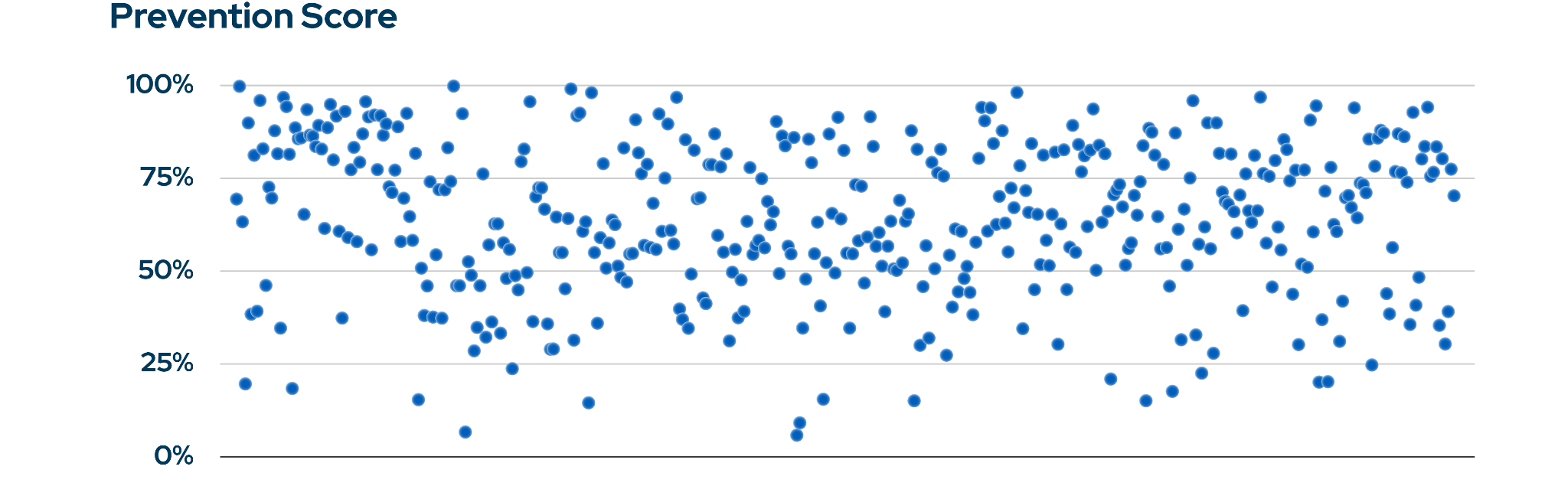
Each point represents a customer environment, showing how the same security technologies can deliver different protection outcomes in real-world deployments.
Why do security controls perform differently? Even well-established security products can lose effectiveness after deployment because of configuration drift, broken integrations, operational complexity, and changing attacker techniques. Having a control deployed does not prove it will work when needed.
- Deployment does not equal protection. Global prevention effectiveness reached 69%, showing that nearly one-third of simulated attacks still bypassed production defenses.
- Logging does not equal detection. 58% of simulated attacks were logged, but only 14% generated an alert, showing that visibility alone does not prove detection effectiveness.
- Detection rules can fail silently. Performance issues were the leading detection rule failure category at 49%, followed by log collection issues at 41%. This shows why detection content needs continuous validation, tuning, and re-validation.
- Indicators do not equal behavior coverage. Malware download prevention fell to 50%, down from 71% in 2024. As attackers change hashes, payloads, and infrastructure, validating attacker behavior beyond known indicators becomes critical.
- Controls must be validated against attacker techniques. Blue Report findings across MITRE ATT&CK tactics show that low-noise behaviors remain difficult to prevent. Discovery was the least-prevented tactic at 36%, followed by Exfiltration at 39%.
- Patch availability does not equal protection. Every one of the ten least-prevented vulnerabilities disclosed in 2025 and 2026 was blocked in fewer than 25% of simulations, with the weakest blocked in only 8% of attempts.
BAS turns security assumptions into measurable evidence by showing whether controls actually stop the behaviors attackers use.
How Does Gartner Position BAS Tools Within Adversarial Exposure Validation (AEV)?
Gartner positions Breach and Attack Simulation as a capability within Adversarial Exposure Validation. In Gartner’s CTEM two-platform model, Exposure Assessment Platforms discover and prioritize exposures, while AEV provides adversarial evidence to validate whether those exposures can actually lead to risk.
Within AEV, Gartner includes BAS, automated penetration testing tools, and Penetration Testing as a Service (PTaaS).
BAS contributes the security-control perspective by testing whether prevention and detection controls actually block, detect, and respond to attacker behavior.
|
CTEM Layer |
Capabilities Shown in the Gartner Model |
Role |
|
Exposure Assessment Platform |
EASM, CAASM, DRPS, ASCA, vulnerability assessment, vulnerability prioritization |
Finds, contextualizes, and prioritizes potential exposures |
|
Adversarial Exposure Validation |
BAS, automated penetration testing tools, PTaaS |
Tests exposures and defenses through adversarial activity to replace assumptions with evidence |
|
Breach and Attack Simulation |
Security control validation |
Proves whether prevention and detection controls block, detect, and respond to attacker behavior |
|
Automated Penetration Testing |
Exploit-based testing and attack-path validation |
Proves what an attacker can exploit and how far they can reach |
|
PTaaS |
Human-led penetration testing delivered as a service |
Adds expert-led adversarial validation within a defined scope |
BAS Tools vs. Automated Penetration Testing: What Is the Difference?
BAS and automated penetration testing validate different sides of security. BAS asks whether security controls work as intended; automated penetration testing asks how far an attacker can actually get despite those controls. Neither replaces the other.
|
Capability |
Breach and Attack Simulation (BAS) |
Automated Penetration Testing |
|
Core question |
Do my security controls actually block, detect, and respond? |
Can an attacker exploit weaknesses and reach critical assets? |
|
Perspective |
Defender-side: validates the security stack |
Attacker-side: follows the path an adversary would take |
|
How it works |
Safely emulates attacker techniques against prevention and detection controls |
Chains exploitable vulnerabilities, weak credentials, and misconfigurations into attack paths |
|
What it proves |
What was blocked, detected, logged, alerted on, or missed |
Whether an attack path is real, with proof of compromise |
|
Detection-stack visibility |
Tests telemetry, detection rules, alerting, and response |
None; it operates as the attacker and cannot see whether defensive controls detected its actions |
|
When an attack is blocked |
Techniques can still be validated across the defensive stack |
An early block can stop the attack chain and leave downstream steps untested |
|
Live exploitation |
Does not depend on firing destructive exploits to validate control behavior |
Uses real exploitation, with guardrails, where it is safe and possible |
|
Primary use |
Continuously improve prevention, detection, and response effectiveness |
Prove exploitability, attack paths, lateral movement, and blast radius |
The difference becomes clearest after a successful pentest. Automated penetration testing can prove that a Pass-the-Hash path reaches Domain Admin, but it cannot tell you whether the EDR detected the credential dump, the SIEM alerted on lateral movement, or a response workflow triggered. BAS answers those defensive questions.
There is also a coverage gap that neither capability should be forced to solve alone. Live exploitation cannot safely reach every asset, and many new CVEs have no working exploit. In the Picus platform, Exposure Validation fills that gap for business-critical, restricted, and air-gapped assets and for CVEs that cannot yet be tested with a live exploit.
What Changed in 2026: Gartner COST and CISA BOD 26-04
Gartner Continuous Offensive Security Testing (COST), published in March 2026, calls for organizations to move from periodic penetration testing to continuous, trigger-driven validation. Testing should initiate when risk changes, such as when new exploits emerge, major releases or control updates occur, or routine changes affect the environment. Gartner’s strategic planning assumption is that more than 60% of enterprise pentest programs will operate as continuous validation by 2028.
CISA BOD 26-04, issued in June 2026, shifts federal civilian agencies away from CVSS-led patch prioritization toward evidence-based decisions, reflecting the shrinking window between vulnerability disclosure and weaponization.
Together, they point to the same operating shift: move from calendar- and score-driven security decisions to continuous, evidence-based validation. For BAS, that means a change in the threat landscape or your environment can become the trigger for the next test.
How Are BAS Tools Evolving Toward Signal-Driven Validation?
Signal-driven validation is a model where changes in the threat landscape or your environment automatically trigger the specific validation workflow needed to re-prove security.
Scheduled BAS improves on periodic testing, but it still validates on a calendar. The problem is that environments change faster than even daily BAS can test them. A policy change, new privilege, emerging exploit, or new attacker technique can make yesterday’s result stale before the next scheduled run.
- Signals can come from outside or inside. External signals include a new threat, CISA KEV entry, exploit, or technique relevant to your stack. Internal signals include a new asset, policy change, updated privilege, or control drift.
- The signal determines what should run. A new threat campaign can trigger BAS; a security policy change can re-test affected controls; an infrastructure change may require both autonomous pentesting and BAS.
- Threat intelligence becomes executable. Picus AI Threat Builder can turn threat intelligence into a runnable simulation in roughly nine minutes, backed by a 24-hour emerging-threat SLA.
- Proof is refreshed when conditions change. Fixes are re-tested, and controls are re-proven when rules, policies, or attacker behavior change.
The shift is from “test every day” to “test when something changes.”
Can a BAS Tool Protect You from Zero-day Vulnerabilities?
A BAS tool cannot patch a zero-day, but it can help reduce the risk before a patch or public exploit exists by proving whether your existing controls can block, detect, and respond to the attacker behaviors the vulnerability depends on.
A zero-day response could look like this:
- 08:00 — You are halfway through your first coffee when a critical CVE lands. It is an unauthenticated RCE. There is no patch and no public exploit. Version data tells you which systems may be affected, but not whether your defenses would stop the attack.
- 08:05 — There is still nothing to exploit. Automated pentesting cannot fire a PoC that does not exist. Waiting for one leaves the organization exposed during the period when attackers may already be developing their own.
- 08:15 — Test the attacker behaviors instead. Delivery, execution, privilege escalation, process injection, credential access, and other required behaviors can be safely exercised against NGFW, WAF, endpoint hardening, EDR, and SIEM controls. The result shows what is blocked, detected, alerted on, or missed.
- 08:30 — Close the gaps. Prevention rules, detection logic, hardening, or segmentation can be applied where controls fail.
- 08:45 — Re-run the test. The same behaviors are executed again to prove the compensating controls now hold. A changed configuration is not evidence until the attack is tested again.
- 12:00 — Threat intelligence adds context. Researchers identify the campaign using the vulnerability. The question expands beyond the CVE itself.
- 12:30 — BAS rehearses the broader campaign. Initial access, lateral movement, persistence, and exfiltration can now be tested against the stack. This can expose defensive gaps the vulnerability-focused test alone would never reveal.
- 16:00 — A working exploit becomes public. Live exploitation can now provide additional ground truth where it is safe and permitted.
- 18:00 — The attacker arrives. Ideally, the important difference is that the controls were already tested, gaps were mitigated, and the fixes were re-validated hours earlier.
That is the role of BAS in zero-day defense: not removing the vulnerability, but shortening the period in which you are assuming your defenses will hold.
The full day, hour by hour: What Zero-Day Response Should Be in the Post-Mythos Era.
Key Criteria When Selecting a Breach and Attack Simulation (BAS) Tool
- Attack vector coverage across network, endpoint, application, cloud, identity, and data.
- Realistic adversary behavior drawn from real threat groups and campaigns.
- Threat library with a speed commitment: published SLA, sector templates, minimal advisory-to-test delay.
- Signal-driven execution on new threats, KEV entries, and environment changes.
- Prevention and detection validation across NGFW, IPS/IDS, WAF, EDR/XDR, SIEM, DLP, gateways, and cloud.
- Validated mitigation and proven closure: pre-tested vendor-specific fixes, deployable, auto re-validated.
- Custom campaigns assembled from your own CTI and open-source intel.
- Autonomy with governance: tunable autonomy, decision gates, deterministic runs, full audit trail.
- Role-based reporting for SOC, executives, and auditors.
- MITRE ATT&CK mapping with kill-chain coverage.
- Deployment flexibility: cloud, on-prem, air-gapped, hybrid; agentless where needed.
Top 6 Breach and Attack Simulation (BAS) Tools Reviewed by Gartner
Gartner Peer Insights showcases reviews of the top Breach and Attack Simulation (BAS) tools based on user feedback, highlighting their capabilities in enhancing cybersecurity defenses [1]. The leading solutions are as follows:
- Picus Security
- Cymulate
- AttackIQ
- SafeBreach
- XM Cyber
- Pentera
These platforms enable organizations to simulate attack scenarios, assess the effectiveness of their security controls, and identify gaps in their defenses.
If you’d like a detailed competitive analysis of these six vendors and their strengths, click here.
Limitations of Open Source BAS Tools
Caldera is powerful but complex and post-compromise heavy. Atomic Red Team is granular but manual and rarely chains a realistic campaign. Infection Monkey is noisy and unrepresentative of stealthy adversaries. Stratus is cloud-only. None runs on signal, delivers validated mitigations, or re-validates closure. They suit learning and supplementing a commercial platform; enterprise control validation needs the full loop.
|
Framework |
Pre Compromise Techniques |
Post Compromise Techniques |
Attack Campaigns |
Update Frequency |
Automation |
Customization |
Mitigation Insights |
|
MITRE Caldera |
✔ (initial access added) |
✔ |
✔ (chained via adversaries) |
Frequently |
Automated |
✔ |
✔ (reporting, ATT&CK mapping) |
|
Atomic Red Team |
✖ |
✔ |
✖ (no built-in campaigns) |
Frequently |
Manual |
✖ |
✖ (no built-in insights) |
|
Infection Monkey |
✔ (focus is post-initial breach) |
✔ |
✔ (infection propagation & lateral) |
Frequently |
Autonomous |
✔ |
✔ (reports on gaps) |
|
Stratus Red Team |
✖ |
✔ |
✖ |
Frequently |
Manual |
✖ |
✖ |
|
Dumpster Fire |
✖ |
✔ (event simulation) |
✖ |
Rare / outdated |
Manual |
✖ |
✖ |
|
Metta |
✖ |
✔ (limited actions) |
✖ |
Outdated / no updates |
Manual |
✖ |
✖ |
|
Red Team Automation |
✖ |
✔ (scripts for detection tests) |
✖ |
Outdated |
Manual |
✖ |
✖ |
Picus Breach and Attack Simulation
Picus Breach and Attack Simulation continuously proves what your live prevention and detection stack blocks, detects, and misses, and closes each gap with vendor-specific rules that are re-validated to confirm closure.
It is one of three capabilities on the Picus Platform, alongside Picus Exposure Validation (exploitability verdicts for every asset, including CVEs with no working exploit) and Picus Autonomous Penetration Testing (proof of compromise along real attack paths). Findings from one feed the next; run the three as siloed tools on three schedules and a day's work takes six weeks. All three share one data fabric with 75+ integrations, orchestrated by Picus Swarm, five agents coordinated by Numi AI running on signal with your team at the decision gates.
-
13 years of validation, category pioneer
-
24-hour emerging-threat SLA, 50+ person Picus Labs
-
Roughly 9 minutes from threat intelligence to runnable simulation
-
Vendor-specific rules with re-validation that proves closure
-
SIEM rule health validation; agentless AWS, Azure, GCP, Kubernetes
-
AI Security Validation for production LLM applications
-
Cloud/SaaS, on-premises, air-gapped, hybrid
Proof: 2x control effectiveness within 90 days. 338 million+ simulations in H1 2026.
Why Should You Choose Picus for the Best BAS Tool in the Market?
Gartner Peer Insights. Customers' Choice, 2026 Voice of the Customer for Adversarial Exposure Validation. 154 reviews as of June 2026: 4.8/5 overall, 98% willingness to recommend, the highest among vendors with more than 100 reviews. Customers' Choice vendors are listed alphabetically; no ranking is implied.
Frost & Sullivan. #1 Innovation Index and Growth Index Leader in Automated Security Validation (Frost Radar); 2026 Global Automated Security Validation Company of the Year.
G2. Fall 2026 Leader in Enterprise and Mid-Market; Momentum Leader and Best Relationship in Mid-Market; 4.8/5.
Outcomes. 128% more prevention and 72% more detection from existing controls; 89% lower mean time to remediation; 92% fewer SLA violations on critical findings.
Validate which exposures actually work against your defenses. See Picus Breach and Attack Simulation in action.

.png?width=353&height=200&name=Picus-Frost%26sullivan-Awards-preview-april22%20(1).png)
.png?width=353&height=200&name=picus-cyber-fundamentals-6surfaces-validation-preview-april8%20(2).png)
.png?width=353&height=200&name=picus-cyber-fundamentals-6surfaces-validation-preview-april8%20(1).png)