Key Insights from Gartner® Market Guide for Adversarial Exposure Validation 2025
Update: Picus Security is now recognized in the 2025 Gartner® “Voice of the Customer” for Adversarial Exposure Validation (AEV). Download the report to see why users rated us 4.8/5.
Security teams are overwhelmed by the sheer volume of vulnerabilities, making it challenging to identify and prioritize those that need immediate attention. Gartner’s Adversarial Exposure Validation (AEV) combines Breach and Attack Simulation (BAS) and Automated Penetration Testing to simulate real-world attacks, pinpointing exploitable, business-critical threats. This helps teams focus on high-risk vulnerabilities while deprioritizing theoretical, and low-impact ones.
What Is Adversarial Exposure Validation (AEV), Exactly?
Adversarial Exposure Validation is a core component of the Continuous Threat Exposure Management (CTEM) framework. It acts as a continuous testing mechanism that simulates real-world offensive cyberattacks to assess an organization's security posture. Unlike traditional vulnerability management, AEV doesn't rely on theoretical risk scores. Instead, it uses technologies like BAS and Automated Penetration Testing to validate the actual exploitability of vulnerabilities in an organization's unique environment.
By testing the effectiveness of existing security controls using threat intelligence-based attack scenarios, AEV ensures evidence-based prioritization. This reduces operational burden and allows organizations to focus their remediation efforts only on exposures that truly pose a risk to their environment.
Why Is AEV Adoption Accelerating?
Gartner predicts that by 2027, 40% of organizations will adopt exposure validation initiatives, primarily using AEV solutions. This rising adoption is driven by several critical needs:
Cutting through noise in vulnerability management
Scaling offensive testing efforts without growing headcount
Proving the performance of security controls, teams, and vendors
Prioritizing exposures that truly put systems at risk
Core Capabilities and Use Cases
AEV platforms typically address three high-impact use cases:
Optimize Defenses: By simulating full attack kill chains from adversarial campaigns, teams gain a realistic understanding of where security controls effectively block attacker behaviors and, when they don't, whether they detect and alert appropriately.
Improve Exposure Readiness: Not all vulnerabilities carry the same level of attention. AEV helps teams prioritize the vulnerabilities that pose the greatest risk to business continuity.
Scale Offensive Testing: By automating continuous simulations of complex, multi-stage attacks, organizations reduce the routine workload on their teams, freeing up offensive teams to focus on more creative and strategic security challenges.
.png?width=670&height=503&name=Figure1%20(1).png)
See How Leading Teams Operationalize AEV
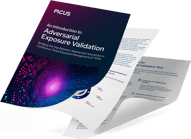 This guide breaks down the exact steps to move from broad exposure assessment to validated prioritization. Learn why AEV is mission-critical, how it integrates into the CTEM cycle, and how leading organizations shrink massive vulnerability lists into a high-impact set of validated risks.
AEV Capabilities That Set Picus Apart
Control Validation: Daily Proof of Defensive Readiness
Picus simulates sophisticated adversarial techniques observed in the wild, testing defenses across network, endpoint, email, web app, and data layers. All adversarial tactics are mapped to MITRE ATT&CK, allowing leaders to pinpoint exactly where controls prevent, detect, delay, or fail to stop attacks.
Exposure Validation: Signal Over Noise
By correlating vulnerability data, asset context, and security control effectiveness, Picus identifies which exposures are truly exploitable and critical to business operations. This significantly reduces noise, allowing teams to focus on vulnerabilities that present real risks, rather than those that appear severe on paper.
Attack Path Validation: Understanding Blast Radius
Picus identifies and visualizes how attackers chain seemingly isolated vulnerabilities to move laterally, escalate privileges, maintain persistence, and target high-value assets, such as domain admins. Instead of presenting isolated findings, leaders gain a comprehensive view of full compromise scenarios, allowing them to understand the true impact of security misconfigurations.
Detection Validation: Strengthening SOC Confidence
Picus tests detection rules to identify issues related to the performance and hygiene of SIEM rules and obtain insights to accelerate threat detection and response. This way, SOC teams can stay on top of the detection rule baseline and automate manual detection engineering processes.
Turning Evidence Into Action
Picus Labs offers both vendor-neutral and vendor-specific prevention and detection recommendations, tailored to the technologies you already use. This provides teams with clear, actionable steps to close security gaps, accelerating mobilization and ensuring that improvements are measurable.
Why Organizations Adopt Picus for AEV
Security leaders trust Picus to achieve the outcomes Gartner associates with successful AEV programs:
A validated, prioritized exposure set instead of overwhelming scanner output
A continuous measure of control effectiveness, essential for governance and reporting
Alignment with the CTEM framework, enabling clear movement from discovery to mobilization
Improved SOC readiness through validated detection coverage
Scalable adversarial testing without expanding headcount
Unified visibility across controls, exposures, and paths, eliminating fragmented tools
Gartner’s AEV research confirms a universal need across mature security programs: exposures must be validated, not assumed.
Picus helps organizations build that capability into daily operations. The result is a clearer picture of risk and an evidence-backed security program.
Get a Live View of Your Exposure Reality
Watch real adversarial techniques validated against your environment. Learn how Picus exposes exploitable gaps, verifies control performance, and reveals attack paths.
Gartner, Market Guide for Adversarial Exposure Validation, Eric Ahlm, Dhivya Poole, Angela Zhao, Mitchell Schneider, 11 March 2025.
GARTNER is a registered trademark and service mark of Gartner, Inc. and/or its affiliates in the U.S. and internationally and is used herein with permission. All rights reserved.
Gartner does not endorse any vendor, product or service depicted in its research publications, and does not advise technology users to select only those vendors with the highest ratings or other designation. Gartner research publications consist of the opinions of Gartner’s research organization and should not be construed as statements of fact. Gartner disclaims all warranties, expressed or implied, with respect to this research, including any warranties of merchantability or fitness for a particular purpose.
Share this:


-3.png?width=353&height=200&name=image%20(61)-3.png)