The common perception in the security industry is that Breach and Attack Simulation tools are meant for enterprise organizations that have already built their security stack, have a large SOC team, a seven-figure security budget, a fiery CISO, an in-house red team, and a tool sprawl problem to solve. While this may sound plausible, it is terribly wrong.
Believe it or not, small and mid-sized businesses (SMB) face the same threat actors, APT groups, malware families, and CVE-based exploitation attacks as Fortune 500 enterprises. However, SMBs face them with fewer resources, being understaffed, and with almost no visibility on whether their implemented security stack is working or not.
Not surprisingly, this is the reason why SMBs are among the primary targets of malware attacks, as the attacker believes that the majority of SMBs are easier to breach, extort their customers’ critical information, scare them, and ask them to pay.
In this blog, I will explain why SMBs must use BAS assessments to safely detect their security gaps before the attacker does and apply the suggested single click mitigation options provided by the vendor to be two steps ahead of the attacker.
The SMB Threat Landscape in 2026: Why Small Targets Face the Biggest Consequences
The best way to disprove a myth is to introduce actual numbers.
The State of SMB Cybersecurity Report is a survey-based research report that presents a clear picture of reality that should concern every business owner, regardless of size.
About one in two SMBs have already experienced a cyber incident, breach, or attack. This is not a hypothetical risk; it is not a rare case that SMBs should not worry about. This is a coin flip scenario. The financial consequences are not helping either:
On average, in 2025, a single cyber incident will result in six- and seven-figure losses, especially when considering downtime, emergency responses, and recoveries.
These figures are already enough for small and medium-sized businesses to be on the brink of bankruptcy.
Beyond Downtime: How Double Extortion and Stealth Exfiltration Are Reshaping SMB Risk
With the rising costs and the growing number of cyber attacks, the rising sophistication of stealthy adversarial behavior is also not helping:
Based on an analysis performed on 1.1 million malicious files collected throughout 2025, the Picus Red Report 2026 found that attacker behavior is increasingly shifting towards stealthy behavior.
A couple of years back, industries witnessed a rise in encryption-based attacks. This has made organizations rethink their backup strategies, thus enhancing their overall resilience models.
This is why, currently, malware is no longer content in merely encrypting all data but has taken a more devious route. Encryption-based attacks have witnessed a 38% year-over-year reduction, thus showing us that, currently, malware wants to crawl inside and nest in the network, slowly exfiltrating critical data using legitimate application layer protocols, especially using Cloud APIs, and then present sufficient proof while demanding the ransom.
SMBs sense the impending storm.
|
61% believe future cyber risk will be even greater. Their top concerns reveal a layered anxiety: 42% worry about increasingly sophisticated attacks, 40% fear direct financial loss, 28% are bracing for higher attack frequency, 26% fear insider threats, and 23% are concerned about growing reliance on cloud technologies. |
These are not abstract worries, they reflect the lived experience of organizations that have already been hit or watched peers fall.
How Attackers Get In: The Cascading Vulnerability Chain in Small Businesses
When asked about how hackers get in, SMBs will generally talk about a string of mistakes rather than a single mistake.
Close to half (45%) of SMBs will talk about human error, such as clicking on a phishing email or misconfiguring their systems, as their biggest gaps. However, this is not the only threat to SMB security.
Just as many (43%) will talk about the targeted cybercriminal attacks, as well as the outdated technologies that 42% of SMBs are currently using.
What comes next are the structural gaps that exist in SMB security. Here, 32% of the participants point to a lack of security policies, and 23% point to unauthorized third-party applications.
At this point, SMBs are concerned with creating a picture that can be used in cascading models of risk.
Clicking on a phishing email (human error), which compromises the system because it was never patched (outdated technology), and the movement of the attacker through the environment was never detected because there was never a policy in place to track that movement…
The SMB Preparedness Paradox: 80% Prove Planning Works, Yet Only 34% Have a Plan
The biggest surprise in the data was the disconnect between what SMBs know and what they do about it. The following is one single data point that illustrates this paradox:
- 80% of SMBs who had an incident response plan in place were able to avoid major damage when attacked.
- However, only 34% of SMBs actually have an incident response plan in place.
The proof that planning is effective is overwhelming, and the adoption rate of planning is critically low.
|
The remaining 66% are operating in various states of unreadiness. 42% have no plan at all, they are in purely reactive mode, waiting for an incident to dictate their response. Another 28% are operating under informal, ad-hoc processes that have never been tested under pressure. |
When an incident does strike, the response chain is equally fragile.
33% of SMB owners handle security alerts themselves, alongside everything else they manage. Perhaps more alarming, 13% offload these alerts to untrained employees who lack the expertise to differentiate real threats from noise. Only 14% rely on an external cybersecurity provider like an MSSP.
In other words, the majority of SMBs are just one serious incident away from an improvised, under-resourced response that can quickly spiral into crisis.
The Security Spending Blind Spot: Why One in Three SMBs Can't Measure What They're Paying For
Before we can discuss what tools these organizations should be using, we have to confront the fundamental issue: one in three SMBs cannot even quantify their current security investments.
They have a financial blind spot, money is being spent on security, but nobody can say exactly how much, on what, or whether it is working.
Among those who can quantify tool adoption, the data reveals an overall pattern of foundation-level security investments without validation.
- 58% rely on network firewalls, and 52% use email spam filtering.
- 45% provide employee security awareness training, which addresses the human error problem but does nothing to validate whether technical controls are catching what employees miss.
- Only 30% use cloud application security tools, and a mere 26% conduct regular security assessments or penetration testing.
This is where Breach and Attack Simulation (BAS) steps in.
Most SMBs have invested in security products but have yet to find a way of validating whether these products actually work against actual attack techniques.
They are spending money on locks but have yet to find out if these locks actually work.
Myth vs. Reality: Why Breach and Attack Simulation Is No Longer Enterprise-Only
The perception that BAS is exclusively for large enterprises stems from the technology’s origins.
Early BAS platforms required significant infrastructure, complex deployments, and skilled operators. That is no longer the case.
The market has matured dramatically, and modern BAS solutions are available as cloud-native SaaS platforms that require no on-premises hardware, minimal configuration, and far less operational overhead than traditional security testing.
|
The Myth |
The Reality |
|
“BAS requires dedicated infrastructure and hardware.” |
Modern BAS platforms are cloud-native SaaS. Lightweight agents deploy in minutes with no on-prem appliances required. |
|
“We need a large SOC team to operate BAS.” |
BAS automates testing entirely. A single IT administrator can run thousands of attack simulations and receive prioritized, actionable results without specialized security expertise. |
|
“BAS is too expensive for our budget.” |
BAS costs a fraction of annual pen testing fees. Compared to $120,000+ average breach costs, BAS is one of the highest-ROI investments an SMB can make. |
|
“We’re too small to be targeted.” |
43–61% of SMBs were attacked last year. Attackers specifically target smaller organizations because their defenses are weaker. Being small makes you more vulnerable, not less. |
|
“Our antivirus and firewall are enough.” |
Traditional tools miss modern, multi-stage attacks. BAS reveals whether your existing controls actually detect and block real-world threat techniques—most organizations discover significant gaps on their first run. |
How to Adopt BAS with a Lean Team and a Limited Budget
You do not have to start from scratch and rethink your whole security strategy. For the majority of SMBs, the journey to security validation is not as daunting as you think:
Start with What You Have
Let me get one thing straight. BAS does not replace your existing security tools. No, it does not work as another NGFW, WAF, or a SIEM system that you just buy one, and eliminate their cost.
If you have existing security tools such as a firewall, email gateway, EDR solution, or a SIEM system, then BAS will show you how well these security controls perform for you under a real-life cyber attack.
Because, as I am well aware of the budget that it takes to invest in these technologies, and feeling a false sense of security.
For many SMBs, it turns out that making a simple configuration adjustment to one of these existing security tools eliminates a major security risk and eliminates the need for you to buy anything at all.
To learn more about the integration of security controls, you can visit here.
Leverage Managed BAS and MSSP Partnerships
Here is some food for thought. As an SMB, you do not have to own and operate a BAS solution.
Managed Security Service Providers (MSSPs) and Virtual CISOs (vCISOs) are increasingly offering BAS as a managed service.
Many MSSPs offer a token-based subscription model, which allows the MSSPs to perform continuous validation on behalf of the client. This simple model can allow smaller organizations to gain access to enterprise-level security testing without having to hire another team to manage the simulations, reports, fixes, and what not.
|
Why SMBs are motivated to partner with MSSPs. The motivations are practical and urgent: 52% would partner with an MSP out of fear of cyberattacks, 40% are driven by their responsibility to protect customers, 36% are motivated by compliance requirements, 33% want to lower cyber insurance premiums, and 30% recognize a need for specialized expertise they cannot build in-house. |
Focus on the Threats That Matter Most
SMBs don’t have to simulate all the techniques in the MITRE ATT&CK framework.
They can focus on the most common types of attacks that are affecting the most SMBs. Some of these include CVE-based exploitation for initial access, credential dumping, privilege escalation for legitimate and long term high-priv access, and data exfiltration & encryption for impact.
Simulating these types of attacks can give the organization the biggest picture of where they are exploitable exposures, right away.
|
In fact, you can test your defenses against the top 10 most widely used MITRE ATT&CK techniques observed in the wild. The whole point behind the Picus Red Reports is to inform industry about the evolving threat landscape. The Picus Platform prepares a variety of threat templates based on these techniques, mentioned APT & malware groups, as well as endpoint threats observed in the wild. |
Use Actionable Mitigation to Compress Remediation
The biggest time drain for lean security teams is not identifying a problem, it is researching the fix. Modern BAS platforms provide vendor-specific remediation guidance: the exact firewall signature, SIEM detection rule, or EDR policy adjustment needed to close each gap. For a two-person IT team, this eliminates hours of manual work per finding.
Validate Your Defenses in Minutes with Picus Security Control Validation
Picus Security Control Validation (SCV) makes enterprise-grade security validation accessible to organizations of every size.
Whether you are a 50-person company with a single IT administrator or a mid-market firm building out your security program, Picus SCV delivers the continuous, automated testing you need, without the complexity.
- Deploy in minutes, not months. Picus SCV is cloud-native and integrates seamlessly with your existing firewalls, EDR, SIEM, email gateways, and cloud environments. No hardware. No heavy lifting.
- Simulate real-world attacks automatically. Access a continuously updated threat library of thousands of attack techniques, including the latest ransomware families, APT campaigns, and zero-day exploits, mapped to the MITRE ATT&CK framework.
- Get one-click, vendor-specific mitigation. When Picus finds a gap, it tells you exactly how to fix it. The Picus Mitigation Library provides ready-to-apply, all validated mitigation suggestions that are both vendor-specific and vendor neutral to improve your prevention and detection layer solutions. No manual research. No guesswork.
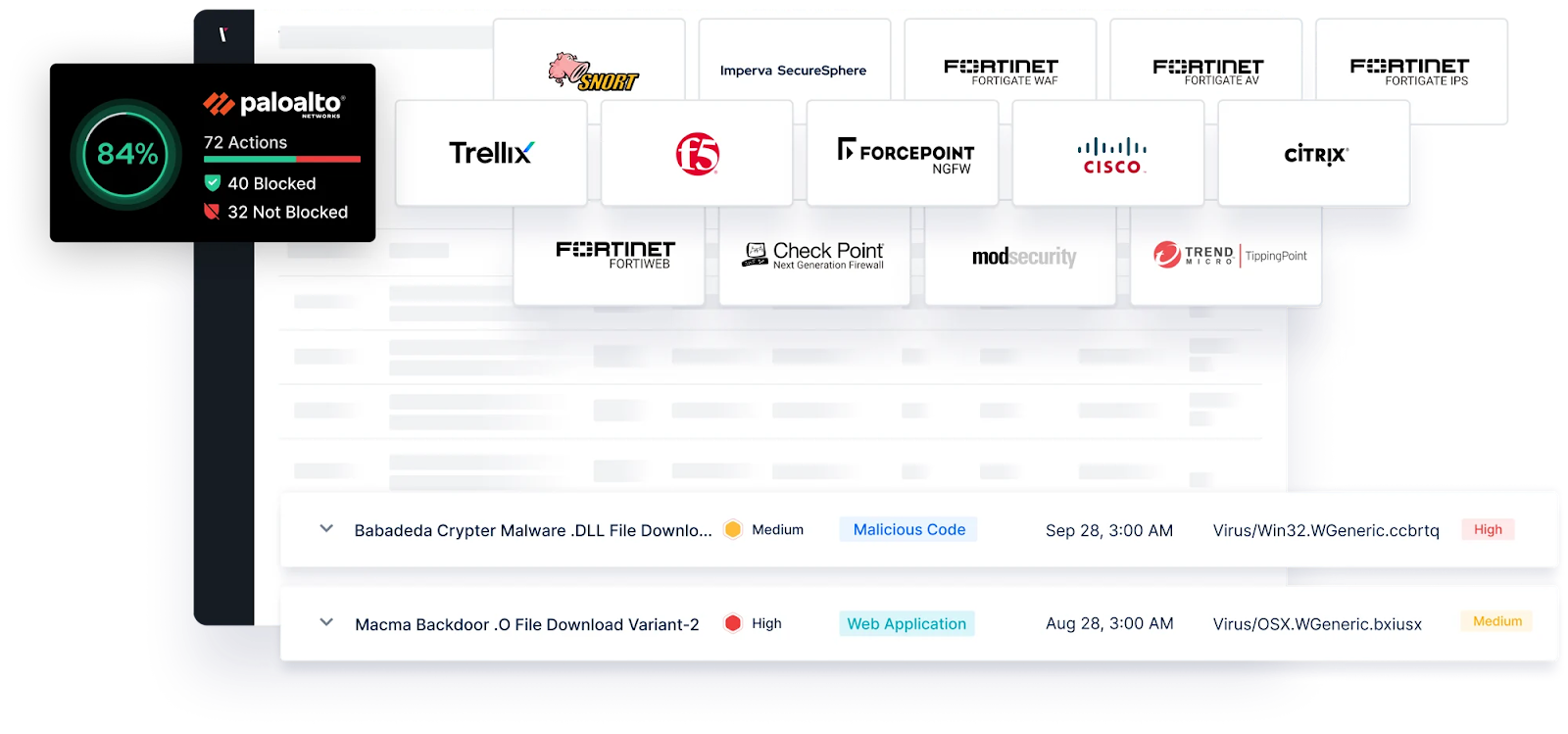
- Prove your security posture to leadership and insurers. Generate clear, executive-ready reports with a transparent Exposure Score that communicates risk in business terms, ideal for board presentations and cyber insurance applications.
- Stay ahead of emerging threats. With a 24-hour SLA on threats with proof-of-concept exploits and CISA alerts, your defenses are validated against the newest attack techniques before attackers can use them against you.
Rated #1 in Breach and Attack Simulation by G2 and recognized as a Gartner® Peer Insights™ Customers’ Choice, Picus SCV is trusted by organizations worldwide to turn security spending into measurable, proven resilience.
Your business may be small. Your defenses don’t have to be.
Get Your Free Demo Now.


.png?width=353&height=200&name=Picus-Frost%26sullivan-Awards-preview-april22%20(1).png)
.png?width=353&height=200&name=picus-cyber-fundamentals-6surfaces-validation-preview-april8%20(2).png)
.png?width=353&height=200&name=picus-cyber-fundamentals-6surfaces-validation-preview-april8%20(1).png)