Every CISO has found themselves in the same boardroom position: how to justify cybersecurity spend in terms that the C-Suite and board can understand. Unlike other spend categories that generate business growth, cybersecurity has always been viewed as a cost center, a necessary but hard-to-justify expense.
The advancements in Breach and Attack Simulation (BAS) technology are revolutionizing the entire conversation.
By providing actionable, measurable evidence of security control effectiveness, BAS technology gives CISOs the information needed to prove tangible return on investment and turn what was previously viewed as a cost into a business driver.
According to IBM’s 2025 Cost of a Data Breach Report, the worldwide average cost of a data breach fell to $4.44 million in 2025, down 9% over last year due to improvements in breach detection and containment through security tool deployments. However, in the US, data breach costs have risen to a record high of $10.22 million [1].
The difference between organizations that regularly validate their defenses and those that don’t has never been clearer or larger, measurable in terms of millions of dollars.
This guide will outline a step-by-step process for calculating BAS ROI and making a business case for continued investment in security validation technology.
The ROI Problem in Cybersecurity
The problem with traditional cybersecurity ROI calculations has always been that it has been difficult to calculate in the first place due to its inherent nature of focusing solely on cost avoidance rather than profit creation.
The basic formula, reduced risk divided by investment cost, may be easy to remember, but it’s hard to calculate due to the need to estimate risks and costs.
The truth is that most CISOs only have limited information to go on, periodic penetration testing and vulnerability scanning that offers only a snapshot in time. The truth is that configurations are constantly shifting, new threats are emerging all the time, and what was true three months ago during a penetration test may no longer be true today.
Meanwhile, board members and CFOs need financial information.
They need to know what ROI means in terms of cost savings, reduced risks in terms of dollars and cents, and efficiency gains.
|
Mean time to detect or mean time to patch doesn’t mean anything to them. |
BAS tools offer a solution to this problem by giving you hard evidence of how well your existing security controls really perform against real-world attack techniques in constant motion, and improve their efficiency with ready-to-apply mitigation recommendations.
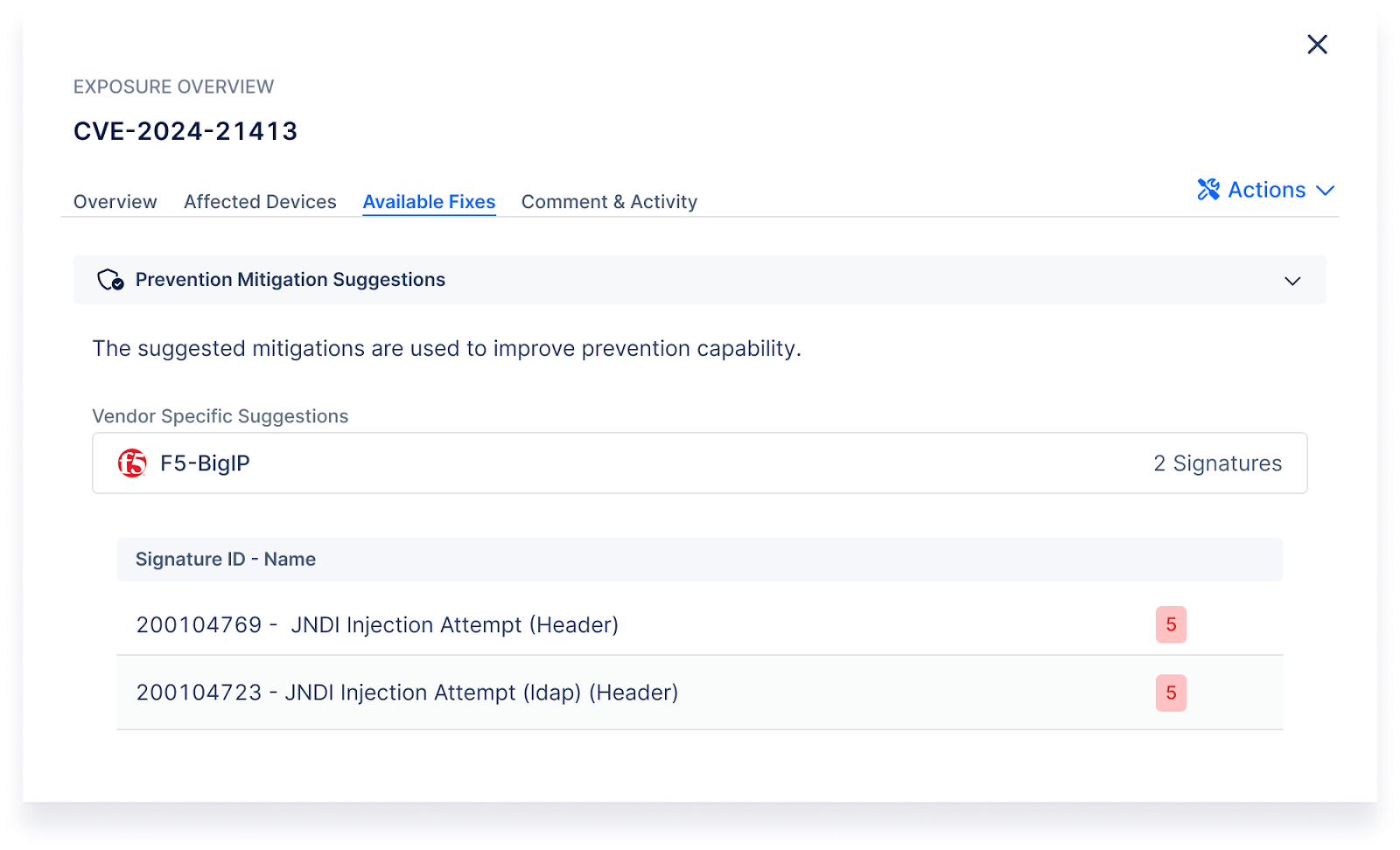
Figure 1. Picus Mitigation Library, Vendor-Specific Suggestions
What BAS Actually Measures
BAS assessments measure how effectively an organization’s security defenses perform when faced with real attacker techniques.
Rather than analyzing configurations or calculating theoretical risk scores, BAS safely emulates adversary behaviors, such as malware delivery, credential abuse, lateral movement, and data exfiltration, inside the environment. These controlled simulations trigger the same defensive mechanisms that a real attack would encounter, allowing security teams to observe how their controls actually behave.
During these simulations, BAS evaluates the performance of the entire defensive stack, including technologies such as firewalls, web application firewalls (WAF), IDS/IPS, secure email gateways, endpoint protection and detection platforms (EDR/XDR), data loss prevention (DLP), and SIEM-based detection systems.
Unlike other security testing methodologies (refer to the table below) that provide theoretical risk scores about how your security stack is doing & or will likely do, BAS actually measures. It actually measures how your measures are reacting in terms of prevention, detection, alerting, and response rates.
|
Capability |
BAS |
Red Teaming |
Pen Testing |
Vulnerability Scanning |
|
Fully automated |
✔ |
✖ |
✖ |
✔ |
|
Consistent and continuous assessments |
✔ |
✖ |
✖ |
✔ |
|
Simulates the latest cyber threats |
✔ |
✖ (dependent on tester skill) |
✖ (dependent on tester skill) |
✖ |
|
Validates security control effectiveness |
✔ |
✔ |
✖ |
✖ |
|
Focused on identifying vulnerabilities |
✖ |
✖ |
✔ |
✔ |
|
Simulates attacks targeting specific CVEs |
✔ |
✖ |
✖ |
✖ |
|
Performs testing across the cyber kill chain |
✔ |
✔ |
✔ |
✖ |
|
Generates metrics to measure effectiveness |
✔ |
✖ |
✖ |
✔ |
|
Provides actionable mitigation insights |
✔ |
Limited |
Limited |
✖ |
|
Accelerates adoption of MITRE ATT&CK |
✔ |
✖ |
✖ |
✖ |
|
Safely assesses production environments |
✔ |
✖ |
✖ |
✖ |
The objective is to generate empirical evidence of defensive effectiveness across several key dimensions:
- Prevention: whether security controls block malicious activity before compromise
- Detection: whether malicious techniques are correctly identified by security tools
- Alerting: whether alerts are generated with the right fidelity and timing
- Response readiness: whether monitoring and response processes react appropriately
By repeatedly running realistic attack scenarios, BAS provides a continuous measurement of how well security technologies, configurations, and detection logic perform under real-world conditions.
This approach shifts security validation from theoretical risk assessment to evidence-based performance testing, helping organizations understand not just what vulnerabilities exist, but whether attackers could actually succeed in their environment.
A Practical Framework for Calculating BAS ROI
To build a compelling business case, CISOs should focus on four measurable ROI categories: cost avoidance from breach prevention, operational efficiency gains, security tool optimization, and compliance and audit cost reduction.
Cost Avoidance Through Breach Prevention
Cost avoidance is the most compelling conversation for board-level discussions.
Start with your organization’s sector/region's estimated likelihood of a breach and multiply that number by your industry’s average cost of a breach. For instance, healthcare organizations face an average cost of a breach of $7.42 million, while the global average is $4.44 million.
|
BAS can reduce an organization’s likelihood of a breach directly by identifying and remediating control gaps before an attacker can exploit them (including zero-day CVE exploitations with publicly available PoCs). |
If continuous security validation can reduce your estimated annual likelihood of a breach even a few percent, the resulting cost savings can far exceed your annual investment in BAS.
Define this as a risk-adjusted savings approach: the reduction in expected annual losses due to improved control effectiveness validated through simulation.
Operational Efficiency Gains
Manual security validation is time-intensive and expensive.
Red team engagements typically cost tens of thousands of dollars per assessment and deliver results that are relevant for only a limited window.
BAS automates the vast majority of this workload. Instead of mobilizing a team for weeks-long engagements, security engineers can run thousands of simulations continuously without human intervention, focusing their time on analyzing results, tuning controls, and remediating the highest-impact gaps. This advantage grows when BAS platforms like Picus provide easy-to-apply mitigation content for both prevention and detection layers, removing the operational burden of identifying and testing vendor fixes.
Hence, organizations that adopt continuous security validation report significant reductions in the person-days required for security assessments.
|
Calculate the labor hours your team currently dedicates to manual testing, multiply by fully loaded cost rates, and compare against the BAS platform cost. For most organizations, the efficiency gains alone approach break-even. |
Security Tool Optimization
Most enterprises operate a sprawling stack of security tools, often 60 to over 100 different products.
|
Organizational Category |
Total Security Tools |
Cloud-Specific Tools |
|
Global Enterprise (>25k staff) |
60 – 100+ |
30 – 60+ |
|
Elite Budget Tier(>$25M) |
35 – 80+ |
20 – 50 |
|
Mid-Market Core (5k – 10k staff) |
25 – 50 |
25 – 50+ |
|
Market Baseline (Global Avg) |
25 – 55 |
15 – 35 |
BAS reveals which tools are performing well, which are misconfigured, and which are redundant. This visibility directly impacts spending.
- If simulation data shows that two overlapping tools provide essentially the same coverage, you can consolidate.
- If a tool consistently fails to detect simulated threats, you can either tune it or replace it with something more effective.
In either case, BAS data drives informed procurement decisions rather than renewing licenses on faith.
The financial impact here includes both direct cost savings from tool consolidation and indirect savings from improved effectiveness of the tools you keep.
Compliance and Audit Cost Reduction
Regulatory frameworks such as GDPR, DORA, NIS2, and PCI DSS increasingly require organizations to demonstrate that they regularly test the effectiveness of their security controls.
Manual evidence gathering for compliance audits is tedious and costly.
BAS platforms generate continuous compliance-ready reports that map simulation results to specific regulatory requirements and security frameworks like MITRE ATT&CK. This reduces the time and cost of audit preparation, minimizes the risk of non-compliance penalties, and provides auditors with the evidence-based assurance they need.
Organizations using BAS for continuous compliance validation report streamlined audit cycles and reduced reliance on external consultants.
Key Metrics That Speak the Board’s Language
In communicating the BAS ROI to the board, key metrics should be provided that correlate to business results.
- Trends in the prevention score, or the percentage of simulated attacks that are being blocked, indicate that the company is improving its defense posture quarter over quarter.
- Trends in the detection score, or the ability of the SOC to identify and alert on threats, indicate that the company is keeping pace with the adversary in terms of tactics and techniques.
- The mean-time-to-detect (MTTD) & mean-time-to-repeair (MTTR), measured against BAS-identified gaps, indicates that the company is improving its ability to respond to the threat.
Perhaps the most impactful measure is that a CISO can now communicate the company’s security posture in real-time, rather than simply passing or failing a test.
|
When the board asks, “Are we secure?” The CISO can now respond, “Our prevention score against the top 10 most commonly used attack techniques & threat groups that are attacking our industry is 92% versus 78% just a quarter ago, and our mean time to detect simulated attacks has gone from 45 minutes to 12 minutes.” |
Common Pitfalls in BAS ROI Calculation
Do not overpromise by overestimating breach probability or implying that BAS can completely eliminate risk.
When estimating the cost of a breach, be sure to utilize credible and industry standard sources or your cyber insurance company's risk models to drive these estimates.
Another common mistake is that organizations will only concentrate on hard dollar savings and not softer benefits such as increased productivity of teams, better cross-functional collaboration between security and IT ops teams, and increased confidence in your security posture during M&A activity or client security assessment activity.
These are legitimate benefits that BAS provides and should be included in your narrative, even though they are harder to quantify.
Why Leading Enterprises Choose Picus for Security Validation
If you’re ready to move from theoretical risk models to evidence-based security investment decisions, the Picus Security Control Validation, powered by Breach and Attack Simulation Technology, is purpose-built to deliver every ROI lever discussed in this guide.
Named the #1 Breach and Attack Simulation solution by G2 with a 4.9/5 customer satisfaction score, Picus delivers the industry’s most comprehensive security validation experience.
What sets Picus apart is how directly it drives ROI.
For instance, through data analysis from the Picus Platform, we've identified a significant gap between traditional security assessment methods and real-world exposure risks.
The following illustrates this discrepancy:
- CVSS 3.1 classifies 63% of vulnerabilities as high or critical. However, many of these do not reflect actual exploitable risks in the real world.
- Risk-Based Vulnerability Management (RBVM) flags 45% as high-risk, but not all of these vulnerabilities are exploitable in a live environment.
These statistics enforce unnecessarily strict patching deadlines on security teams, with possible business disruptions.
In contrast, Picus Exposure Validation offers a more accurate, context-driven view of vulnerabilities. Our attack simulations show that only 9% of vulnerabilities labeled as high or critical are actual exploitable exposures that pose a risk.
|
KPI |
Baseline (CVSS) |
Picus Exposure Validation |
|
Backlog |
9,500 findings |
1,350 findings |
|
MTTR (Mean Time to Repair) |
45 days |
13 days |
|
Rollbacks |
11 per Quarter |
2 per Q |
Being recognized as Innovation Leader in the Frost Radar™ 2026 for Automated Security Validation and as a Customers’ Choice in 2025 Gartner® Peer Insights™, Picus SCV consolidates the capabilities that enterprises need to validate, measure, and continuously strengthen their defenses, all from a single platform.
Ready to see what your security stack is actually stopping?
Request a free demo and discover how continuous security validation transforms your cybersecurity budget from a cost center into a measurable, defensible investment.
References
[1] The MJ Companies, “U.S. Average Breach Cost Hits Record High of $10.22 Million,” The MJ Companies, Sep. 16, 2025. Available: https://themjcos.com/?p=25002. [Accessed: Mar. 05, 2026]