
As CISOs prepare for 2026, cybersecurity budgets are evolving from reactive, optimization-driven strategies to a stronger focus on growth, precision, and proven effectiveness. According to Gartner’s forecast, global cybersecurity spending is expected to reach $240 billion in 2026, marking a 12.5% increase from 2025’s $213 billion [1].
This shift in focus highlights the importance of measuring security yield, ensuring that every dollar spent translates into tangible risk reduction. Key trends are emerging in cybersecurity spending, including industry benchmarks, sector-specific expectations, and the growing significance of adversarial exposure validation. As CISOs streamline defense strategies, proving the ROI of cybersecurity investments will be critical in 2026. Continuous validation of exposures in unique business contexts will ensure that these growing budgets are not just increasing but effectively reducing risk.
This guide will cover:
- Cybersecurity budget benchmarks for 2026, breaking down spending categories and trends.
- The top industry verticals leading cybersecurity investments.
- Regional growth forecasts and global trends in cybersecurity spending.
- The rising importance of Adversarial Exposure Validation (AEV) in maximizing ROI.
Stay ahead by understanding how CISOs are transforming their budgeting approach to meet the evolving demands of cybersecurity in 2026.
2026 Cybersecurity Budget Benchmarks: A CISO’s Guide to Spending Trends
Estimated Cybersecurity Budget Allocation by Total Spend
Cybersecurity has transitioned from a back-office expense to a core business pillar. Current field insights from security leaders reveal a significant concentration of investment within the mid-to-high tiers, signaling a collective shift toward mature, resilient security postures.
The most striking trend is the emergence of a high-investment "middle ground." Approximately 50% of organizations now allocate between $1M and $10M annually [2]. This suggests that the majority of enterprises have moved beyond foundational security and are now investing in sophisticated proactive exposure management, detection, response, and governance frameworks.
|
Organization Archetype |
Annual Spend Range |
Market Share |
|
Emerging/SME |
Under $1M |
~13% |
|
Mid-Market |
$1M to $10M |
~54% |
|
High-Growth Enterprise |
$10M to $25M |
~16% |
|
Global Elite |
Over $25M |
~17% |
While smaller organizations (spending under $500k) represent a dwindling minority, larger enterprises, those exceeding $10M in spend, maintain a steady presence. However, the widening "Goldilocks Zone" indicates that the primary challenge for CISOs is no longer securing capital, but managing it effectively.
As we progress through 2026, the industry is encountering diminishing returns from the sheer volume of security solutions. The focus has shifted from acquisition to optimization. Organizations are moving away from the 'more is better' mindset in favor of:
- Complexity Reduction: Consolidating disparate tools into integrated platforms.
- Measurable Efficacy: Moving from subjective security "feel" to data-driven proof of defense.
- Operational Velocity: Empowering lean teams to execute high-impact strategies without the friction of redundant work.
In the current fiscal climate, success is defined not by the size of the budget, but by the ability to transform that capital into a high-velocity, streamlined defense.
Forecasting Year-over-Year Cybersecurity Budget Growth in 2026
In 2026, cybersecurity investment is moving into a phase of sustained expansion, with stagnant budgets becoming a rare outlier as organizations pivot to address a more sophisticated threat landscape and stricter regulatory demands.
The market is currently defined by four distinct investment personas, led by the Steady Expanders, a dominant majority comprising roughly 50% of businesses that have standardized on a 5% to 20% budget increase to maintain a competitive security posture [2]. This group represents the new baseline for "maintenance of effort" in modern enterprise defense.
|
Investment Persona |
Velocity Category |
Estimated Market Share |
Strategic Driver |
|
Aggressive Scalers |
Increase >20% |
~15% |
Deep infrastructure overhauls and closing major capability gaps. |
|
Steady Expanders |
Increase 5–20% |
~50% |
Sustainable growth to match the evolving threat landscape. |
|
Targeted Optimizers |
Increase 1–5% |
~25% |
Maintaining parity with inflation while refining existing stacks. |
|
Fiscal Disciplinarians |
Flat or Decreasing |
~10% |
Consolidation, legacy decommissioning, or operational cost-cutting. |
At the more aggressive end of the spectrum, approximately 15% of organizations, classified as Aggressive Scalers, are projecting massive hikes exceeding 20%. This cohort is likely reacting to critical security gaps, post-incident recovery, or urgent compliance mandates that require a total infrastructure overhaul. Meanwhile, the Targeted Optimizers represent about 25% of the market, opting for modest 1% to 5% increases that focus on steady refinement and keeping pace with inflation rather than radical change.
Finally, a dwindling minority of roughly 10%, known as Fiscal Disciplinarians, are maintaining flat or decreasing budgets. For these organizations, the focus has shifted entirely to decommissioning legacy systems and consolidating toolsets to find operational efficiencies. Overall, with 90% of peers either increasing or maintaining their spend, the strategic narrative for 2026 has shifted from simply securing capital to maximizing investment velocity, the ability to transform those funds into a high-velocity, streamlined defense.
Estimated Cybersecurity Spending by Industry Vertical for 2026
As cybersecurity budgets increase across organizations, sector-specific investments are also showing significant growth. Industry verticals such as healthcare, technology, and financial services are leading the way, focusing on securing their digital and physical assets in response to growing threats and regulatory demands.
Insights reveal that 65-70% of healthcare organizations and 55-60% of technology companies are preparing to spend over $5M annually on cybersecurity in 2026, reflecting heightened concerns over data privacy and regulatory compliance.
|
Industry |
Estimated % Spending > $5M Annually |
Anticipated Budget Growth (2026) |
|
Healthcare |
65-70% |
90-95% |
|
Technology |
55-60% |
80-85% |
|
Financial Services |
50-55% |
75-80% |
|
Manufacturing |
40-45% |
90-95% |
|
Retail |
35-40% |
65-70% |
Manufacturing is expected to see the highest budget growth, with 90-95% of organizations in this sector preparing for significant increases in 2026. The shift towards digital transformation and the need for Operational Technology (OT) security are key drivers, as manufacturing companies prioritize securing both their IT and OT environments.
Retail, while spending less compared to other sectors, is also seeing steady growth, with 35-40% of organizations spending over $5M annually. This growth reflects the increasing reliance on e-commerce and the need for robust cybersecurity to protect consumer data.
As sectors continue to ramp up their cybersecurity budgets, the challenge will not only be securing adequate funding but also ensuring that these investments are channeled effectively to address the evolving threat landscape. For these industries, 2026 will be a pivotal year in ensuring comprehensive security across their digital infrastructures.
Personnel Spending: The Largest Cybersecurity Investment for CISOs in 2026
In 2026, personnel costs will continue to be the largest line item in cybersecurity budgets across organizations of all sizes [3]. As cyber threats evolve, so does the demand for skilled professionals to defend against them. Here’s how personnel spending breaks down by company size:
|
Employee Size |
Personnel Spending (%) |
|
+25,000 |
~30% |
|
10,000–25,000 |
~25% |
|
5,000–10,000 |
~20% |
|
2,500–5,000 |
~20% |
|
500–2,500 |
~25% |
As shown in the table, larger organizations with over 25,000 employees dedicate the most substantial portion of their cybersecurity budgets to personnel, allocating ~30% for internal teams. This focus on human resources reflects the need for skilled professionals to manage increasingly complex security environments. In contrast, smaller organizations spend a slightly smaller percentage of their budgets on staff, opting for managed services like MDR (Managed Detection and Response) to supplement their internal capabilities.
Key Takeaways:
-
Larger Organizations: Companies with more than 25,000 employees allocate the highest percentage (~30%) of their cybersecurity budgets to personnel. This is typically due to the extensive in-house Security Operations Centers (SOCs) they maintain.
-
Medium and Smaller Organizations: For organizations with fewer employees, personnel spending drops slightly. For example, those with 2,500–5,000 employees spend ~20% on staff, while those with 500–2,500 employees allocate ~25% to personnel costs.
-
Overall Average: Across all organizations, ~25% of cybersecurity budgets are dedicated to staffing, demonstrating that talent remains a critical focus for cybersecurity strategy.
While larger organizations are more likely to have dedicated internal teams to manage cybersecurity risks, smaller companies are increasingly turning to outsourced solutions. Despite the cost of outsourcing, MSSPs offer a cost-effective way for organizations to scale their security operations without having to invest as much in full-time employees.
How MSSP Spending Varies by Organization Size: Small, Mid-Market, and Enterprise
|
Organization Size |
MSSP Budget Allocation (%) |
|
>25k employees |
10% - 12% |
|
10-25k employees |
15% - 17% |
|
5-10k employees |
19% - 21% |
|
2.5-5k employees |
19% - 21% |
|
500-2.5k employees |
17% - 19% |
MSSP Spending for Enterprise-Level Organizations
For larger organizations (>25k employees), MSSP budget allocation tends to be lower (around 10-12%) because these companies often have well-established internal security teams with dedicated resources for threat detection and incident response. These organizations can afford to manage more of their security operations in-house, reducing the need to outsource to MSSPs. Additionally, their large-scale infrastructure often supports automation and internal capabilities that minimize reliance on external services.
MSSP Spending for Small and Medium-Sized Businesses (SMBs)
For SMBs (ranging from 500 to 10k employees), MSSPs make up a higher percentage of the cybersecurity budget (typically 19-21%). These organizations usually lack the resources or expertise to build and maintain large internal security teams.
As a result, they heavily depend on external providers to offer comprehensive coverage, including 24/7 monitoring, threat detection, basic incident response, automated security validation (mainly through Breach and Attack Simulations tools), and automated pentesting technologies.
By outsourcing these services, SMBs can access high-level security expertise and technology without the need for costly internal staff and infrastructure. This enables them to stay protected against cyber threats while keeping their operational costs manageable.
The Overall MSSP Budget
The overall MSSP budget allocation for all organizations generally falls within a 17-18% range. This reflects a balance between internal security investments and the need to outsource critical services. For smaller organizations, the reliance on MSSPs is higher, as they can't afford the same level of internal security resources. Conversely, larger enterprises with mature security teams allocate less to MSSPs, as they are more capable of handling these operations internally.
This variation in MSSP allocation is driven by the size, maturity, and resource availability within the organization. Smaller businesses need MSSPs to bridge the gap, whereas larger businesses can rely more on their internal capabilities to manage security.
How Organizational Complexity Affects CISOs' Technology Spending in 2026
TL:DR;
While aggregate Technology spend (On-Premise + Cloud) is nearing 40%, the 2026 reality is that People (30%) remain the single largest individual investment.
|
The strategic goal for 2026 is to use the 'Product' budget to reduce the 'Complexity Tax' on the 'People' budget. |
On-premise Security Control Investments
When it comes to technology spending, traditional on-premise security products (such as NGFW, WAF, SEG, EDR, EPP, IDS/IPS, and SIEM etc.) continue to make up a significant portion of cybersecurity budgets, especially for organizations of varying sizes [2].
|
Organization Size |
On-Premise Security Products Budget Allocation (%) |
|
>25k employees |
20% - 22% |
|
10-25k employees |
15% - 18% |
|
5-10k employees |
17% - 19% |
|
2.5-5k employees |
15% - 17% |
|
500-2.5k employees |
16% - 17% |
From the data shown:
-
For larger organizations (>25k employees), about 20-22% of the cybersecurity budget is allocated to on-premise security products, as they tend to have robust internal infrastructure and may still need extensive on-premise solutions for certain legacy systems.
-
Mid-sized organizations (ranging from 2.5k to 25k employees) allocate around 15-19% of their budget to these technologies, reflecting a balanced approach between on-premise and cloud-based security investments. On-premise products remain essential for safeguarding critical data and assets within their internal environments.
-
For smaller organizations (500-2.5k employees), 15-17% is allocated to traditional on-premise solutions. This allocation helps cover their foundational cybersecurity needs, even as they increasingly move to cloud-based products for scalable protection.
While cloud security products are becoming more prevalent, on-premise security technologies are still crucial in protecting endpoints, networks, and data within an organization's physical infrastructure.
For many organizations, especially those with stringent regulatory or data sovereignty requirements, these on-premise solutions remain indispensable for maintaining control and visibility over their security posture.
Cloud Security Control Investments
As organizations scale and increasingly rely on cloud infrastructure, cloud security solutions have become a significant portion of their cybersecurity budgets.
The allocation for cloud security varies depending on the size of the organization, with larger enterprises typically dedicating a larger share to securing their cloud environments.
|
Organization Size |
Cloud Security Products Budget Allocation (%) |
|
>25k employees |
20% - 22% |
|
10-25k employees |
19% - 21% |
|
5-10k employees |
17% - 19% |
|
2.5-5k employees |
18% - 20% |
|
500-2.5k employees |
16% - 18% |
From the data shown:
-
Larger organizations (those with more than 25,000 employees) tend to allocate a significant portion (around 20-22%) of their cybersecurity budget to cloud security solutions, reflecting their extensive use of cloud infrastructure.
-
Mid-sized organizations (ranging from 2,500 to 10,000 employees) allocate between 17-21% of their cybersecurity budget to cloud security tools, as they increasingly rely on cloud solutions while maintaining some on-premise systems.
-
Smaller organizations (with 500 to 2,500 employees) allocate about 16-18% to cloud security products, often due to a combination of on-premise tools and cloud-based security needs.
This table helps show how cloud security spending increases with organization size, but it's still secondary in some cases to traditional on-premise investments, especially for smaller and mid-sized organizations.
The 2026 Complexity Trap: Benchmarking Security Tool Adoptation
The following table outlines the distribution of cybersecurity tools across various organizational tiers.
These figures represent the total count of security products (e.g., EDR, SIEM, Firewalls) versus those specifically dedicated to cloud environments (e.g., CSPM, CWPP, CASB).
|
Organizational Category |
Total Security Tools |
Cloud-Specific Tools |
|
Global Enterprise (>25k staff) |
60 – 100+ |
30 – 60+ |
|
Elite Budget Tier(>$25M) |
35 – 80+ |
20 – 50 |
|
Mid-Market Core (5k – 10k staff) |
25 – 50 |
25 – 50+ |
|
Market Baseline (Global Avg) |
25 – 55 |
15 – 35 |
As cybersecurity budgets expand, the increase in technology investments is leading to diminishing returns. The data reveals that simply adding more solutions often results in greater operational friction rather than improving security effectiveness.
The Enterprise "Complexity Trap"
Large-scale organizations with over 25,000 employees face the highest density of architectural sprawl. Approximately 25%, or one in four, of these massive enterprises now manage a portfolio exceeding 100 distinct security products. This volume frequently results in critical "blind spots" as disconnected tools fail to share telemetry, forcing security teams into a reactive cycle of manual correlation.
The Mid-Market Cloud Surge
Mid-sized organizations (5,000–10,000 staff) have emerged as the market's most aggressive adopters of cloud-specific security. Nearly 50% of this segment utilizes more than 25 tools dedicated solely to cloud protection. This surge is likely driven by rapid digital transformation initiatives and a strategic pivot away from legacy, "all-in-one" on-premise platforms that no longer meet the demands of a multi-cloud environment.
The Correlation Between Funding and Fragmentation
There is a direct, measurable link between high-tier financial resources and extreme tool volume. When cybersecurity budgets surpass the $25 million threshold, the probability of the organization managing more than 50 tools jumps to roughly 35%. This suggests that increased funding often inadvertently leads to the acquisition of niche, "best-of-breed" solutions rather than the strategic consolidation required for a streamlined defense.
The Rise of Adversarial Exposure Validation (AEV): Proving the ROI of Cybersecurity Budgets
As cybersecurity budgets grow in 2026, CISOs must do more than just spend, they need to validate that their investments are actually reducing real-world risks. This is where Adversarial Exposure Validation (AEV) technologies become indispensable.
In a landscape where budgets are expanding, CISOs face the challenge of reducing complexity and proving that their existing security controls are effective in the face of constantly evolving threats. Instead of relying on periodic assessments or generic vulnerability scanning, AEV continuously tests and validates the effectiveness of security controls in real-time.
Why AEV Is Critical for Maximizing Cybersecurity ROI
Continuous Validation, Not Snapshot Testing
Unlike traditional, point-in-time assessments, AEV provides continuous testing of security controls against real-world attack techniques.
By running simulations of actual cyberattacks, such as ransomware payloads, lateral movement, and data exfiltration, AEV ensures that defenses are always battle-tested, delivering ongoing assurance that systems are secure in real-time.
Eliminating Theoretical Risk and Focusing on Exploitability
In the past, cybersecurity prioritization often relied on theoretical models, such as CVSS or EPSS scores, or assumed risk levels. While these methods provided some insights, they did not always reflect whether a vulnerability could be exploited in the real world.
AEV shifts this approach by focusing on validated exploitability rather than theoretical severity. It continuously tests vulnerabilities in the context of an organization's unique security environment, simulating real-world attack scenarios to confirm if a vulnerability can actually be exploited. This approach prioritizes actions based on what is genuinely exploitable, providing actionable, context-driven insights that allow security teams to focus on the risks that matter most.
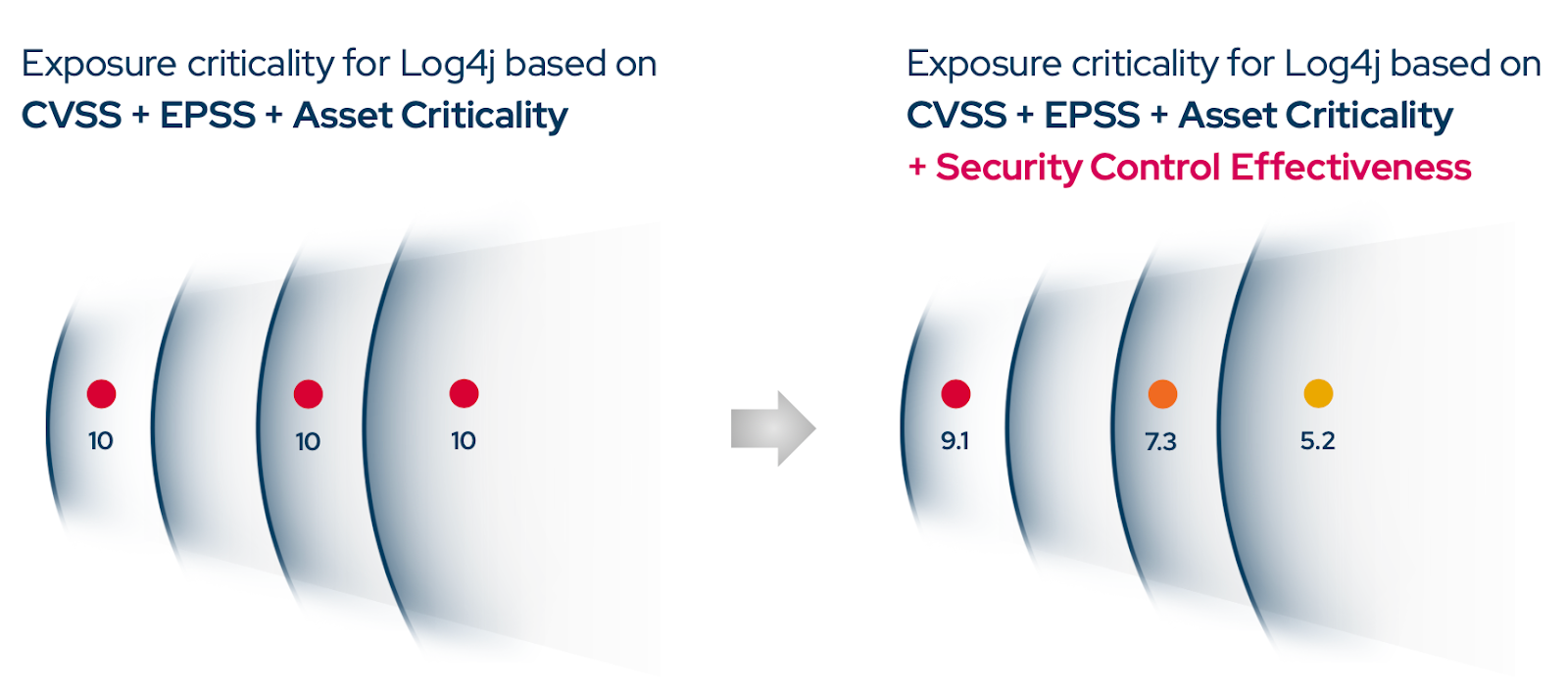
Figure. Calculating the Risk Score Factoring Security Control Effectiveness with Picus
Optimization of Security Tools and Resources
One of the most significant benefits of AEV is its ability to identify underperforming tools, those that are part of the security stack but fail to effectively block attacks. By validating security controls against simulated attack techniques, AEV helps identify which tools or configurations are ineffective, enabling leaner, more efficient security teams to focus resources on the most effective defenses. This optimization cuts down on wasted resources and ensures that security teams are not overwhelmed by irrelevant or theoretical alerts.
Proven Risk Reduction and ROI Metrics
AEV delivers quantifiable metrics that prove the effectiveness of security investments. These metrics include Mean Time to Detect (MTTD), Mean Time to Respond (MTTR), reductions in vulnerability backlog, and rollbacks, all of which help organizations measure how quickly they can identify and respond to real threats.
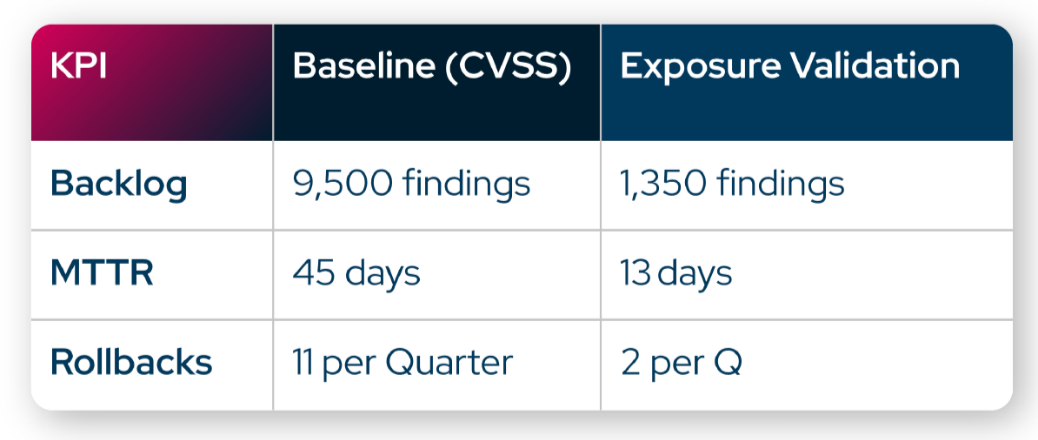
Figure. Backlog, MTTR, and Rollback Decrease with Picus Exposure Validation
By continuously validating security controls and aligning them with real attack paths, AEV ensures that each dollar spent on cybersecurity delivers measurable outcomes, proving the ROI of security budgets.
Prioritization Based on Exploitability
AEV enhances decision-making by focusing on vulnerabilities that can actually be exploited, rather than those that simply look risky. Through continuous validation, AEV helps organizations prioritize exposures that are likely to lead to successful attacks, enabling security teams to focus on the most critical vulnerabilities first.
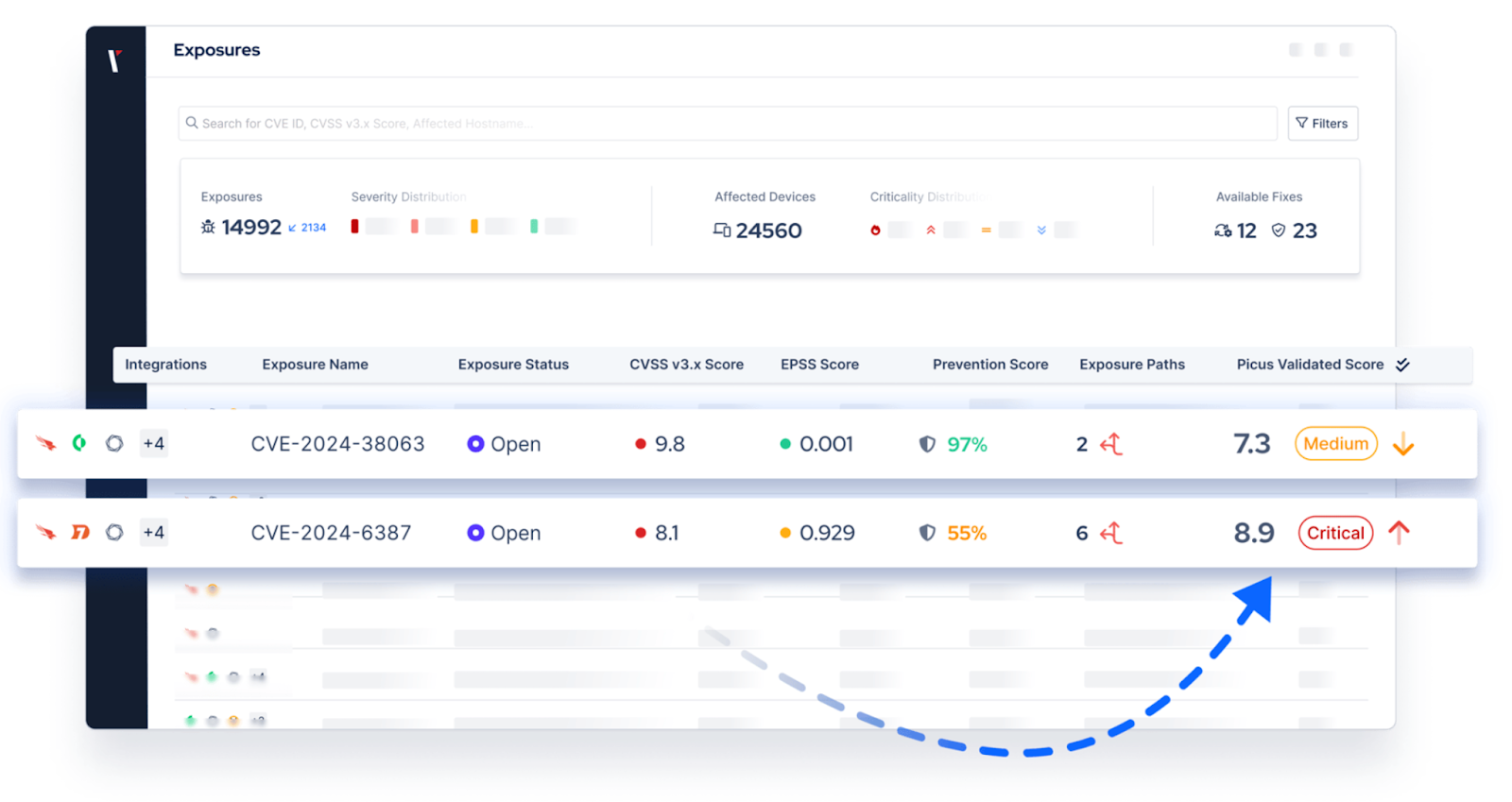
Figure. Validated Risk Prioritization with Picus Exposure Score
This approach ensures that the highest-priority threats are addressed before they can be leveraged by attackers.
How Picus Delivers Continuous Validation Through AEV
The Picus Security Platform is built around the principle of continuous adversarial exposure validation. Instead of relying on annual pentests or periodic vulnerability scans, Picus enables security teams to run meaningful tests on-demand, as often as needed.
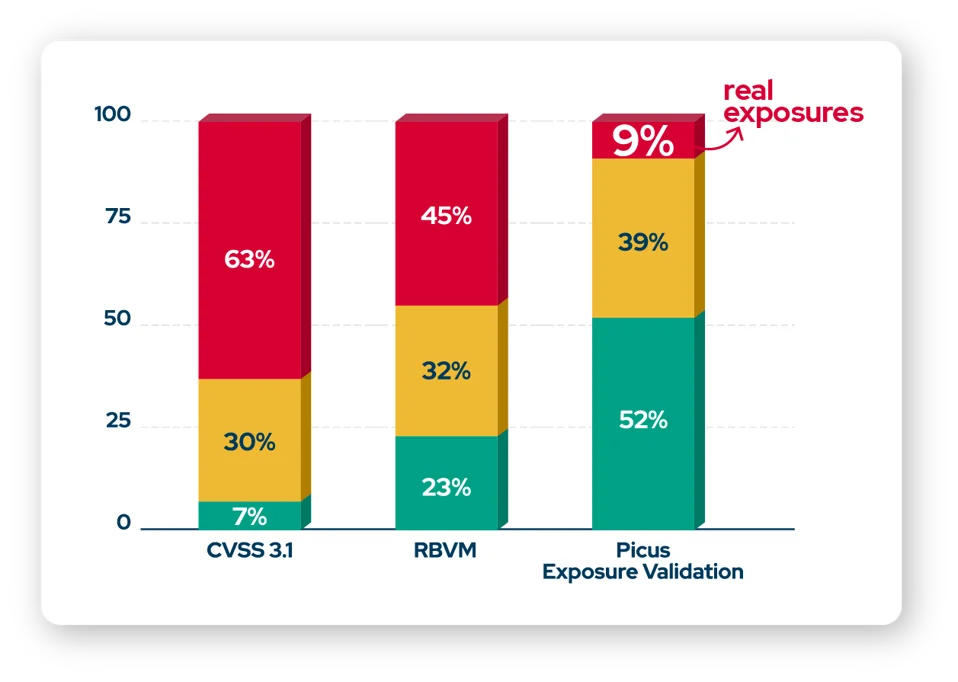
Picus combines two powerful validation technologies:
- Breach and Attack Simulation (BAS): Continuously simulates adversarial techniques to verify whether security controls effectively stop real-world attack techniques. By leveraging Agentic AI, Picus accelerates the process of threat analysis and emulation, allowing organizations to validate defenses against the latest attack tactics in real time. This ensures that security teams can respond to emerging threats without delay, and that defenses are always tested against the most relevant and up-to-date attack strategies.
- Automated Penetration Testing (APT): Automates penetration testing to simulate complex, multi-step attacks that real attackers would use, such as Kerberoasting, privilege escalation, and identity exploitation. This technology goes beyond simple vulnerability scanning by chaining together vulnerabilities to simulate realistic attack paths. APT ensures that security controls are effectively tested under conditions that mirror actual attacker behavior, identifying any gaps in defenses before attackers can exploit them.
By integrating these two technologies, Picus continuously validates exploitability, helping organizations shift from guessing which vulnerabilities pose a threat to knowing exactly where their defenses are strong, and where they need improvement. This approach ensures that security teams can prioritize real risks with high confidence, and take action based on validated threats rather than theoretical ones.
Ready to optimize your cybersecurity budget and maximize ROI?
👉 Request a demo today and take the first step toward a more effective cybersecurity strategy in 2026.
References
[1] Gartner Analysts to Discuss Ongoing Security Challenges at the Gartner Security & Risk Management Summit 2025, September 22-24 in London, U.K. https://www.gartner.com/en/newsroom/press-releases/2025-07-29-gartner-forecasts-worldwide-end-user-spending-on-information-security-to-total-213-billion-us-dollars-in-2025
[2] How CISOs Should Plan Security Budgets for 2026 https://www.wiz.io/blog/ciso-budget-planning-2026
[3] 2026 Cybersecurity Budget: Complete Enterprise Planning Guide https://www.elisity.com/blog/2026-cybersecurity-budget-complete-enterprise-planning-guide


-3.png?width=353&height=200&name=image%20(61)-3.png)