There is a harsh reality for modern organizations: buying more security tools doesn't mean you are more secure. Your firewalls, email gateways, endpoint prediction solutions, and SIEM platforms only protect you if they are properly configured, tuned, and effective against real-world attacks. The problem is most organizations don’t continuously test whether that’s actually true.
Traditional methods, such as vulnerability scanners and manual penetration testing engagements, provide snapshots of your security posture. Modern threats evolve daily. Environments are dynamic, changing constantly. Hence, relying on point-in-time assessments introduce nothing but a false sense of security.
BAS services change the model.
Breach and Attack Simulation services deliver continuous, automated validation of your security controls using safe, real-world attack techniques. Instead of assuming your defenses work, BAS proves whether they prevent, if not, detect, log, and alert as intended.
BAS eliminates assumption-driven security and checkbox compliance, replacing them with continuous, evidence-based validation of real defensive effectiveness.
What Are BAS Services?
Breach and Attack Simulation (BAS) services use automated platforms to safely simulate and emulate real-world cyberattacks against your organization's implemented security infrastructure.
Instead of waiting for:
- An annual penetration test report
- A compliance audit
- Or worse, a real attacker to expose a gap
BAS enables organizations to leave behind the reactive, two-step approach and evolve to proactively validate whether their implemented security controls actually work under a real, sophisticated cyberattack.
A BAS tool validates your exploitable exposures in your security gaps & hardens them by:
- Emulating real attacker tactics, techniques, and procedures (TTPs) observed in the wild
- Simulating the full attack lifecycle (initial access → lateral movement → exfiltration)
- Testing both prevention and detection layers (NGWF, WAF, IPS/IDS, SEG, EDR, XDR, SIEM, so on.)
- Running safely in production environments without disrupting operations
- Providing ready-to-apply, single-click both vendor-neutral & vendor-based mitigation suggestions for quick fixes
Rather than asking “Are we compliant?,” BAS assessments answer the more important question.
|
If we were attacked today, would our current security controls stop it? |
Why Traditional Testing Isn't Enough Anymore
To understand the value of BAS services, you have to look at the limitations of traditional security testing.
Vulnerability Scanners Lack Context
Vulnerability scanners are effective at identifying missing patches and misconfigurations. However, they generate large volumes of noise without providing a proof-of-exploitability.
Based on publicly known CVE databases, vulnerability scanners assign severity scores using industry-standard systems such as CVSS and EPSS, which rely on global worst-case assumptions.
However, by design, they do not account for:
- Prevention & detection layer controls already in place
- Asset criticality (in terms of business operations)
- Threat landscape (whether a vulnerability is leveraged in a campaign)
- Real-world exploitability in your own specific IT environment
As a result, a vulnerability with a CVSS score of 9.8 must be treated as critical, even if your WAF or IPS consistently blocks exploitation attempts.
Moreover, for compliance adherence, your IT team ends up enforcing aggressive patch SLAs based on scanner output alone, often disrupting business operations while more exploitable attack paths remain unaddressed.
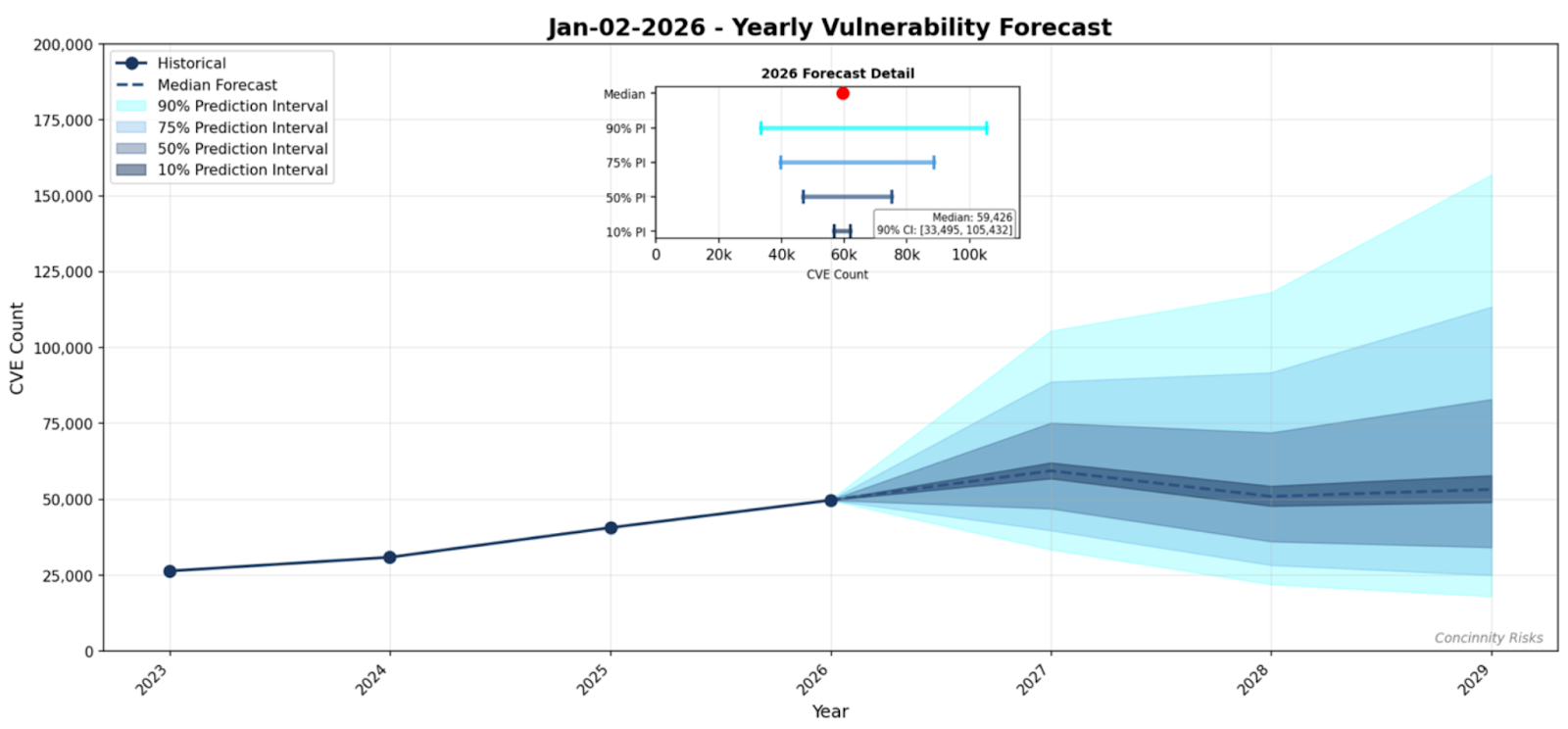 Figure 1. Vulnerability Forecast for 2026, by FIRST.
Considering that in 2025 alone, more than 49,000 vulnerabilities were disclosed, with nearly 40% labeled high or critical, relying solely on vulnerability scanners creates a dangerous gap between theoretical risk and validated risk, and unnecessary pressure on your security team.
To have an in-depth comparison of BAS vs vulnerability scanners, read our blog.
Penetration Testing is Point-in-Time
Penetration testing is valuable. It shows how an attacker could exploit your environment at a specific point in time.
But that’s the key limitation: it’s point-in-time.
Modern environments change constantly. New systems are deployed. Access rights shift. Cloud workloads scale up and down. Configurations drift. Meanwhile, new vulnerabilities and attack techniques emerge daily.
A penetration test may accurately reflect how secure you were on Tuesday.
If a firewall rule is misconfigured on Wednesday, or a critical vulnerability is disclosed on Thursday, that exposure may remain invisible until the next engagement.
Pentesting is also resource-intensive and difficult to scale. It cannot run continuously, and it cannot realistically keep pace with today’s rate of change.
- It answers: “Could we be breached right now?”
- It does not answer: “Are we continuously resilient as our environment and threats evolve?”
Relying purely on human offensive security testing to constantly test your defenses is incredibly cost-prohibitive and difficult to scale. To have a better understanding of BAS services vs pentesting, you can visit this blog.
Security Tool Sprawl and Control Drift
As cybersecurity budgets increase, so do the technology investments.
However, there is a high correlation between the cybersecurity budget and the number of technology investments. A recent research shows that simply adding more solutions to the security stack often results in operational friction rather than improving the security posture.
|
Organizational Category |
Total Security Tools |
Cloud-Specific Tools |
|---|---|---|
|
Global Enterprise (>25k staff) |
60 – 100+ |
30 – 60+ |
|
Elite Budget Tier(>$25M) |
35 – 80+ |
20 – 50 |
|
Mid-Market Core (5k – 10k staff) |
25 – 50 |
25 – 50+ |
|
Market Baseline (Global Avg) |
25 – 55 |
15 – 35 |
Table. Number of Security Controls per Organizational Category
This is because security tools require continuous tuning, integration, rule updates, policy alignment, and operational oversight.
Furthermore, modern infrastructures are highly dynamic.
- Configurations change.
- Access rights evolve.
- New SaaS applications are introduced.
- Cloud workloads scale dynamically.
- Detection rules become outdated.
- Control policies drift.
And let’s be honest, manual security assessments methods cannot validate every single security measure implemented against both known and emerging threats observed in the wild.
In terms of operational practices, this is just infeasible.
Hence, without continuous validation, organizations operate under the assumption that their layered defenses are working, when in reality, control effectiveness may degrade silently over time.
|
Useful Statistics. Based on the Red Report 2026, we saw that 80% of the top 10 most commonly used techniques aim at stealth. In fact, while Data Encrypted for Impact decreased by 38%, data exfiltration via Application Layer Protocols is seen in 1 out of every 5 malware. We know that the "ransomware" smoke alarm is gone, and adversaries are becoming stealthier and want to stay in as long as possible. So, just because you do not see an intrusion happening does not mean that they are not there. |
The Key Benefits of Using BAS Services
Implementing BAS as part of your core security strategy fundamentally shifts you from a reactive posture to a proactive one.
Here is why organizations are making the switch:
Continuous Security Validation
Cyber threats are 24/7, and your security validation should be too.
BAS services run continuously, automatically updating with the latest threat intelligence to test your multi-layered defense stack against both known, and newly discovered APT groups and malware strains the moment they hit the wild.
|
Important Note. The BAS services are moving towards the Agentic BAS approach. This represents the next evolution of BAS services by combining AI speed with controlled, safe validation. Instead of solely using LLMs to generate exploit code, which can introduce hallucinations and operational risk, agentic BAS uses AI to analyze threat intelligence, extract relevant attack techniques, and map them to a trusted library of safe simulation actions. This allows organizations to turn an emerging threat report into a validated attack scenario within hours, not days. The result is faster, more reliable threat validation without introducing new risk to production systems. Click here to read more. |
Maximizing Your Security ROI
Most organizations use only a fraction of the capabilities their security tools offer.
BAS highlights exactly which tools are failing to detect or block threats. This allows you to fine-tune your existing investments, like optimizing your SIEM rules or adjusting your EDR policies, rather than blindly buying more software.
Safe, Non-Disruptive Testing
Unlike manual penetration testing, which can sometimes accidentally take down a server or disrupt operations, BAS services are designed to be entirely safe. They simulate the behavior of an attack without delivering the destructive payload, ensuring your day-to-day business operations run smoothly.
To read more about if BAS tools are actually safe to run, click here.
Prioritizing Vulnerability Remediation
Instead of handing your security team a list of 10,000 theoretical vulnerabilities, BAS provides highly contextual, actionable, proven data to work on.
BAS services identify which attack techniques are viable, for instance, which of the techniques are prevented by your security controls, if not, detected, logged, and alerted, allowing your team to focus on fixing the gaps that pose the most immediate risk to the business.
Below, you will find first-hand-driven statistics from our platform.
|
Baseline (CVSS) |
Exposure Validation with Picus Security |
Exposure Validation with Picus Security |
|
Backlog |
9,500 findings |
1,350 findings |
|
MTTR |
45 days |
13 days |
|
Rollbacks |
11 per Quarter |
2 per Quarter |
This data is strong proof that, with security control validation, your team can stop treating every prevented “high critical” CVE as a strong SLA. From another perspective, you can also identify if a seemingly “medium” critical vulnerability can turn into an initial foothold by adversaries.
Ready to Validate Your Defenses? Meet the Picus Security Control Validation Platform
Knowing that you need continuous validation is the first step. The second is choosing a solution that actually makes your security team's life easier, rather than adding to their alert fatigue.
This is where the Picus Platform steps in.
As a pioneer in the BAS space, the Picus Security Control Validation (SCV) product goes beyond simply running automated attacks. It is designed to proactively test your defenses, identify visibility gaps, and instantly provide the exact mitigation signatures you need to fix them.
Here is how Picus SCV elevates your security posture:
- Real-World Threat Library: Picus SCV boasts a massive, continuously updated library of thousands of real-world threats, mapped directly to the MITRE ATT&CK framework.
- Actionable Mitigation Insights: When Picus finds a gap, it doesn't leave you hanging. The platform provides both vendor-neutral & vendor-specific, easy-to-apply, single-click mitigation rules for your specific firewalls, SIEMs, and IPS/IDS systems.
- Executive Reporting: Easily translate deeply technical security metrics into clear, quantifiable risk scores that your C-suite and board of directors can easily understand.
Don't wait for a breach to find out if your security controls are working.
Get your free demo, and discover how Picus Security Control Validation can transform your security posture from uncertain to undeniably robust.


.png?width=353&height=200&name=Picus-Frost%26sullivan-Awards-preview-april22%20(1).png)
.png?width=353&height=200&name=picus-cyber-fundamentals-6surfaces-validation-preview-april8%20(2).png)
.png?width=353&height=200&name=picus-cyber-fundamentals-6surfaces-validation-preview-april8%20(1).png)