Automated pentesting and automated red teaming run the same offensive engine but point it at different goals. Automated pentesting is broad: it tries to compromise everything reachable and map the whole attack surface. Automated red teaming is narrow: it drives at one defined objective and answers a single yes-or-no. Same techniques, opposite intent, exhaustive breadth versus surgical focus. Mature programs run both.
Defining automated penetration testing
Automated penetration testing is software-led offensive testing that exploits and chains everything reachable into multi-stage attack paths, mapping how far an attacker could get from a foothold. It answers one question: what can be compromised here?
It works from a human-defined scope and a library of techniques, using a rule-based engine to pick the next move from the result of the last one. Once running, it behaves like an attacker with no fixed target: exploit a weakness, harvest credentials, move laterally, re-enumerate from the new foothold, escalate privileges, and repeat, taking everything it can. The output is a wide map of the attack surface: every viable path, the choke points that connect them, and prioritized remediation to close them. Because it explores exhaustively, it runs longer and surfaces far more than any single decision usually requires.
Defining automated red teaming
Automated red teaming is software-led offensive testing aimed at one specific objective: proving whether a particular outcome is achievable, such as ransomware reaching critical assets or an attacker crossing a new segmentation boundary. It answers a different question: can this specific thing happen?
Red teaming is an engagement, so the objective and scope are defined up front. The rule-based engine then drives straight at that goal, fast, focused, and deliberately ignoring the rest of the attack surface, because a wide inventory is not the point. The result is one concrete, evidence-backed yes-or-no, delivered quickly.
Automated pentesting vs automated red teaming: at a glance
|
Automated pentesting |
Automated red teaming |
|
|
Question it answers |
What can be compromised here? |
Can this specific thing happen? |
|
Scope |
Broad: everything reachable |
Narrow: one defined objective |
|
Intent |
Map the whole attack surface |
Prove one outcome |
|
Duration |
Longer, because scope is "everything" |
Fast and surgical |
|
Output |
A map of viable paths and choke points |
One evidence-backed yes-or-no |
|
Best for |
Comprehensive exposure validation |
Validating a specific change or threat |
Do automated pentesting and automated red teaming use the same techniques?
Yes. The offensive discipline is identical: discovery, exploitation, credential abuse, lateral movement, and privilege escalation, all driven by the same rule-based engine within a human-defined scope. What changes is not the technique but the mission you point it at.
That is the whole distinction. Give the engine the scope "everything reachable" and it runs a pentest, fanning out to inventory every exploitable path. Give it one objective, "can an attacker cross this boundary?", and it runs a red team, driving straight at that goal and ignoring the rest. A useful rule of thumb: a thorough pentest can run for a long time because its scope is "everything," but a red team should not. If a red team engagement stretches that long, the scope was too big, and it has effectively become a pentest.
Is automated red teaming just a smaller automated pentest?
No. It is scoped to a single defined objective from the start, not a trimmed-down "take everything" run. A pentest would surface the same finding, but only as a by-product of mapping the whole estate; automated red teaming exists to answer one question fast, without the larger, slower map around it. The intent, proving one specific outcome, is what makes it red teaming rather than a small pentest.
When should you use automated pentesting vs automated red teaming?
Use automated pentesting to map exposure across an environment: what is reachable, what chains together, and where the choke points are. Use automated red teaming to get a fast, definitive answer on one specific risk before it reaches production.
- Reach for automated pentesting when you want comprehensive attack-surface validation, a full picture of exploitable paths to critical assets, or the blast radius of a newly disclosed CVE.
- Reach for automated red teaming when you have made a specific change, new segmentation, a new identity policy, a new control, and need to validate one outcome quickly, or when you want to confirm whether a defined threat like ransomware can achieve its goal. A newly split network segment is the classic case: you do not need a full inventory of every vulnerability, you need a yes-or-no on whether an attacker can still cross the boundary, and you need it now.
Can automated red teaming replace automated pentesting?
No. They answer different questions, so one cannot stand in for the other. "Can this one thing happen?" and "what can be compromised here?" are complementary, and a complete program runs both: pentesting for breadth, red teaming for the fast, targeted checks that breadth would slow down.
One boundary is worth keeping clear for either mode. Both prove whether an attack succeeds; neither confirms whether your detection rules fired or your prevention controls blocked it. That remains the job of breach and attack simulation and detection validation, working alongside offensive testing in a layered program.
How is this different from autonomous red teaming?
Automated red teaming still follows a rule-based engine and a human-defined objective. Autonomous red teaming replaces that engine with an AI agent that reasons in real time and scopes the objective itself from a signal, such as a new segmentation policy or fresh threat intel, rather than waiting for a human to define it. Same offensive discipline and the same breadth-versus-focus split, but a different decision layer and trigger. This is where modern platforms are heading.
To learn more about the comparison of autonomous pentesting and red teaming, you can read this article.
Where Picus fits in
Finding the exposure was never the hard part. Proving the right call, patch, mitigate, monitor, or accept, is the gap.
Picus Autonomous Penetration Testing runs both jobs on one engine: a broad attack-path engagement when you need to know what is reachable, or a narrow, surgical objective when you need a fast yes-or-no on one control change. It chains real attacks across your network, endpoints, and Active Directory to prove which exposures are genuinely exploitable, ordered by blast radius rather than a severity score, with guardrails you control.
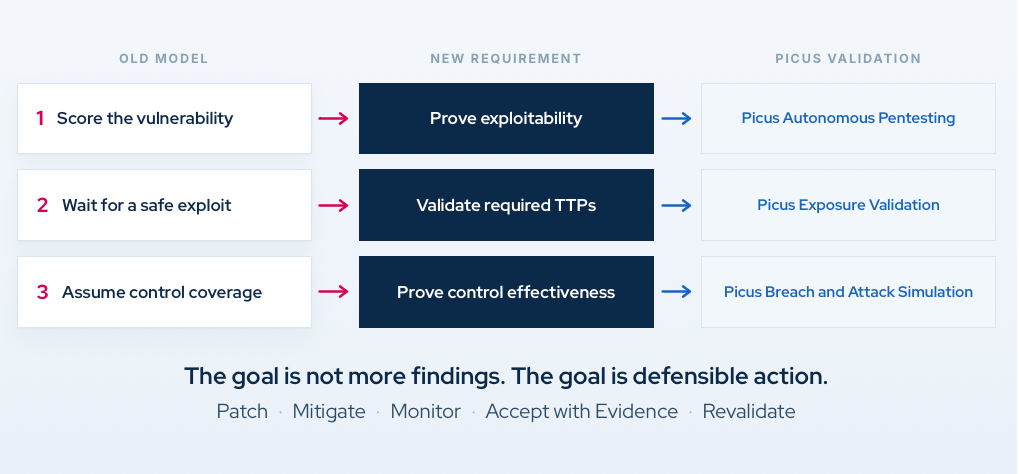
Offensive testing only proves that an attack succeeds, so Picus closes the rest of the loop too.
- Picus Exposure Validation proves exploitability on the business-critical, restricted, and air-gapped assets a live exploit cannot safely touch, and on CVEs with no working exploit.
- Picus Breach and Attack Simulation confirms whether your EDR, SIEM, and firewall actually detect and block the techniques behind each finding, and keeps every decision defensible as controls and assets change. That is one continuous loop: validate, decide, fix, re-validate.
The outcomes track Gartner’s recommended program KPIs:
- 2x control effectiveness within three months,
- an 89% reduction in MTTR on emerging threats, and
- 92% fewer SLA violations on high and critical vulnerabilities.
Get your free demo to map the whole attack surface, or validate one objective before it ships, and prove it either way.