Automated penetration testing is used by vulnerability management teams, SecOps analysts, red and blue teams, CISOs, and the MSSPs and MSPs who serve them. It runs real attacker techniques, reconnaissance, exploitation, credential access, lateral movement, and privilege escalation, against a live environment to prove which attacks would actually succeed, then turns each result into a defensible decision.
What they share is one problem: scanners and severity scores say what exists, not what an attacker can reach and exploit here. Automated penetration testing answers that on demand, instead of waiting on a once-a-year manual engagement.
Who uses it, and why:
- Vulnerability management teams use it to cut a backlog of thousands of findings down to the ones that are genuinely exploitable, prioritized by blast radius instead of CVSS.
- SecOps teams without a red team use it to run real attack-path testing themselves, no offensive specialist required.
- Blue teams and SOC analysts use it to see which attacks slip past detection and where, and to sharpen alerting against real, validated paths instead of theoretical threat lists.
- Red teams use it to scale attack-path discovery across the estate and free their experts for novel, high-creativity work no tool has seen before.
- CISOs use it to see which attacks would actually reach the crown jewels, then defend each remediation call and the budget to the board.
- MSSPs and MSPs use it to deliver repeatable, evidence-backed testing across many client environments at once.
Do you need an in-house red team to use automated penetration testing tools?
No. Automated penetration testing tools are built so a vulnerability management analyst, a SecOps engineer, or a small team can run real attack chains without a dedicated offensive unit. It works the way a pentester does: from an initial foothold, it enumerates the environment, exploits what it can, harvests credentials, moves laterally using what it found, escalates privileges where possible, and repeats on every new host it reaches. Each step feeds the next until the chain either reaches a crown-jewel asset or breaks against a control. What comes back is a validated attack path from entry point to impact, not a pile of isolated findings ranked by severity.
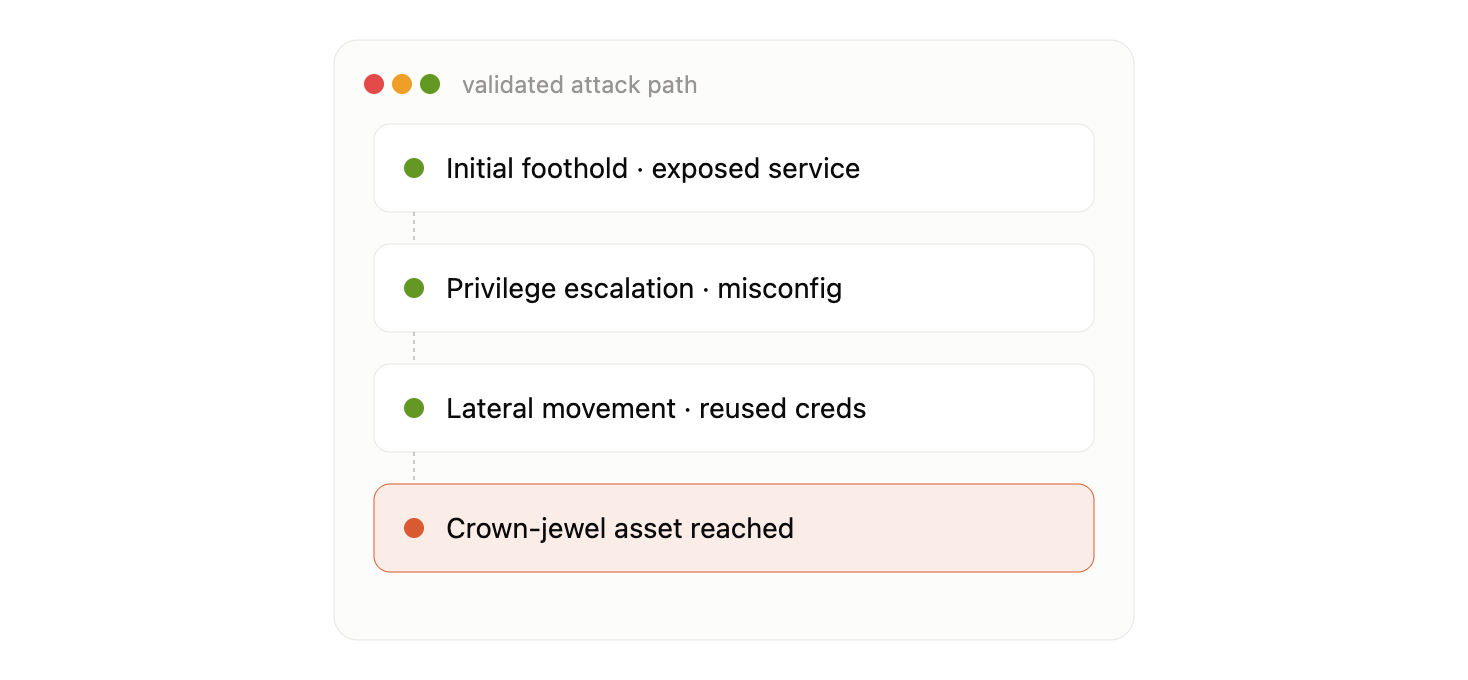
Teams that do have a red team use it to scale rather than to start. It covers the full estate on demand, at a frequency no manual engagement can match, so human experts spend their hours on novel attacks no tool has seen before. A red team makes the practice stronger, but it was never the entry requirement.
How do blue teams and SOC analysts benefit from automated pentesting?
They get a per-step verdict on every control in the attack path, not a hopeful assumption. When automated penetration testing runs a real attack chain through your environment, each step hits your live defenses. The result is not just "path succeeded" or "path failed." You see exactly which control caught which step: the NGFW prevented the exfiltration attempt, but the EDR was bypassed during credential dumping. The SIEM did not alert on lateral movement. The email gateway blocked the malicious payload.
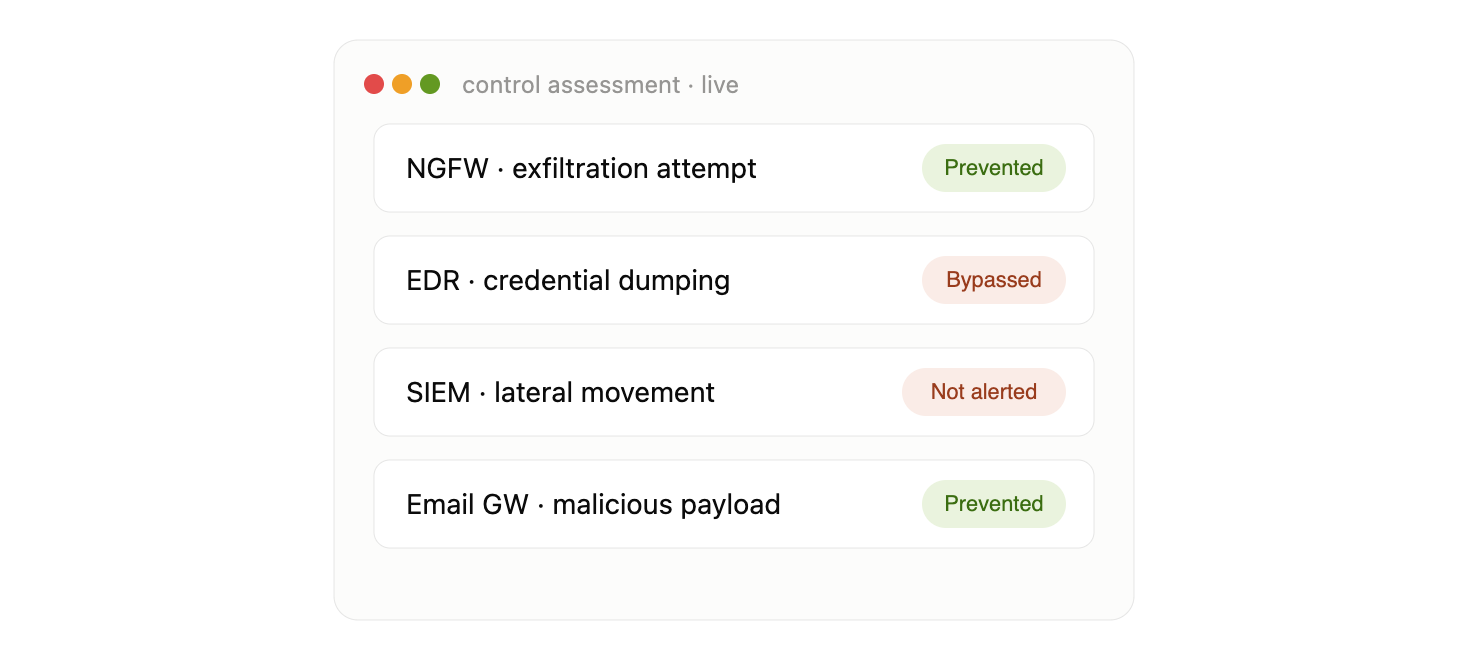
That tells a SOC analyst exactly where to focus. Instead of tuning rules against a theoretical threat list, the team is closing gaps that a real attack chain just proved exist. And because tests can be scheduled at regular intervals, control drift gets caught in weeks rather than months later during the next manual assessment.
|
A note on scope: the per-step verdicts you get from automated pentesting are a byproduct of running real attack chains. If the goal is to systematically test your entire prevention and detection stack against the latest attacker techniques, that is Breach and Attack Simulation, a separate discipline. The two are complementary: automated pentesting proves which attack paths reach the crown jewels; BAS proves what your controls block and detect across the full technique landscape. Together they close the loop, attack surfaces validated, controls validated, every decision defensible. |
Why do CISOs care about automated pentesting specifically?
Because it turns "we think we are covered" into "we can prove which attacks would actually succeed," and that proof is what a CISO needs to defend every remediation call to the board. Scanners produce thousands of findings ranked by severity. Automated penetration testing proves which of those an attacker can actually chain into a path to the crown jewels and which they cannot. That changes the conversation from "we have 4,000 criticals" to "these 180 are genuinely exploitable, here is the decision on each: Patch, Mitigate, Monitor, or Accept, backed by evidence from our own environment."
It moves the needle on three things a CISO is measured on.
- First, prioritization without firefighting: the backlog gets cut to what is truly exploitable, so the team works on what matters and carries defensible exceptions on everything else. Organizations that switch from severity-based to exploitability-based prioritization routinely see double-digit drops in SLA violations and critical ticket volume.
- Second, an always-current answer: environments shift constantly, new assets, misconfigurations, identity changes, and a point-in-time pentest expires the moment any of those move. Automated testing runs on a regular cadence, so the CISO can answer "are we secure right now?" with a recent test, not a three-month-old report.
- Third, budget defense: proving which exposures are real and which are not makes it far easier to justify where the security budget goes and demonstrate program effectiveness to leadership and auditors.
Do SMBs benefit from automated pentesting tools, or is it only for enterprises?
Both benefit, for different reasons. For an SMB, automated penetration testing delivers enterprise-grade attack-path testing without hiring or retaining a costly red team, which is often the only way a smaller organization gets regular, on-demand coverage at all. The barrier to real exploit-chain testing drops to running the software.
For enterprises, the value is scale and reach. A sprawling estate has thousands of hosts, identities, and network paths, and a manual engagement can only test a slice of them before the report is due. Automated testing covers that breadth on demand and safely in production, at a depth and frequency manual engagements cannot match. The need is industry-wide. About 68 percent of a typical enterprise attack surface goes untested, and 95 percent of organizations rank pentesting a top priority (Synack and Omdia, 2026). Automation is how both ends of the size range close that gap.
What industries get the most value from automated penetration testing?
The industries with the most to lose from downtime or a breach get the most value: financial services, healthcare, manufacturing, retail, energy, and the public sector. Anywhere operations must stay up, and regulators expect proof, knowing which attacks would actually succeed is worth more than another severity-ranked queue. Public-sector and regulated buyers have an added driver: CISA's Binding Operational Directive BOD 26-04 (June 2026) replaced CVSS-led patching with prioritization based on whether a vulnerability is exposed, exploited, automatable, and capable of giving full control, and regulated industries tend to follow federal standards.
On vulnerability management, the two are sequential, not competing. Vulnerability scanners find and inventory exposures across the estate. Automated penetration testing proves which of those exposures are genuinely exploitable in your environment. With around 135 new CVEs published per day and fewer than 0.5 percent ever patched upstream, finding the exposure was never the hard part. Proving the right call is. An automated pentesting tool ingests assets, vulnerabilities, and business context from scanners like Tenable, Rapid7, and Wiz, then prioritizes by validated exploitability instead of CVSS score, so teams patch what an attacker can actually reach and safely deprioritize what is not exploitable here.
How do you convince my CISO/board to invest in automated pentesting?
Lead with business outcomes, not features, then back them with proof. Boards fund resilience and disciplined spend, so make the case in their terms:
- Keep the business running by closing the specific attack paths that reach critical operations.
- Spend where it changes the outcome by acting on the exposures attackers can actually reach, not the loudest severity scores.
- Do less low-value patching, with evidence behind every deferral.
- Cut firefighting by shrinking the critical backlog to what is truly exploitable.
- Answer "are we ready for machine-speed threats?" with proof rather than an assertion.
Then bring the numbers, such as: 92 percent fewer SLA violations on high and critical vulnerabilities, a critical ticket backlog cut by 98 percent, and weeks of manual pentesting compressed to minutes. And address the "expiring snapshot" problem directly: the environment changes constantly, so a once-a-year engagement cannot keep pace. Automated testing runs at the cadence you set, weekly, monthly, or quarterly, which means the exploitability picture stays current and every decision stays defensible instead of expiring with the next annual cycle.
Close with the policy tailwind. BOD 26-04 turned exploitability-driven prioritization into a federal standard in 2026, which moves validation from "nice to have" toward "where the rules are heading."
How do MSSPs and MSPs use automated pentesting for client delivery?
To deliver repeatable, evidence-backed attack-path testing across many clients at once. Manual engagements do not scale to a managed-services book of business. Automated penetration testing lets a provider run consistent, scheduled testing across every client environment, then produce clean reports showing exactly what an attacker could reach in each one.
That shifts the service from a point-in-time report that expires the day it ships to a regular testing program. Providers schedule weekly or monthly test cycles across their client base, so each client's exploitability picture stays fresh between engagements. They use this to differentiate their offering, to justify retainers with proof instead of activity logs, and to triage client risk by validated exploitability rather than raw scanner output. The practical payoff is that engineers spend their hours where they actually reduce a client's risk, and the provider has defensible evidence to show for every billing cycle.
How do I present automated pentest findings to a non-technical board?
Lead with attack paths and decisions, not CVE counts. A board does not act on a list of 480 vulnerabilities. It acts on a sentence: these are the attacks that would actually reach what matters, and here is the decision we made on each. Translate every finding into one of four defensible calls: Patch, Mitigate, Monitor, or Accept, each backed by evidence from your own environment.
Then answer the question the board is really asking: are we secure right now, and can we prove it? Show the attack paths proven in your specific environment, which chains you have already broken, and the residual risk you are knowingly carrying.
An illustrative example makes it concrete: 480 undifferentiated alerts on a single CVE become 180 actions that matter and 300 accept decisions you can defend in an audit. That contrast, from noise to a short list of evidence-backed calls, is the entire story a board needs to hear. And because automated testing can be run as often as needed, the answer does not expire with the next infrastructure change. You can stand behind it the next quarter too.
What makes Picus Autonomous Pentesting different from automated pentesting?
It does not wait for a human to press go. Most automated pentesting tools run when someone triggers them. Picus made its pentesting autonomous because adversaries now weaponize new CVEs in hours and break out in under 30 minutes. Validation that waits for a schedule or a manual trigger leaves windows that machine-speed attackers are built to exploit.
Picus Autonomous Pentesting is signal-driven. When a new CVE is disclosed, a configuration drifts, a new asset comes online, or an emerging technique surfaces in the wild, the platform responds on its own: it plans the attack chain, executes it against your live environment, and delivers a validated result without a human in the loop (it is completely auditable, and tunable to the degree you want to hold the control).
The logic is straightforward: if adversaries use AI to move at machine speed, defenders need validation that moves at the same speed.
Autonomous pentesting alone is not the complete picture
Live exploitation can only safely reach a fraction of the environment, roughly 10 to 15 percent of a typical enterprise's exposure picture. It goes silent on business-critical, restricted, and air-gapped assets, and it cannot test CVEs that have no working exploit. Proving exploitability everywhere takes more than one method:
- Picus Exposure Validation covers what live testing cannot. It maps a CVE to the techniques an attacker must chain to exploit it, then validates those techniques against your actual controls, with no live exploit fired. That means a defensible answer on day one of disclosure, even for the assets no pentest can safely touch.
- Picus Breach and Attack Simulation proves what your prevention and detection stack blocks and detects against the latest attacker techniques, then ships vendor-specific fixes and re-validates that each gap is closed.
Together, the three run as one validation loop: validate, decide, fix, re-validate at machine speed, powered by Picus Swarm. Attack surfaces validated, exposures validated, controls validated, every decision defensible.
Picus customer data shows the difference, all by closing real gaps rather than buying more tools.
- 92% fewer SLA violations on high and critical vulnerabilities,
- 89% reduction in MTTR on emerging threats,
- 2x control effectiveness within three months, and
- a 98% smaller critical-ticket backlog at one customer,
The platform holds a 95 percent recommendation rate, 4.9 on G2, 4.8 on Gartner Peer Insights, and the number one Leader spot on Frost Radar for Automated Security Validation.
Get a demo and see which attacks would actually succeed in your environment.


.png?width=353&height=200&name=picus-APT-cost-july21%20(1).png)
.png?width=353&height=200&name=picus-APT-vs-Red-Teaming-july20%20(1).png)