Manual penetration testing is human-led. Automated penetration testing is software-led. Both attempt real exploitation to prove what an attacker could do, so the difference is speed, scale, and who drives each step. Neither is universally better: most programs run manual engagements periodically and automated pentests on a high-frequency cadence. But both share the same blind spot: they only prove risk where an exploit can safely fire, leaving the restricted assets and no-exploit CVEs that make up most of the attack surface unanswered.
How does manual penetration work?
Manual penetration testing works by putting skilled ethical hackers against your systems to find, chain, and exploit weaknesses by hand. A tester enumerates assets, hunts for weaknesses, chains them together, reaches sensitive data, and writes up the findings.
Its strength is human creativity: reasoning about business-logic flaws, unusual trust relationships, novel attack paths no tool has a signature for, and the kind of sophisticated, improvised EDR bypass a human thinks up on the spot. The trade-off is time and coverage. A manual engagement is a point-in-time snapshot, scoped narrowly, and it starts expiring the moment your environment changes. Run one in March and you have a March answer, even if you deploy new infrastructure in April.
Explaining how automated penetration testing works
Automated penetration testing works by using software to discover, exploit, and validate weaknesses without a human running every step. It runs from a defined scope and a library of attack techniques, using a rule-based engine to pick the next move from the result of the last one, building an attack chain incrementally.
The strength is speed and scale: weeks of manual work compressed into minutes, run often enough that your picture stays current. The trade-off is that automation depends on being able to safely fire real exploits, which works well on assets a tool can reach and touch, and far less well everywhere else. The short version: manual testing goes deep but slow, automated testing goes broad and fast, and they answer different questions.
Can automated pentesting replace manual?
Not entirely, and any vendor who says otherwise is overselling. Automated pentesting extends coverage between and beyond manual engagements, but human testers still lead on novel business-logic flaws and specialized red team work.
Reach for a manual engagement when depth matters more than frequency: a first-of-its-kind application with complex business logic, a compliance audit that requires human sign-off, or a red team exercise modeling a specific threat actor. Reach for automation when currency and speed matter: confirming a fix actually closed a path, keeping pace with an environment that changes weekly, and covering far more of the estate than a scoped manual test can reach.
If the question is "can an expert find the one weird path nobody anticipated?", a human still wins. If the question is "is this still exploitable right now, across everything, and did my fix hold?", automation wins.
Is automated cheaper than hiring a manual pentester?
Per test, yes. A manual engagement carries a high fixed cost and is hard to run often. Automated pentesting has a low marginal cost, so you can run it as often as you like without re-scoping or re-contracting.
But cost per test is the wrong lens. The real economics are about the risk window. A manual pentest you run once a year leaves eleven months where new exposures go unproven. Automated pentesting shrinks that window by re-testing far more often, weekly or on demand, instead of once a year. The cheaper option is the one that keeps you from paying for a breach you could have caught, not the one with the lowest invoice.
How often should you run each?
Run manual engagements periodically, automated pentests on a high-frequency or on-demand cadence. Manual pentests are typically annual or tied to a major release or compliance cycle. Automated pentesting is far more frequent, but it is not truly continuous.
An automated pentesting runtime depends on the attack chain the engagement actually builds. A short path can finish in minutes, while a deep engagement that keeps discovering, exploiting, harvesting credentials, and pivoting across the environment can run for a week. Because a full run is heavy and its length is not fixed, weekly or on-demand at high frequency is the realistic cadence, plus a targeted run whenever something material changes.
The cadence gap matters more than it used to.
New CVEs are now weaponized in hours rather than weeks, adversaries break out in under 30 minutes, and roughly 135 new CVEs are published per day, up about 40% year over year [1].
Testing once a year leaves windows wide open. Frequent automated pentests between manual engagements, and an on-demand run the moment a new CVE or infrastructure change lands, are how you keep those windows closed.
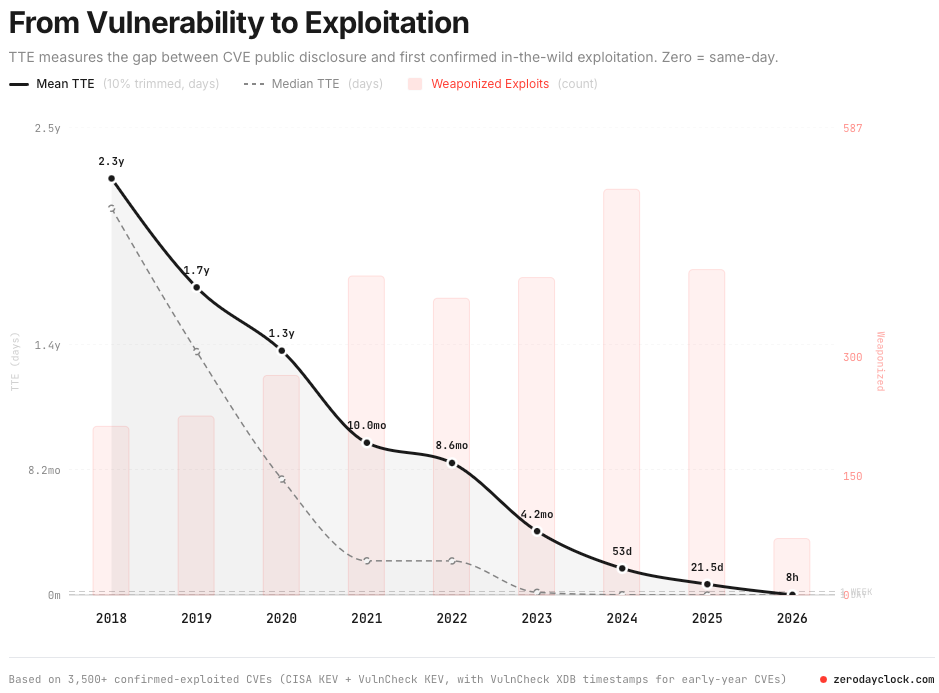
Figure 1. Mean Time to Exploit a CVE by Zero Day Clock
Will automated pentesting find the same vulnerabilities as a manual pentester?
Mostly the documented, well-understood ones, not the creative outliers. Automated pentesting is strong at discovering and chaining documented techniques at scale, but it does rule-based reasoning over a pre-built library, and it runs each technique in its most stable, production-safe form: for pass-the-hash, for example, it reaches for the most reliable build of a known tool like Mimikatz. That makes it reliable but not creative. The improvised, non-obvious methods never surface, because no rule anticipated them. A human tester works differently. Staying just as safe, a skilled tester can still reason toward more creative solutions, which is why they still lead on the genuinely novel attack paths and business-logic flaws that depend on understanding intent.
There is also a coverage limit that has nothing to do with tool quality.
Both approaches prove exploitability by attempting real exploitation, and live exploitation can only run where an exploit can safely fire. According to Synack and Omdia (2026), around 68% of an enterprise attack surface goes untested, with only about 32% tested on average, even though 95% of organizations rank penetration testing a top priority. In a typical enterprise, the safely-testable slice is on the order of 10 to 15% of the exposure picture.
Three structural limits explain the gap.
- Live exploitation cannot safely touch business-critical, restricted, or air-gapped systems, which are usually the assets that matter most.
- Not every vulnerability has a working exploit; roughly 1 in 3 known ransomware CVEs from 2025 had no public or commercial exploit as of early 2026 (VulnCheck, 2026), so execution cannot answer whether they are exploitable in your environment.
- And even when an exploit exists, weaponizing it and adding it to the tool takes time, and that lag lands right when the threat is hottest.
How accurate is automated pentesting compared to manual pentesting?
On the assets it can reach, automated pentesting is highly accurate, because it proves exploitability by real execution rather than predicting it from a score. A validated exploit chain is strong evidence: it either worked or it did not.
Accuracy drops to zero on the assets a live exploit can never safely touch, and on CVEs with no working exploit. That is not a false-positive problem. As we discussed in the previous section, it is a coverage problem, and manual testing hits the same wall on restricted systems. The way to get an accurate answer for the other 85 to 90% of your exposure is control-aware inference: mapping a CVE to the techniques its exploitation requires, then validating those techniques against your actual controls, without firing a live exploit.
Do I still need a manual pentest if I have automated pentesting?
Often yes, for specific reasons: compliance sign-off that requires a human, deep assessments of complex custom applications. Automation handles continuous validation and fast re-testing; manual handles depth and creativity. Most mature programs run both.
But the sharper question in 2026 is not "automated or manual?" It is "how do I get a defensible answer for every exposure, including the 85 to 90% that live exploitation can never safely reach?" Neither a slow manual snapshot nor a partial automated scan answers that alone.
Automated vs manual penetration testing: side-by-side
|
Manual penetration testing |
Automated penetration testing |
|
|
Who drives it |
Human ethical hackers |
Software, on a defined scope |
|
Speed |
Days to weeks per engagement |
Minutes to hours, or a week |
|
Scale and coverage |
Narrow, scoped by hand |
Broad, across the reachable estate |
|
Cadence |
Periodic (annual, per release, per audit) |
Continuous or on demand |
|
Cost per test |
High fixed cost |
Low marginal cost |
|
Best at |
Novel business-logic flaws, creative attack paths, compliance sign-off |
Currency, re-testing fixes, wide continuous coverage |
|
Evidence |
Human-written, point-in-time |
Validated exploit chains, repeatable |
|
Shared blind spot |
Restricted, air-gapped, and business-critical assets a live exploit cannot safely touch; CVEs with no working exploit |
Same limit: proof only where an exploit can safely fire |
The next step: automated pentesting is going autonomous
Here is what has changed in 2026. Automated pentesting, the software-led, rule-based approach described above, now has an autonomous evolution. Instead of a rule engine picking the next move from branches an engineer wrote in advance, an AI agent reasons through each step in real time, and instead of waiting for a scheduled run, the engagement scopes itself the moment a signal arrives (a new CVE, fresh threat intel, or an infrastructure change). This is a distinct model, autonomous penetration testing, not just faster automation. Mature programs increasingly run both.
Finding the exposure was never the hard part. Proving the right call, patch, mitigate, monitor, or accept, is the gap.
Enter Picus Autonomous Penetration Testing
Picus Autonomous Penetration Testing adds an agentic decision layer that reasons in real time, adapting when a step fails, re-planning and choosing the next action to chain real attacks across your environment and prove which exposures are genuinely exploitable, all with guardrails you control. It compresses weeks of manual work into minutes, runs continuously so the picture stays current, and lets you re-validate the exact path you fixed the moment the fix ships. Every decision is backed by a validated exploit chain and ordered by blast radius, not by a static severity score.
Picus does not stop at the slice a live exploit can safely reach.
- For business-critical, restricted, and air-gapped assets, and for CVEs with no working exploit or on day one of disclosure, Picus Exposure Validation proves exploitability without firing a live exploit.
- Picus Breach and Attack Simulation keeps every decision defensible as controls and assets change.
That is one continuous validation loop across attack surfaces, exposures, and security controls: validate, decide, fix, re-validate.
The outcomes track the KPIs Gartner tells programs to measure:
- 92% fewer SLA violations on high and critical vulnerabilities,
- an 89% reduction in MTTR on emerging threats, and
- 2x control effectiveness within three months, all by closing real gaps instead of buying more tools.
Stop choosing between a slow snapshot and a partial scan.
See Picus validate a real exposure end to end, from exploit to fix to re-test, in your own environment. Get your free demo to prove what attackers can actually exploit.
References
[1] https://www.first.org/blog/20251229-Vulnerability-Forecast-Review


.png?width=353&height=200&name=picus-APT-cost-july21%20(1).png)
.png?width=353&height=200&name=picus-APT-vs-Red-Teaming-july20%20(1).png)