The surest way to prove a rocket will fly is to launch it. But no space program proves its fleet that way, because you cannot launch every rocket. Some are one of a kind. Some are crewed, and you will not risk the people aboard. Some exist only as a design on paper, with nothing yet to launch.
So engineers prove the rocket on the ground instead. Engine thrust on a static stand, fuel systems under pressure, heat shields against thermal load. If any required component fails its test, the rocket cannot fly, and they know it without ever leaving the pad. The launch is the proof you reach for when you can. The ground test is the proof you rely on when you cannot. I think about this every time someone tells me their security program will prove exploitability by running an exploit.
The Trouble With Proving It by Launching
Live exploitation is the launch: run a real exploit against a real asset, watch it succeed or fail, and you have the strongest proof there is. This is what automated pentesting tools do, and they do it well. They take the manual penetration test that used to happen once a quarter and run it continuously, at scale, without waiting for a human.
That is real progress, and it is where the story usually stops: automate the pentest and you have solved exposure validation. You have not. Automating the launch makes you faster; it does not change what a launch can reach. The limit is structural, not a matter of how good the tool is or how many you run. You can only fire a live exploit where doing so is safe and where a working exploit exists. That leaves three gaps no automated pentesting tool closes, and stacking three together does not close either:
- No exploit, no rocket to fire. A large share of disclosed vulnerabilities never get a public or safe exploit. With nothing to launch, live testing cannot tell you whether they are exploitable in your environment.
- The crewed rocket you will not risk. Your business-critical, regulated, and air-gapped systems are exactly the ones you cannot safely detonate an exploit against. The assets that matter most are the ones live exploitation must skip.
- The rocket still on the assembly line. Weaponizing a new exploit and adding it to your tooling takes time. The window when attackers are already moving opens long before your launch is ready.
|
The assets that matter most are the ones that live exploitation must skip. |
The Exploit Clock Reset to Hours
This was easier to ignore when exploitation moved slowly. Automated pentesting tools rightly compressed the launch from once a quarter to continuous, but they solved the speed of launching, not the reach of it. The assets a launch must skip are skipped just as thoroughly at machine speed as they were once a quarter.
And the clock has changed. AI has collapsed the time from disclosure to working exploit from weeks to hours. Models generate exploit variants on demand, and increasingly the attacker on the other end is itself automated: agentic, tireless, faster than any human team. A growing share of new vulnerabilities appear in real attack campaigns within a day of disclosure. When adversaries use AI to probe your infrastructure and chain techniques in your environment at machine speed, an automated pentesting tool, however fast, falls behind on everything it cannot safely launch against. Automating the launch is necessary but not sufficient. Proving exploitability everywhere, including where no launch is possible, is the only way to keep pace.
Break the Chain, Break the Exploit: TTP-Chain Validation
Here is what the rocket engineers understood that security is still catching up to: you do not need the launch to know the outcome. You need to know whether every required component would hold.
An exploit is not magic. It is a chain of specific techniques, the tactics, techniques, and procedures (TTPs) an attacker must execute in sequence: gain execution, bypass a protection, escalate privilege, move toward the target. Each link depends on conditions in your environment, and each can be tested on its own against your actual, deployed controls, the way an engineer tests an engine on a static stand without launching the vehicle. We call this TTP-Chain Validation: map a CVE to the chain of techniques its exploitation requires, then validate each technique against your controls. If your environment breaks any required link, the exploit cannot succeed here, and you know it without firing a live exploit. If every link would hold, the exposure is genuinely exploitable, with evidence. It is validation by inference rather than detonation, and it is the only approach that reaches the assets a launch never can, on the day a vulnerability is disclosed, not weeks later.
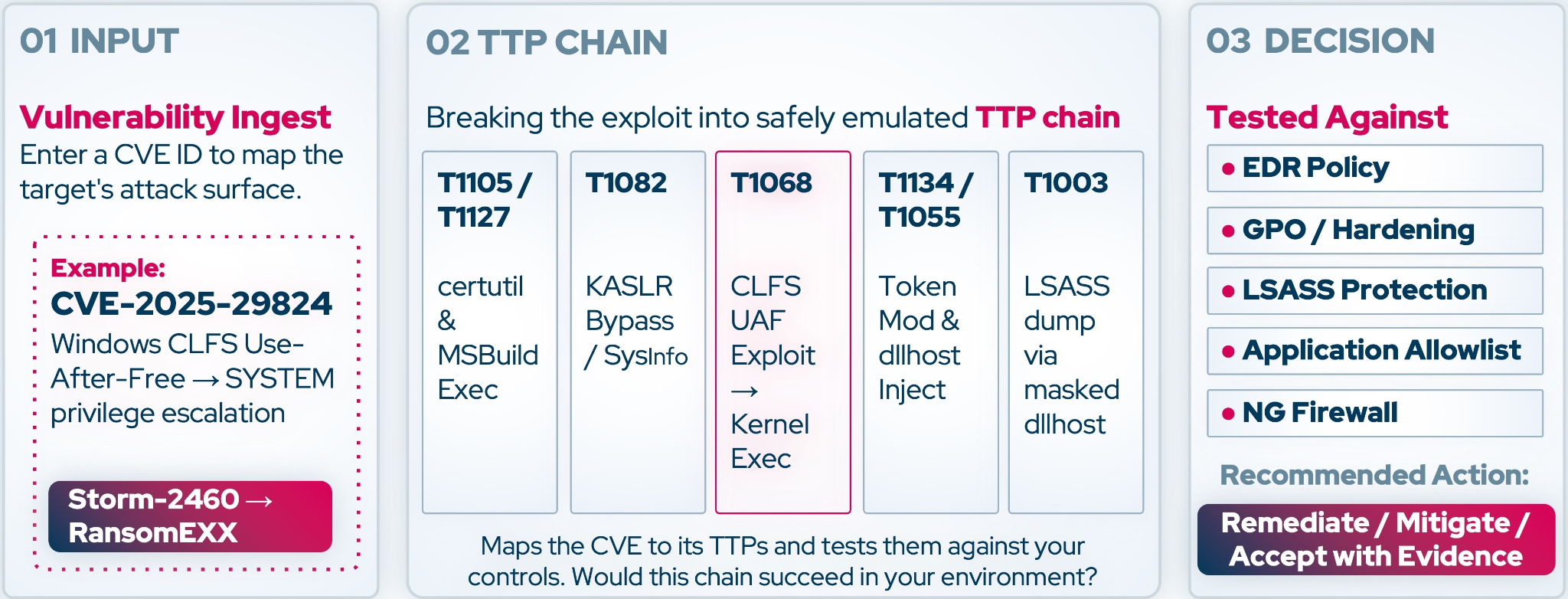
TTP-Chain Validation in action: a single CVE (here, CVE-2025-29824) is broken into its TTP chain and tested against your deployed controls, then resolved into a defensible decision.
|
You do not need the launch to know the outcome. You need to know whether every required component would hold. |
From a Pile of CVEs to a Defensible Decision
For most security teams, finding exposures was never the bottleneck. Scanners surface tens of thousands; severity scores flag most as critical. The list is not the problem. The hard part is proving which exposures an attacker could actually use against your defenses, deciding the right call on evidence, patch, mitigate, monitor, or accept, and mobilizing before the window closes. That is a question about exploitability in your specific environment, and live exploitation can only answer it for the slice it can safely reach.
The strongest programs use both routes deliberately. They run an automated pentest where launching is safe, because nothing beats watching the real thing succeed. And they use TTP-Chain Validation everywhere else, because that is the only way to cover the assets and timelines a launch cannot. The mistake is treating the automated pentest as the finish line rather than one half of the answer. The launch and the chain test are not rivals, and the launch alone is not enough.
One Funnel: From a Fresh CVE to a Defensible Call
This is the principle behind how we built exposure validation at Picus: a single funnel that turns a raw finding into a defensible decision, narrowing stage by stage from a fresh CVE at the top to action at the bottom.
At the top, ingest. A CVE or scanner finding comes in and Picus scopes it to reality: the hosts it affects, their exposure and business priority, and the EDR, GPO, and firewall controls in the path. One advisory can surface hundreds of instances; severity alone cannot say which matter.
In the middle, map and validate. Picus decomposes the CVE into its technique chain, then takes both routes. Where a live launch is safe, Picus Autonomous Pentesting fires the real exploit chain against reachable assets. Where it is not, on critical, restricted, and air-gapped systems, or CVEs with no exploit, Picus Exposure Validation applies TTP-Chain Validation, testing the chain against your controls by inference. Every instance gets an answer: blocked, or genuinely exploitable here.
At the bottom, decide. Hundreds of undifferentiated instances narrow to two piles: the exposures your defenses contain, which you accept with evidence, and the smaller set that are truly exploitable, which resolve into a defensible call with the chain and controls tested attached as proof. Picus Breach and Attack Simulation keeps testing as the environment changes, so last quarter's decision is re-validated, not assumed. The whole funnel runs continuously and autonomously, at machine speed, because that is the only speed that keeps up with an AI-driven adversary.
Prove the Chain, or Fall Behind
The bigger idea is not ours to own. It belongs to every engineer who ever proved a vehicle would fail without risking it on the pad. In the AI era, where exploitation is automated and the window from disclosure to attack is measured in hours, automating your own pentest is the easy half of the answer, and mistaking it for the whole answer is how you stay one step behind. The teams that keep pace will prove what is exploitable everywhere, including where a live exploit can never reach, and decide with evidence before the window closes. Automating the launch was never going to be enough. Proving the parts is the only thing that is.
|
You do not need to launch the rocket to know it will not fly. You need to know whether it would hold together if you did. |


.png?width=353&height=200&name=picus-APT-cost-july21%20(1).png)
.png?width=353&height=200&name=picus-APT-vs-Red-Teaming-july20%20(1).png)