Autonomous pentesting is offensive security testing in which a swarm of specialized AI agents independently determine scope based on incoming signals then execute and validate real attacks against an organization's internal network. The agents chain discovered vulnerabilities into multi-stage attack paths, identify choke points, and produce evidence-backed proof of exploitable risk, with every decision and action auditable at each step.
Unlike automated pentesting (whose attacks are rigidly scripted and deliberately kept static, restricted to a handful of well-known procedures stable and safe enough to run in production), autonomous pentesting decides what to test, how to test it, and when to escalate, while remaining configurable for human-in-the-loop oversight at any stage.
Autonomous pentesting is also called agentic pentesting, AI-powered pentesting, or self-driving pentesting.
What Makes a Pentest Autonomous?
A pentest becomes autonomous when an AI agent, not a person and not a fixed rulebook, decides when to start, what to test, and how to test it. A signal such as a newly published CVE, fresh intelligence on a threat actor's TTPs, or an infrastructure change triggers the run, and the agent scopes the engagement and reasons through each step on its own.
Underneath, it's still a pentest. It runs the same offensive discipline practitioners have used for decades: discovery, vulnerability exploitation, credential dumping, lateral movement, privilege escalation, and impact analysis.
Two properties set it apart: it is autonomous and it is traceable.
- Autonomous because the main orchestration AI agent decides when to start, what to test, and how to test on its own. A signal (such as a newly published CVE, intelligence on a threat actor's TTPs, or an infrastructure change) triggers the run, not a rulebook and not a person scheduling it. The agent picks up the signal, scopes the engagement around what the signal implies, and reasons through each next step as the run unfolds.
- Traceable because the work is split across specialized agents under a lead coordinator. The coordinator holds the shared context, assigns each task to the right specialist, and spawns or retires sub-agents as each phase requires. Every agent's output, reasoning, and evidence is readable at the handoff, which makes the workflow more deterministic and reliable than a single monolithic model.
What Is Agentic Penetration Testing?
Agentic penetration testing is autonomous pentesting performed by a coordinated swarm of specialized AI agents instead of a single AI program. A lead coordinator orchestrates the run and spins up specialist agents for the work each phase actually needs, then terminates them when the work is done. One agent might handle discovery, another might be spawned to analyze a vulnerability and write an exploit for it, others handle validation, reporting, and remediation actions. The agent lineup is not fixed: it changes based on what the engagement actually requires.
How Does Multi-Agent Pentest Architecture Work?
The core idea is that agents are spun up and retired on demand. The lead coordinator looks at what the current phase needs and brings in the right specialist. Discovery work calls for one kind of agent. Encountering a vulnerability that requires a custom exploit calls for a different agent that can analyze the weakness and generate the exploit code for it. Once a phase is complete, those agents are terminated rather than left running.
This dynamic structure is the point. The system is not carrying every capability all the time. It activates what the kill chain actually demands at each stage, and shuts those agents down when no longer needed.
Agentic Pentesting vs Autonomous Pentesting: What Is the Difference?
Agentic and autonomous pentesting are often used interchangeably, but they describe two different things. Agentic refers to the architecture: a coordinator agent that spawns and retires specialist AI agents as a task requires. Autonomous refers to the execution: the system scopes itself from an incoming signal and runs without a human initiating it. One describes how the system is built; the other describes how it runs. Modern pentesting platforms are typically both.
|
Term |
What It Emphasizes |
|
Agentic |
The architecture: a coordinator with specialist agents spawned and retired as needed |
|
Autonomous |
The execution: the system scopes itself from a signal and runs without a human starting it |
One describes how the system is built. The other describes how it runs. Modern platforms are typically both.
When Is Autonomous Penetration Testing the Right Fit for an Organization?
Autonomous penetration testing is the right fit when the speed of change in your environment has outpaced the speed of human pentesting. It works best for organizations facing unpatchable CVEs, constant threat intel updates, frequent infrastructure changes, and too many hand-offs between internal teams.
In 2026, the defender's opportunity window, the gap between CVE disclosure and active exploitation, has nearly disappeared, shrinking to as little as 24 hours.
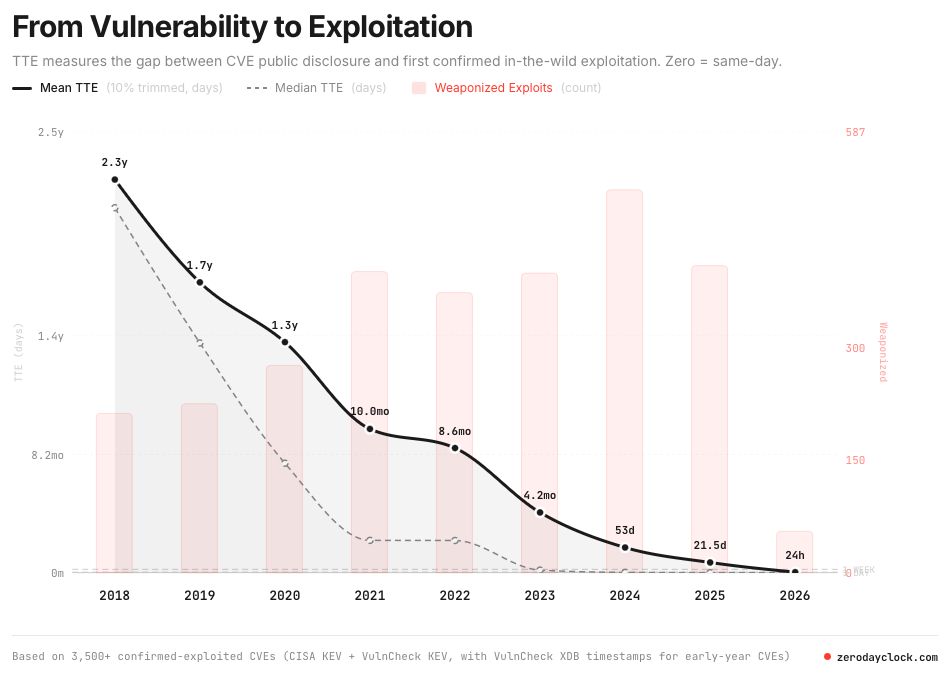
Figure 1. Based on 3,532 CVE-exploit pairs from trusted sources (CISA KEV, VulnCheck KEV & XDB) by Zero Day Clock [1]
When Anthropic's Claude Mythos Preview discovered CVE-2026-4747, a 17-year-old unauthenticated RCE in FreeBSD's NFS server [2], the AI didn't just find the bug. It built a working exploit in hours, fully autonomously. If an AI can weaponize a legacy flaw that fast, validation needs to start when the signal arrives, not when the next engagement is scheduled.
Five Signs Your Organization Needs Autonomous Pentesting
Patching is not feasible or fast enough.
When a 17-year-old NFS vulnerability surfaces in core enterprise infrastructure, you cannot patch during business hours, and the last update broke production. You need real exploitability and blast radius answers now, to decide whether to reduce attack surface, close a port, or rely on compensating controls.
Too many hand-offs between security teams.
Vulnerability management, CTI, and pentesting run as separate, change-driven processes. By the time a signal reaches the people who can act on it, the attack window is already open.
Your environment changes faster than human pentests can cover.
New segmentation policies, new identity systems, new assets coming online weekly… Each change needs verification before it reaches production. Quarterly human pentests cannot keep that cadence.
A single finding needs context, not just confirmation.
A remote code execution vulnerability on one host is a starting point, not a verdict. The real question is what an attacker can chain from there, which attack paths open up, which choke points emerge, what the actual blast radius looks like.
You need continuous validation, not point-in-time engagements.
Drift analysis, fix verification, single-CVE checks on demand, signal-triggered re-tests. None of these scale with humans alone.
When It Is Not The Right Fit
Autonomous pentesting is not the right fit when you need narrow human-driven red team engagements with social engineering or physical components, when your environment is small enough that an annual human pentest covers it, or when your remediation process is broken. Faster testing on top of a broken remediation pipeline only produces more unactioned tickets.
Enter Picus Autonomous Penetration Testing
Picus brings autonomous pentesting to a platform built on a decade of Breach and Attack Simulation and years of automated pentesting. So, the system already knows what's safe to run and what actually detonates. A coordinator orchestrates specialist agents that scope themselves from real signals, chain attack paths, pinpoint choke points, and hand validated, prioritized findings straight to remediation.
No black box. Every decision, action, and result is explainable and auditable at each step – with configurable human-in-the-loop control, from full oversight to full autonomy. And because it runs inside the Picus Platform, attack-path findings are matched against your live control performance and folded into one ranked queue of confirmed, exploitable exposures.
Request your free demo, see what's actually exploitable in your environment, and prove it.
References
[1] From Vulnerability to Exploitation by Zero Day Clock: https://zerodayclock.com/
[2] Assessing Claude Mythos Preview’s cybersecurity capabilities: https://red.anthropic.com/2026/mythos-preview/