Security control validation fits in the validation stage of Continuous Threat Exposure Management (CTEM), the fourth of its five stages. In this stage, it safely runs real attacker techniques against your controls, most often with breach and attack simulation (BAS), and shows whether each one is prevented, detected, or missed. Its results then feed two other stages: prioritization uses them to re-rank exposures, and mobilization uses them to fix the controls that missed a technique.
In this article, we explain what security control validation measures, where it fits in the five CTEM stages, and why a CTEM program depends on it. We also cover how it differs from exploitability validation and agentic pentesting, and how running it on every change makes a mitigate-first response possible.
Key Takeaways
- Security control validation fits in the validation stage of CTEM, which is the fourth of its five stages.
- Security control validation shows which exposures your controls already block, so those exposures can wait for remediation. For an attack that a control misses, it shows which prevention or detection rule to add.
- A security control validation test should start after each of three events: a new vulnerability is disclosed, a new attack campaign is reported, or the configuration of a control changes. A weekly schedule leaves these changes untested for days.
- Agentic pentesting and exploitability validation are the other two validation methods in a CTEM cycle. They differ in whether a real exploit is run.
- Agentic pentesting starts from the assets that you put in scope and runs real exploits on them. It chains the exploits to show how far an attacker can reach. It needs an asset that is safe to attack. Where a step exploits a vulnerability, it also needs a reliable working exploit for that vulnerability.
- Exploitability validation starts from a vulnerability (CVE) and does not run a real exploit. It combines scanner data, asset context, security control validation results, and pentest findings to give a verdict for each affected asset, including business-critical and air-gapped ones.
- Mitigate first is the approach that connects these methods. Its first step is security control validation: the team tests its controls and adds a prevention or detection rule to each control that missed an attack. Its second step is a pentest that checks the hardened controls. When an attack exploits a vulnerability, the rule protects the system until the patch is installed.
What Does Security Control Validation Measure?
Security control validation is the practice of testing whether your security controls prevent or detect real attacks. It is most often performed with breach and attack simulation (BAS) technology. BAS safely runs known attacker behaviors against your prevention and detection controls. Examples are malware downloads, malicious email attachments, exploits for known vulnerabilities, the endpoint behaviors that attackers use most often, and data exfiltration. The techniques are mapped to MITRE ATT&CK.
Each technique is measured in two ways: whether a control prevented it, and whether a control detected it. A technique that is neither prevented nor detected is missed.
- Prevented: A prevention control, such as a firewall, a WAF, or a secure email gateway, stopped the technique.
- Detected: A detection control, such as a SIEM or an EDR, logged the technique, or logged it and raised an alert.
- Missed: No control prevented the technique, logged it, or raised an alert.
The Picus Blue Report 2026 shows these results in production. Picus Labs analyzed more than 338 million attack simulations that Picus customers ran in their own environments between January and June 2026. Of these attacks, 69% were prevented, 58% were logged, and only 14% raised an alert.
Every gap points to a mitigation, which is a specific change to a control. A technique that was not prevented needs a prevention signature, and a technique that raised no alert needs a detection rule.
Teams use security control validation for four jobs: testing readiness against a new attack campaign, responding to a new vulnerability, confirming that a detection rule raises an alert, and catching a control that breaks after a configuration change.
Where Does Security Control Validation Fit in the Five CTEM Stages?
Security control validation is one of three validation methods in stage four of CTEM, together with exploitability validation and agentic pentesting. Its test results are then used in prioritization and mobilization.
|
CTEM stage |
Role of security control validation |
|
Stage 1: Scoping |
No tests run here. Scoping sets which systems are in scope. The controls that protect those systems are the ones tested in stage four |
|
Stage 2: Discovery |
No tests run here. Discovery lists your assets and the security controls that protect each one, such as the firewall in front of a server or the EDR on a laptop |
|
Stage 3: Prioritization |
Exposures are first ranked by CVSS score and asset criticality. Validation results then re-rank them: an exposure that a control already blocks moves down the list |
|
Stage 4: Validation |
Security control validation runs here, alongside exploitability validation and agentic pentesting. BAS runs attacker techniques against your controls and records whether each one is prevented, detected, or missed |
|
Stage 5: Mobilization |
A missed technique shows which control needs a new prevention or detection rule. After the rule is added, the same test runs again |
In prioritization. A CTEM program finds more exposures than a team can fix, so the team ranks them. The first ranking is based on CVSS scores and asset criticality, which do not take into account the controls that protect the affected system. After validation, the test results add that information and the list is re-ranked. For example, a critical vulnerability can wait for its patch if an intrusion prevention system already blocks the exploit. A medium vulnerability moves up if no control stops its exploit.
In mobilization. The fix goes as a ticket to the team that owns the control. The finding is closed only when the retest shows that the technique is now prevented or detected. The retest result then updates the ranking for the next cycle.
Why Is Security Control Validation Critical to a CTEM Program?
Security control validation is critical to a CTEM program because the program’s decisions depend on its results. It shows which exposures your controls already block, and this decides what to fix first. It also shows which fix each gap needs, so the first response can be a change to a control that you already own. This approach is called mitigate first, and security control validation is its first step.
- Prioritization depends on control evidence. According to cve.org, 36,971 CVEs were published in Q3 2026, 3.15 times the number in Q3 2025. No team can fix them all. Without knowing which exposures the controls already block, ranking is guessing.
- A response within hours depends on control changes. Mandiant’s M-Trends 2026 puts the start of exploitation, on average, seven days before a patch is released. EdgeScan’s 2026 Vulnerability Statistics Report puts the mean time to remediate in finance and insurance at 62 days. A new rule on a control that you already own takes hours.
- A pentest is most useful on hardened controls. If the controls were never validated and fixed, each pentest reports the same findings again.
How Is Security Control Validation Different From Exploitability Validation and Agentic Pentesting?
|
Method |
Question it answers |
How it works |
|
Security control validation |
Are my controls working? |
Runs attacker techniques safely against live controls and records each one as prevented, detected, or missed |
|
Exploitability validation |
Which of my assets are affected, and what do I fix first? |
Combines scanner data, asset context, control test results, and pentest findings to give a verdict for each affected asset. No real exploit is run, so business-critical and air-gapped assets are covered |
|
Agentic pentesting |
How far can an attacker reach? |
Chains real exploits on in-scope assets, from initial access to privilege escalation and lateral movement. It is the independent check, from the attacker’s side, that the defenses hold |
Security control validation finds the gaps in your controls, and the team fixes them. Agentic pentesting then checks, from the attacker’s side, that the fixes held. Exploitability validation uses the results of both to give one verdict for each asset.
For the pentest side of the same question, see Where does automated pentesting fit in CTEM? For the validation stage as a whole, see adversarial exposure validation in CTEM.
How Should Security Control Validation Work in a CTEM Program?
In a CTEM program, security control validation should work continuously, as a loop that starts with a change. A change is any event that can alter whether your controls stop an attack. Gartner’s Continuous Offensive Security Testing (COST) model, published in March 2026, replaces scheduled tests with tests that a change triggers (Gartner, How to Implement a Continuous Offensive Security Testing Program, Dhivya Poole, 6 March 2026). CISA’s Binding Operational Directive (BOD) 26-04, published in June 2026, accepts a validated mitigation as equal to patching for a deadline.
A fixed schedule leaves a gap. If a detection rule breaks on Tuesday and the weekly test runs on Monday, the rule stays broken for six days. This gap is called the blind window. Starting a test when the change happens is called change-driven validation.
The table shows the three kinds of change, the signal that reports each one, and the test that it starts.
|
Change |
Signal that reports it |
Test that it starts |
|
Configuration change |
A security policy change, an infrastructure change, or an EDR agent that stops reporting |
Rerun the techniques that the changed control prevented or detected before. A technique that is now missed is a regression |
|
New attack campaign: a threat group starts a new series of attacks |
A threat intelligence report or feed, or a CISA or ISAC advisory, which lists the techniques the group uses |
Run those techniques against the prevention and detection controls |
|
Emerging vulnerability: a new CVE affects your assets |
A vulnerability intelligence feed, a new entry in the CISA Known Exploited Vulnerabilities (KEV) list, or new results in your scan data |
Run the techniques that exploitation requires, such as running commands on the server, against the controls that protect the affected assets |
Each change then moves through the CTEM stages:
- Stages 1 to 3: Detect the change. A signal from a feed or an integration reports the change and starts the test automatically.
- Stage 4: Test the affected controls. The test runs the techniques from the table and records each one as prevented, detected, or missed.
- Stage 5: Mitigate first, then retest. A new rule goes on the control that missed the technique. When the technique exploits a vulnerability, the patch follows on its own schedule, and the rule closes the attacker’s window, the time between the start of exploitation and the deployment of the patch. The same test then runs again to confirm the fix.
- Back in stage 4: Independent check. After the controls are fixed, an agentic pentest attacks the assets in scope as a real attacker would, and looks for attack paths to critical assets. Security control validation tests each control separately, and the pentest shows whether an attacker can still get past them together. Each attack path is then fixed at its root cause, such as a default credential or an exposed service.
How Picus Supports Security Control Validation in CTEM
Picus supports security control validation in CTEM with Picus Breach and Attack Simulation (BAS), part of the Picus Autonomous Exposure Validation Platform. The platform is purpose-built for the stages where CTEM programs stall, and open by design for the stages you have already invested in. Picus BAS is the product that tests your controls. Picus customers ran more than 338 million attack simulations in the first half of 2026 (Picus Blue Report 2026).
The platform runs the Exposure Validation Loop: Sense, Validate, Act.
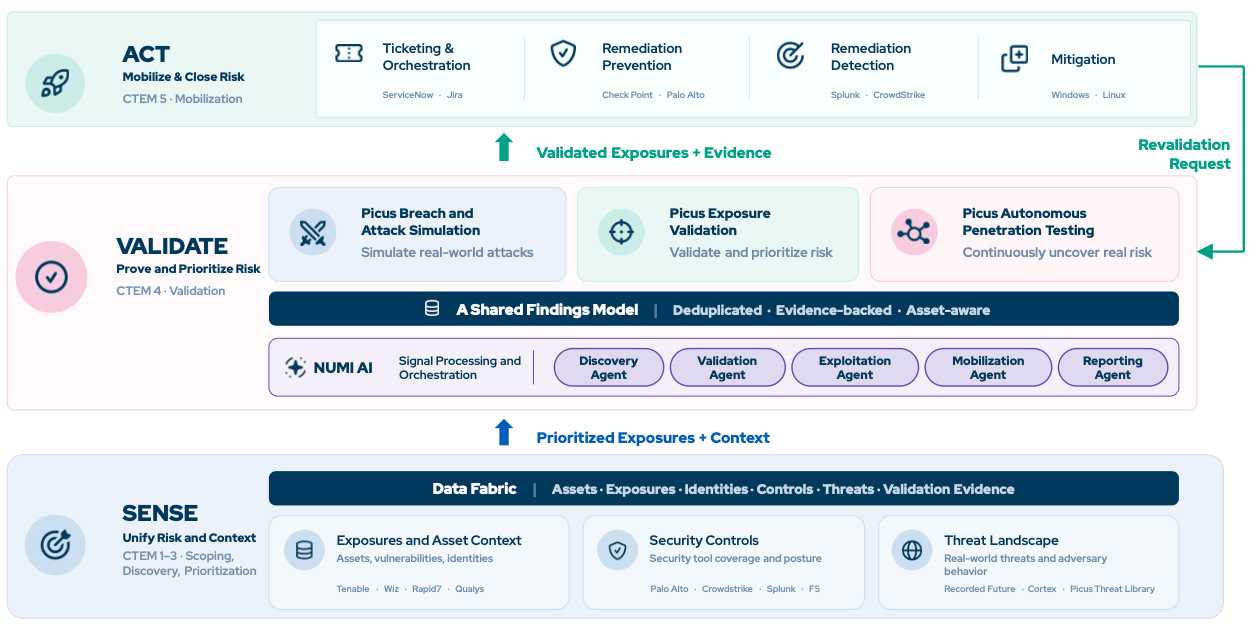
Stages 1 to 3 (Scoping, Discovery, Prioritization): Picus Unifies Risk and Context
Picus works alongside your exposure assessment tools and connects to them through 75+ integrations.
- Exposure and asset data: Assets, vulnerabilities, and identities come from tools such as Tenable, Wiz, Rapid7, Qualys, and SentinelOne.
- Security control data: The coverage and posture of your controls come from tools such as Palo Alto Networks, CrowdStrike, Splunk, and F5.
- Threat data: Real-world threats and attacker behavior come from sources such as Recorded Future and the Picus Threat Library.
- Deduplication: The same asset or vulnerability often arrives from several tools. Picus removes the duplicates, so each asset and each exposure appears once.
- Prioritization: Picus Exposure Validation re-ranks the exposures by what your controls already block.
Stage 4 (Validation): Picus Proves and Prioritizes Risk
Picus validates with three products that write to one list of findings.
- Security control validation: Picus BAS safely runs real attacker techniques against your live controls, across the MITRE ATT&CK matrix, and shows whether each one is prevented, detected, or missed.
- Exploitability validation: Picus Exposure Validation gives an exploitability answer for every affected asset. It uses the control evidence from Picus BAS and the findings from Picus Autonomous Penetration Testing.
- Agentic pentesting: On the assets that you put in scope, Picus Autonomous Penetration Testing chains real exploits, from initial access to privilege escalation and lateral movement, and shows the attack paths to your critical systems. Assets outside the scope are not exploited.
- One list of findings: The three products share one findings model, with duplicates removed, so the same finding is not reported three times.
- Current threats: AI Threat Builder turns a threat intelligence report into a runnable simulation in about nine minutes.
- Adaptive Validation: Picus matches each change to the product that answers it. A new attack campaign or a configuration change starts a Picus BAS test. A new vulnerability goes to Picus Exposure Validation, which uses the Picus BAS results. A change that could open a new attack path goes to Picus Autonomous Penetration Testing.
Stage 5 (Mobilization): Picus Mobilizes and Closes Risk
The Picus approach is mitigate first. Every validated exposure becomes a defensible decision: patch, mitigate, monitor, or accept, with evidence.
- Mitigation content: For each missed technique, Picus provides a vendor-specific prevention signature or detection rule.
- Prevention fixes: Fixes go to controls such as Check Point, Palo Alto Networks, Fortinet, and F5.
- Detection fixes: Rules go to tools such as Splunk, Google Chronicle, CrowdStrike, and SentinelOne.
- Ticketing: Picus creates tickets in ServiceNow and Jira for the assets with validated exposures.
- Revalidation: After each fix, the same test runs again. The finding is closed only when the test confirms the fix.
Picus Swarm Automates the Loop
Picus Swarm is the platform's agentic workforce. Five specialist agents, orchestrated by Numi AI, run the loop from the signal to the mitigation.
- Signal-driven: A signal starts the test automatically.
- Autonomy that you set: Each workflow runs On-Demand, Supervised, or Fully Autonomous, and people approve the decisions that carry risk.
- Speed: For an emerging CVE, Swarm runs the whole loop in about six hours.
Request a demo to see how security control validation would work in your CTEM program.