An autonomous penetration testing platform is a system in which a coordinator orchestrates specialist AI agents that scope an engagement from an incoming signal, then execute and validate real attacks across an organization's internal network, endpoints, and Active Directory and identity environments. It chains vulnerabilities, credentials, and misconfigurations into multi-stage attack paths toward critical assets, pinpoints the choke points that break those paths, and produces evidence-backed, auditable proof: all under configurable human-in-the-loop control.
The word platform matters. This isn't a single scan you launch and walk away from; it's an architecture: a signal layer that decides when to run, a coordinator that derives scope and orchestrates specialist agents, a reasoning engine that decides what to test next, and a feedback loop that hands findings to remediation and re-validates after the fix. It plugs into a broader exposure validation program rather than sitting off to the side as a point tool.
Are Autonomous Platforms Just Automated Ones With AI Marketing?
No. The difference is architectural, not cosmetic. An automated platform runs a rule-based decision engine that an operator scopes and schedules. An autonomous platform replaces that engine with reasoning AI agents that scope themselves from a signal and adapt in real time. Bolting AI branding onto a rule engine doesn't change the engine.
There's a simple test for whether an "AI-powered" platform is genuinely autonomous. Here are a couple of questions you can ask your vendor during PoCs.
- Does it scope itself from a signal, or does an operator still define the target and press go?
- Does it reason past the edge of pre-written logic, or does it stop where the decision tree ends?
- Is it a coordinated multi-agent system with auditable handoffs, or one model wrapped around the same chain-dependent rulebook?
If the underlying engine is unchanged, the structural limits (fixed scope, a handful of procedures per technique, chained dependencies) travel with it, no matter how the marketing reads.
Where Does Automated Pentesting Structurally Break Down?
Automated pentesting breaks down at the edge of its encoded rules. At each node along a path, it consults a rule-based decision engine and tries its fixed library of attack techniques; if none land, it reroutes and tries a different node. What it can't do is reason past that library. When moving forward would require a technique it doesn't have or a custom exploit the rules never anticipated, it has nowhere to go, and the paths beyond that point stay untested. Its scope, its procedures, and its chain are all fixed in advance.
The logic can be sophisticated (decision trees, heuristics, conditional flows) but it's all authored ahead of time, so the intelligence is frozen at the moment the rules were written. The tool can pivot between the options it was given, yet it can't invent a new one. This is exactly where an autonomous platform diverges: instead of falling back on a lookup, it reasons about why the step failed and what else might work. And if reaching the next stage takes a custom exploit, it develops one in real time rather than declaring the path dead.
The Four Limits of Automated Penetration Testing That Are Baked Into the Architecture
Automated penetration testing has four limits baked into its architecture.
- Chain dependency — step B depends on step A, so one blocked step near the top cascades into a blind spot across everything below it.
- Frozen intelligence — the decision tree is only as good as the rules engineers wrote at the time, so novel situations have no branch to follow.
- Scheduled, operator-defined trigger — the tool runs when the calendar says so, not when a new CVE or threat signal lands.
- Diminishing returns — working a fixed scope with a fixed technique library against a largely unchanged surface, each later run surfaces less; by the third run new discoveries taper off, and by the fourth it's mostly re-confirming what it already found.
This isn't something you can tune your way out of: it's the ceiling of a system whose scope and procedure library don't refresh at the speed the threat landscape moves.
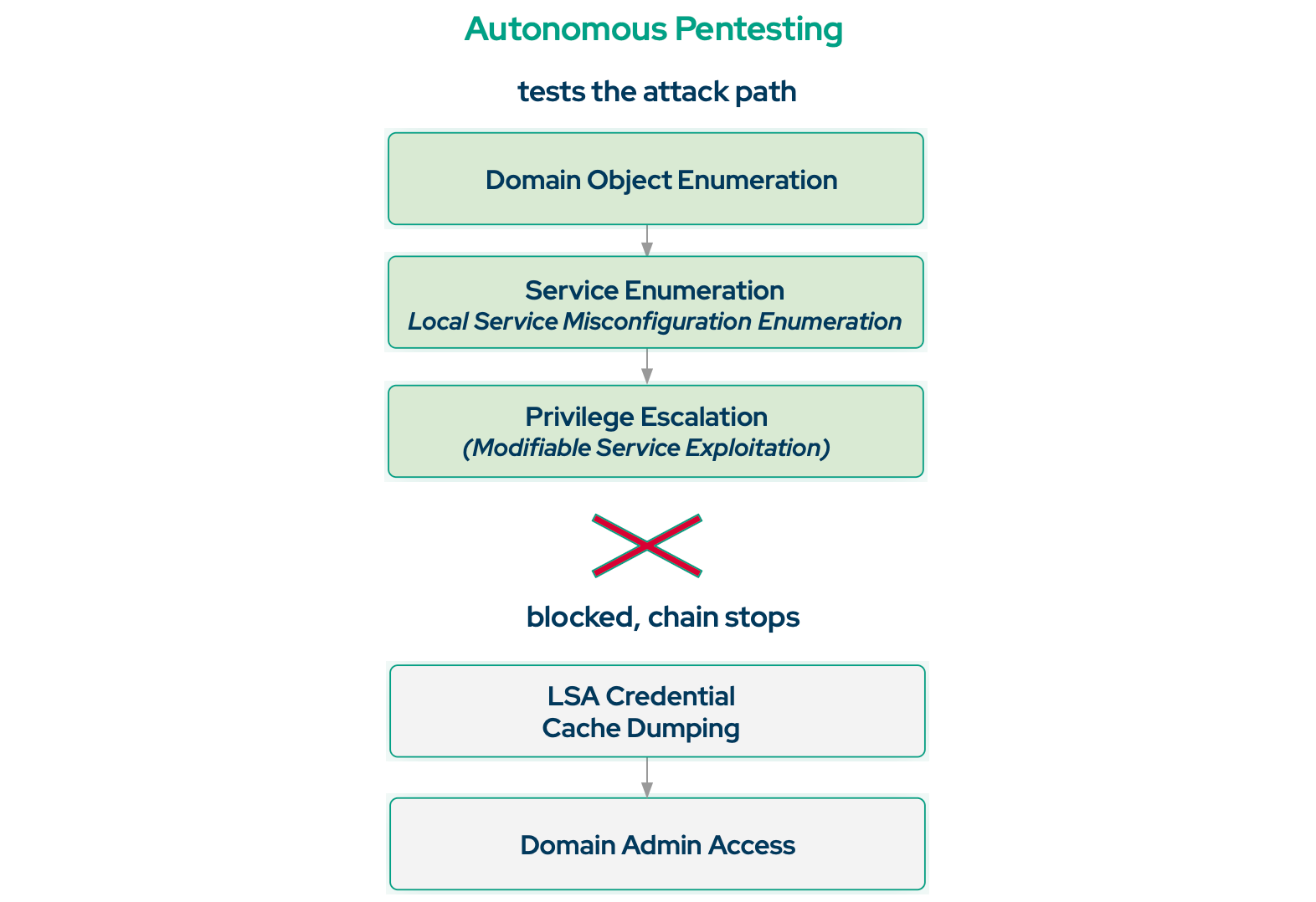
An autonomous platform sidesteps it from both directions: it's triggered by signals, so a new CVE or threat-actor profile hands it genuinely new ground each time, and it reasons rather than replays, so it isn't limited to re-running the same encoded set against the same targets.
What Does an Autonomous Pentest Do When an Exploit Fails?
An autonomous pentest reasons about failure instead of stopping. This is the single biggest differentiator from automated pentesting. An autonomous pentest treats a blocked path as an input to the next decision, weighing why it failed, what else might work, and which alternative route to try, then continues toward the objective the way a human attacker would.
Where an automated tool would consult the next branch in its decision tree, or simply run out of branches, an autonomous pentest reasons its way forward. The lead agent re-tasks its specialists: try a different privilege-escalation technique, or write a custom-exploit, or pivot to another host surfaced during discovery, or reach the same target by a different route. A failure at one step doesn't end the engagement. It shapes the next decision. That's the practical payoff of replacing a lookup with a reasoning system: the parts of an environment where a chained tool would have left dark because it got caught early still get tested.
How Do the Outputs Actually Differ Between Automated and Autonomous?
Both automated and autonomous platforms produce evidence of exploitable attack paths; autonomous platforms add two things: the reasoning behind every step, captured as an auditable trail, and a signal-driven trigger that fires the moment your environment changes rather than at the next scheduled run.
|
Automated Pentesting |
Autonomous Pentesting Platform |
|
|
Trigger |
Operator-scheduled |
Signal-driven (CVE, threat intel, infra change, etc.) |
|
Scope |
Defined by the operator |
Derived from the signal by the lead agent |
|
Decision record |
Logs of which rules fired |
Input/decision/evidence at each agent handoff |
|
Behavior on failure |
Stops at the edge of the rules |
Reasons through and reroutes |
|
Output |
A scheduled findings snapshot |
A live, auditable path map + choke points + remediation tickets, re-validated after fix |
The deeper difference is explainability. Many AI pentesting tools are black boxes: something runs in the background, but you can't see why it chose what it chose. A mature autonomous platform shows its work at every stage: what signal it acted on, what it found in the logs, which decision it made, and what proof backs it. That auditability is also what makes the output defensible to leadership and auditors.
Is Automated Penetration Testing Becoming Legacy?
Not legacy, but no longer the ceiling. Automated pentesting still delivers reliable, repeatable, compliance-grade validation on a schedule. Autonomous platforms extend it by reacting to signals and reasoning past pre-written rules, and that's where the category is heading. The strongest programs run both.
Automated pentesting remains the right tool for a predictable, continuous baseline and for compliance evidence that needs to be repeatable. What's changing is the expectation around the decision layer and the trigger: teams increasingly need validation that starts when reality changes (a new CVE on a Friday night, a fresh threat-actor profile, a segmentation change) and that can reason through situations no rule author anticipated. One boundary stays fixed, though: autonomous pentesting validates exploitability and attack paths. It doesn't confirm whether your detection rules fired or your prevention controls blocked the threat: that's the job of BAS and detection validation alongside it.
How Do You Migrate From an Automated Platform to an Autonomous One?
You don't rip and replace, you layer. Keep automated pentesting as your scheduled baseline, add an autonomous platform for signal-driven, reactive validation, and connect both into one prioritized exposure queue. The first practical step is wiring up the signals that should trigger a run.
A pragmatic path looks like this. Keep your continuous automated baseline running. Then define the signals that warrant an autonomous engagement: a newly disclosed CVE affecting your assets, threat intel on an actor's TTPs, an infrastructure change, or a finding from another control. Next, set your human-in-the-loop thresholds: where the platform should proceed on its own and where it should pause for approval, so autonomy is something you grant deliberately, not all at once. Make sure both engines' outputs flow into a single, control-validated prioritization and remediation queue, with automatic re-validation confirming each fix actually closed the gap. Finally, lean on auditability and determinism as you expand autonomy. Favor a platform trained on real attack-execution data so its choices are consistent and explainable, not opaque. Integration, not replacement, is the goal.
Enter Picus Autonomous Penetration Testing
Everything above describes an architecture, not a feature, and that is exactly how Picus Platform builds it. Autonomous Penetration Testing runs as a coordinated system: a signal layer that fires when reality changes, a coordinator that derives scope from that signal, specialist agents that reason their way through each step, and a feedback loop that hands findings to remediation and re-validates after the fix. When a path is blocked, it does not stop at the edge of a rulebook. It reasons about why, reroutes, and develops a custom exploit when reaching the next stage demands one. And because it is grounded in a decade of real attack-execution data, its choices stay consistent and explainable rather than opaque.
It is also built to layer, not to rip and replace. Keep your automated baseline, wire your signals to Picus for reactive, signal-driven validation, and let both flow into one control-validated, prioritized exposure queue. Every decision, action, and piece of proof is auditable at each agent handoff, with configurable human-in-the-loop control from full oversight to full autonomy, so you grant autonomy deliberately and on your terms.
See it through a live attack path in your own environment. Request your free demo.