Key Takeaways
- WAF prevention efficacy degrades over time due to rule drift, new CVEs, and evolving evasion techniques, making one-time validation insufficient.
- Point-in-time validation methods (pentesting, manual rule reviews) fail to reflect real-time exposure, leaving gaps between assumed and actual protection.
- BAS validates WAF controls by replaying real-world attack payloads (SQLi, XSS, RCE, SSRF, etc.), including obfuscated and evasion-based variants used by adversaries.
- Protocol-level validation is critical, discrepancies between HTTP and HTTPS inspection often expose SSL/TLS visibility gaps.
- Agent-based testing provides deterministic validation by isolating WAF behavior, enabling payload-level comparison (sent vs. received) and eliminating false positives.
- Continuous validation enables measurable security posture management, with metrics like prevention rate, detection rate, attack coverage, and mitigation gaps tracked over time.
- Picus SCV includes a dedicated Web Application Attack Module that continuously validates the effectiveness of your WAF, IPS, and next-generation firewall against known & emerging adversarial threats observed in the wild.
Web Application Firewalls are among the most trusted security controls in enterprise environments. They sit in front of applications, inspect HTTP and HTTPS traffic, and are expected to block everything from SQL injection to remote code execution.
But here's the uncomfortable reality: most organizations deploy a WAF, tune it once, and assume it keeps working, indefinitely.
The threat landscape doesn't afford that luxury. Attack techniques evolve. New CVEs surface. WAF rule sets drift. SSL inspection breaks silently. A WAF that scored 95% prevention effectiveness six months ago may be operating at 60% today, and nobody knows.
This is exactly the problem Breach and Attack Simulation (BAS) was built to solve.
The Gap Between Assumed and Actual WAF Effectiveness
Security teams typically validate WAF effectiveness in one of three ways:
- reviewing vendor documentation,
- relying on periodic penetration tests, or
- checking that the WAF is powered on and generating logs.
None of these approaches answer the real question: Is your WAF actually blocking the attacks targeting your applications right now?
Penetration tests are valuable but inherently point-in-time. They capture a snapshot of your security posture on a specific date, under specific conditions, with a specific set of techniques. Between tests, which may be months or even a year apart, your environment changes, your WAF policy drifts, and attackers develop new methods, or new CVE exploitation PoC will be publicly shared in a Github repository. The test result becomes stale almost immediately.
Manual rule reviews have a similar problem. Knowing that a WAF has a rule for a given attack category doesn't confirm the rule is correctly tuned, actively enforced, or capable of catching modern variations of that technique.
BAS fills this gap by making validation continuous, automated, and evidence-based.
What Breach and Attack Simulation Actually Does for WAF Testing
A BAS platform for web application security works by safely replaying real-world attack payloads, the same techniques adversaries use, against your security controls in a controlled manner. The platform measures whether each payload was blocked or passed through, and reports the outcome with full technical detail.
For WAF security validation, BAS assessments typically cover attack categories including:
- SQL Injection (SQLi) — Classic and advanced variants, including blind, time-based, and out-of-band techniques
- Cross-Site Scripting (XSS) — Reflected, stored, and DOM-based, with obfuscation and encoding variations
- Path Traversal — Directory traversal attempts targeting file system exposure
- Remote Code Execution (RCE) — Payloads exploiting deserialization, command injection, and template injection
- Local and Remote File Inclusion (LFI/RFI)
- Server-Side Request Forgery (SSRF)
- Web shell uploads and exploitation attempts
- Protocol-level attacks targeting HTTP parsing quirks
Each attack category contains numerous variations.
A modern BAS platform doesn't just test whether a WAF blocks the textbook version of SQL injection, it tests dozens of obfuscated, encoded, and evasion-oriented variants that reflect what real threat actors actually use.
The HTTP vs. HTTPS Dimension for WAF Testing
One of the most commonly overlooked WAF failure modes is SSL/TLS inspection.
Many organizations configure their WAF to inspect cleartext HTTP traffic effectively, but HTTPS traffic bypasses deep inspection entirely, either because SSL inspection was never configured, was misconfigured, or was quietly disabled during a maintenance window.
A rigorous WAF validation process must test both protocols independently. When a BAS platform supports HTTPS simulation, it can reveal a critical discrepancy: an attack that is correctly blocked over HTTP may pass undetected over HTTPS, indicating that SSL inbound inspection is not functioning as intended.
This protocol-level visibility is something traditional testing approaches rarely surface. It requires the ability to simulate attacks on both channels simultaneously and compare outcomes, which is a native capability of purpose-built BAS platforms.
Agentless vs Agent-Based WAF Security Testing
Agentless WAF Testing
Malicious payloads are sent directly to live, production web applications. While simple to initiate, this approach carries substantial drawbacks:
- Direct Threat to Production: Live environments are actively exposed to DoS conditions, performance degradation, and accidental data corruption, meaning the tool designed to test your security can itself become the source of an incident
- Cascading Failures: Payloads don't stay contained. Issues can propagate across interconnected systems, turning a routine assessment into a recovery operation
- SOC Overload: Floods security teams with noise, false alerts, and alert fatigue, making it harder, not easier, to maintain a clear security picture during testing
- Fundamentally Unreliable Results: Because outcomes are shaped by the web app, server, and WAF simultaneously, it's nearly impossible to isolate what the WAF actually did, undermining the entire purpose of the test
- Built-in False Positives: A simple timeout or non-response can be misread as a successful WAF block, giving false confidence in security controls that may not have triggered at all
- Watered-Down Payloads: To avoid harming production, some vendors deliberately weaken attack payloads, but sophisticated WAFs recognize these modified signatures, producing results that don't reflect real-world attack scenarios
- Significant Setup Overhead: Requires DNS verification, URL identification, and manual customization per WAF vendor, adding friction before a single test is even run
Agent-Based WAF Testing
Attacks are simulated between Picus components, never touching the live environment:
- Zero Production Risk: Agents operate in isolation, fully protecting live applications from any simulation side effects
- Accurate Results: Direct comparison of sent vs. received payloads pinpoints exactly what the WAF blocked, modified, or missed
- Minimal False Positives: Unchanged payloads are not misclassified, only genuinely blocked threats are recorded as prevented
- Realistic Payloads: Full, unmodified attack payloads are used, ensuring WAF rules are tested against actual threat conditions
- Reduced SOC Burden: Clear separation of simulated and real traffic eliminates noise and alert fatigue
- No Customization Needed: Works universally across WAF vendors with no DNS records, URL lists, or manual configuration required
- Extensive Coverage: The breadth of WAF testing is determined by a BAS vendor's threat library. Picus Security, for example, offers over 2,200 web application-specific TTPs, enabling broad and thorough attack simulation coverage.
Side-by-Side Comparison Table: Agentless vs Agent-based WAF Testing
|
Comparison Criteria |
Agentless WAF Testing |
Agent-Based WAF Testing |
|
Production environment risk |
High |
None |
|
Result accuracy |
Low |
High |
|
False positive rate |
High |
Minimal |
|
SOC operational burden |
Heavy |
Light |
|
Payload authenticity |
Often modified |
Fully realistic |
|
Setup complexity |
High |
Low |
|
TTP coverage |
Limited |
2,200+ |
|
Vendor customization needed |
Yes |
No |
Continuous Validation vs. Periodic Testing
The operational model of BAS fundamentally changes how WAF effectiveness is managed. Rather than a twice-yearly assessment, security teams gain:
Continuous coverage — BAS simulations can run on a scheduled basis, ensuring that any policy change, firmware update, or configuration drift is immediately reflected in validation results.
Threat-aligned testing — When a new web application attack technique emerges or a zero-day is disclosed (with publicly available PoC exploits), a BAS platform can introduce corresponding simulations quickly, allowing security teams to assess exposure before threat actors exploit it at scale.
Historical trending — Prevention rates over time reveal whether security posture is improving, degrading, or stable. This data is invaluable for security program reporting and executive communication.
Mitigation guidance — When a WAF fails to block a simulated attack, through its Mitigation Library, a BAS platform provides vendor-specific mitigation recommendations, including the exact signatures, rule sets, or configurations that need to be applied to close the gap.
What Breach and Attack Simulation (BAS) Cannot Replace
It's important to be precise about what BAS does and doesn't do. BAS platforms validate the prevention and detection capabilities of security controls against known attack techniques. They are not a substitute for:
- Threat modeling and secure design — BAS tests the effectiveness of your defenses, not the logic or architecture of your applications
- Dynamic application security testing (DAST) — BAS simulates known attack techniques against security controls; it does not discover unknown vulnerabilities within your application itself
- WAF behavioral learning validation — Adaptive and machine-learning-based WAF capabilities require real application traffic and genuine user behavior to assess properly. BAS agents are purpose-built sensors that verify whether a malicious payload is blocked or detected, not whether a WAF's behavioral model is learning correctly
Used correctly, BAS complements your existing security testing program rather than replacing any single component of it.
Mapping WAF Validation to Compliance Frameworks
Regulatory frameworks increasingly demand evidence of effective security control operation, not just evidence that controls exist. BAS supports compliance with:
- PCI DSS 4.0 — Requirement 6.4.2 specifically mandates that an automated technical solution is deployed and validated in front of public-facing web applications to detect and prevent web-based attacks. BAS provides continuous, documented evidence of WAF effectiveness against real-world attack techniques, satisfying the intent of outcome-based compliance evidence that PCI DSS 4.0 (v4.0.1) explicitly pushes toward
- NIST CSF — BAS directly supports the Identify, Protect, Detect, and Respond functions by continuously measuring whether controls are recognizing and stopping adversary techniques, and mapping results to NIST SP 800-53 control families
- ISO 27001 — Ongoing security control validation aligns with ISO 27001's requirements for continuous, risk-based monitoring and testing, providing structured, repeatable evidence that controls are operating as intended
- GDPR — Article 32 requires organizations to maintain a process for regularly testing, assessing, and evaluating the effectiveness of technical and organizational measures. Recurring WAF validation directly satisfies this obligation with structured, repeatable records
- HIPAA — WAF validation helps healthcare organizations demonstrate that web-facing controls protecting systems that handle Protected Health Information (PHI) are functioning as required under HIPAA's Security Rule
- SOX / GLBA / FFIEC — For US financial institutions, documented WAF testing generates evidence-aligned validation reports supporting audit readiness across these financial sector regulations
- DORA (Digital Operational Resilience Act) — Threat-Led Penetration Testing (TLPT) requirements under DORA are supported by continuous BAS data demonstrating ongoing resilience against web application threats, helping financial institutions maintain compliance with DORA's ICT risk management and digital resilience testing pillars
- Hong Kong Code of Practice for Critical Infrastructure (CI) Operators — CI operators in Hong Kong are required to demonstrate validated control effectiveness, risk management, and logging integrity across their environments , including web-facing defenses
- Bank Negara Malaysia RMiT — Malaysia's Risk Management in Technology framework shifts compliance expectations from control presence to control effectiveness, including requirements for realistic attack simulations. Continuous WAF validation provides the repeatable, evidence-based assurance RMiT demands
Rather than assembling compliance evidence from ad hoc testing activities, BAS generates structured, repeatable, auditable validation records that map directly to control objectives, shifting compliance from a periodic exercise to a continuous, verifiable state.
Key Metrics to Track in WAF Validation
When running BAS-driven WAF assessments, the metrics that matter most are:
|
Metric |
What It Tells You |
|
Prevention Rate (%) |
Percentage of simulated attacks successfully blocked |
|
Detection Rate (%) |
Percentage of attacks logged by the WAF or SIEM |
|
HTTP vs. HTTPS Delta |
Discrepancy indicating SSL inspection issues |
|
Coverage by Attack Category |
Which attack types have the weakest defense |
|
Severity-based results |
Distribution of blocked vs. not blocked threats by severity level |
|
Unified Kill Chain phase coverage |
Which phases of the attack lifecycle your controls address and where gaps exist |
|
Result timeline |
Prevention and detection performance across repeated simulations over time, showing improvement or drift |
|
Mitigation gap |
Number of not-blocked actions with no vendor-specific signature in place, surfaced via Mitigation Suggestions |
A mature security program tracks these metrics over time, not just as a one-time snapshot.
Closing the Loop: From Simulation to Remediation
The value of BAS is not in the data it generates, it's in the actions that data drives. A rigorous WAF validation workflow looks like this:
- Simulate — Run attack simulations across the full threat library on a continuous schedule
- Identify — Surface attacks that bypassed prevention or evaded detection
- Investigate — Use payload-level detail and protocol breakdowns to understand exactly how the bypass occurred
- Remediate — Apply vendor-specific mitigation recommendations to close the gap
- Re-validate — Re-run affected simulations to confirm that remediation was effective
- Report — Generate evidence of improvement for internal stakeholders and compliance audits
This loop transforms WAF management from a passive, set-and-forget posture into an active, measurable security discipline.
Validate Your WAF with Picus Security Control Validation
The capabilities described throughout this post are delivered natively by Picus Security Control Validation (SCV).
Picus SCV includes a dedicated Web Application Attack Module that continuously validates the effectiveness of your WAF, IPS, and next-generation firewall against a library of over 260 web application threats and 2,150+ unique attack actions, spanning SQL injection, XSS, path traversal, RCE, and many more attack categories, all mapped to MITRE ATT&CK.
Picus SCV includes a dedicated Web Application Attack Module that continuously validates the effectiveness of your WAF, IPS, and next-generation firewall against a library of over 400 web application threats and 2,600+ unique attack actions, spanning SQL injection, XSS, path traversal, RCE, and many more attack categories, all mapped to MITRE ATT&CK.
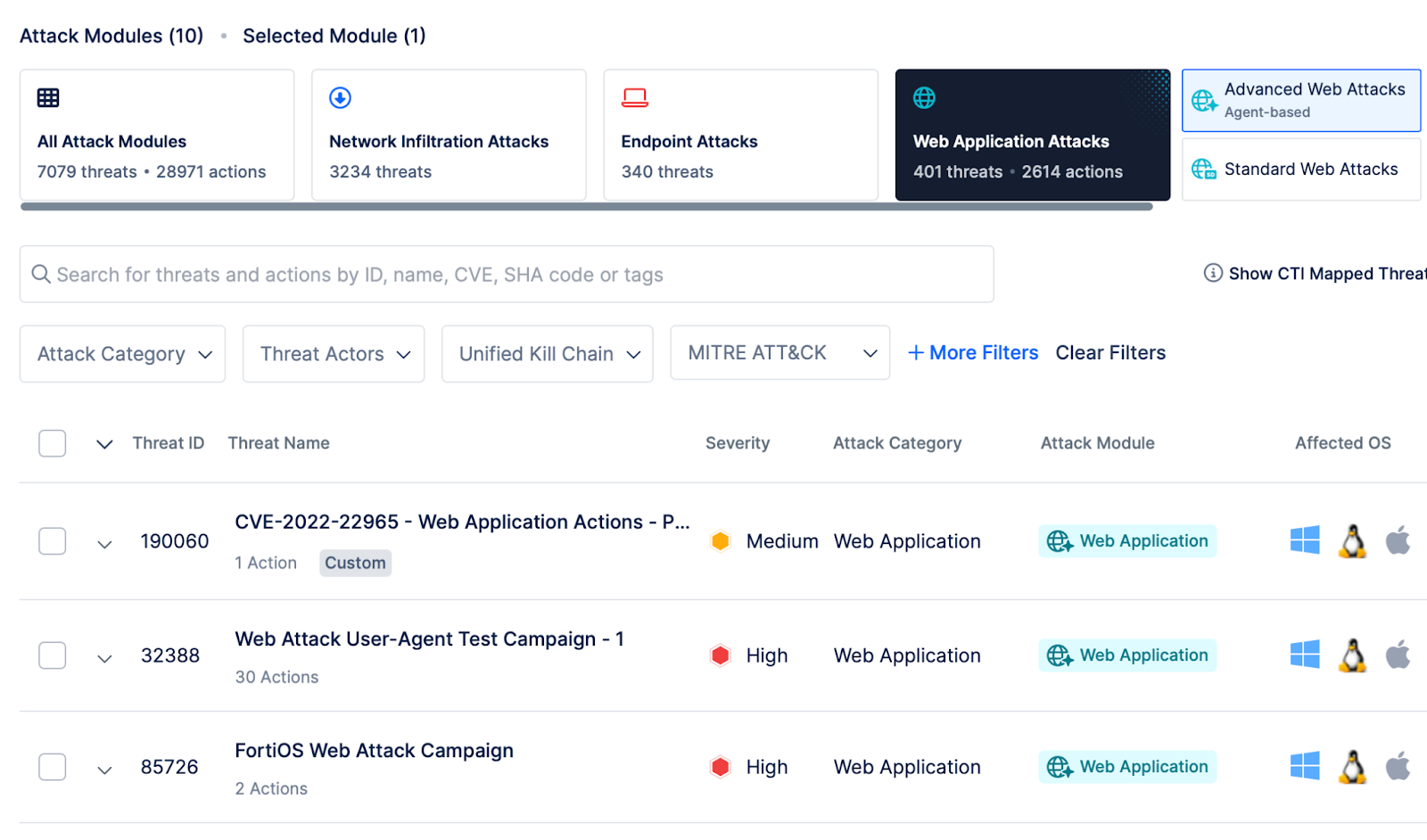
Figure 1. Picus Web Application Attacks Module, Threat Library
The module supports both HTTP and HTTPS attack simulation, giving security teams clear visibility into SSL inspection gaps. Vendor-specific mitigation suggestions are provided for major WAF platforms including F5, Fortinet, Citrix, AWS WAF, and Azure WAF, so remediation is actionable, not theoretical.
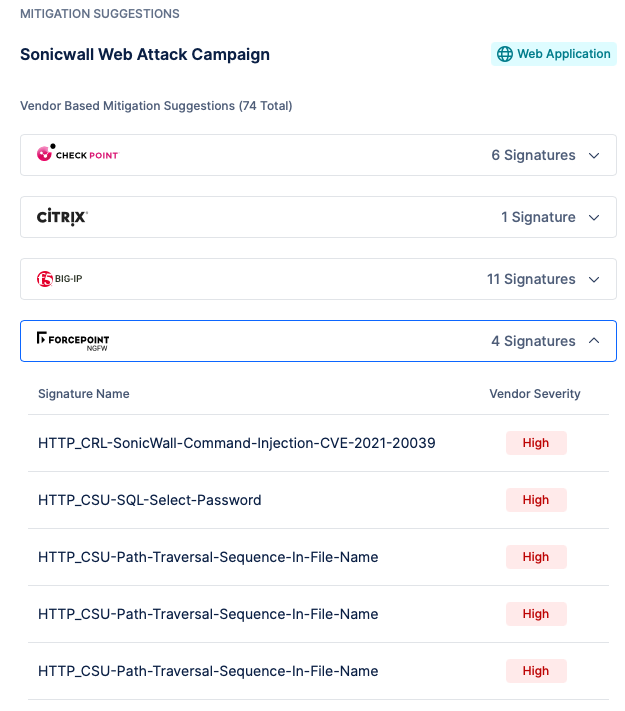
Figure 2. Picus Web Application Attacks Module, Vendor-based Mitigation
Picus SCV integrates seamlessly with SIEM platforms to run detection analytics, verifying not only whether attacks were blocked, but whether they were logged and would trigger an alert. Combined with automated reporting and historical trending, it gives security teams everything they need to demonstrate, track, and continuously improve WAF effectiveness.
Stop assuming your WAF is working. Start proving it. Request your free demo from here.


.png?width=353&height=200&name=Picus-Frost%26sullivan-Awards-preview-april22%20(1).png)
.png?width=353&height=200&name=picus-cyber-fundamentals-6surfaces-validation-preview-april8%20(2).png)
.png?width=353&height=200&name=picus-cyber-fundamentals-6surfaces-validation-preview-april8%20(1).png)